Water Damage Restoration in Honolulu
24/7 water damage restoration in Honolulu and surrounding areas. Call (808) 349-3407.
Standing water doesn’t wait. Within the first hour after a pipe bursts or a washing machine line fails, water is already wicking into drywall, traveling under baseboards, and soaking into the subfloor beneath your feet — none of it visible from the surface. By 24 to 48 hours, that hidden moisture becomes the conditions mold needs to take hold. Water damage restoration is the work of stopping that clock: removing the water, drying the structure completely, and verifying with instruments that the moisture is actually gone — not just that the surface feels dry.
What water damage restoration actually involves
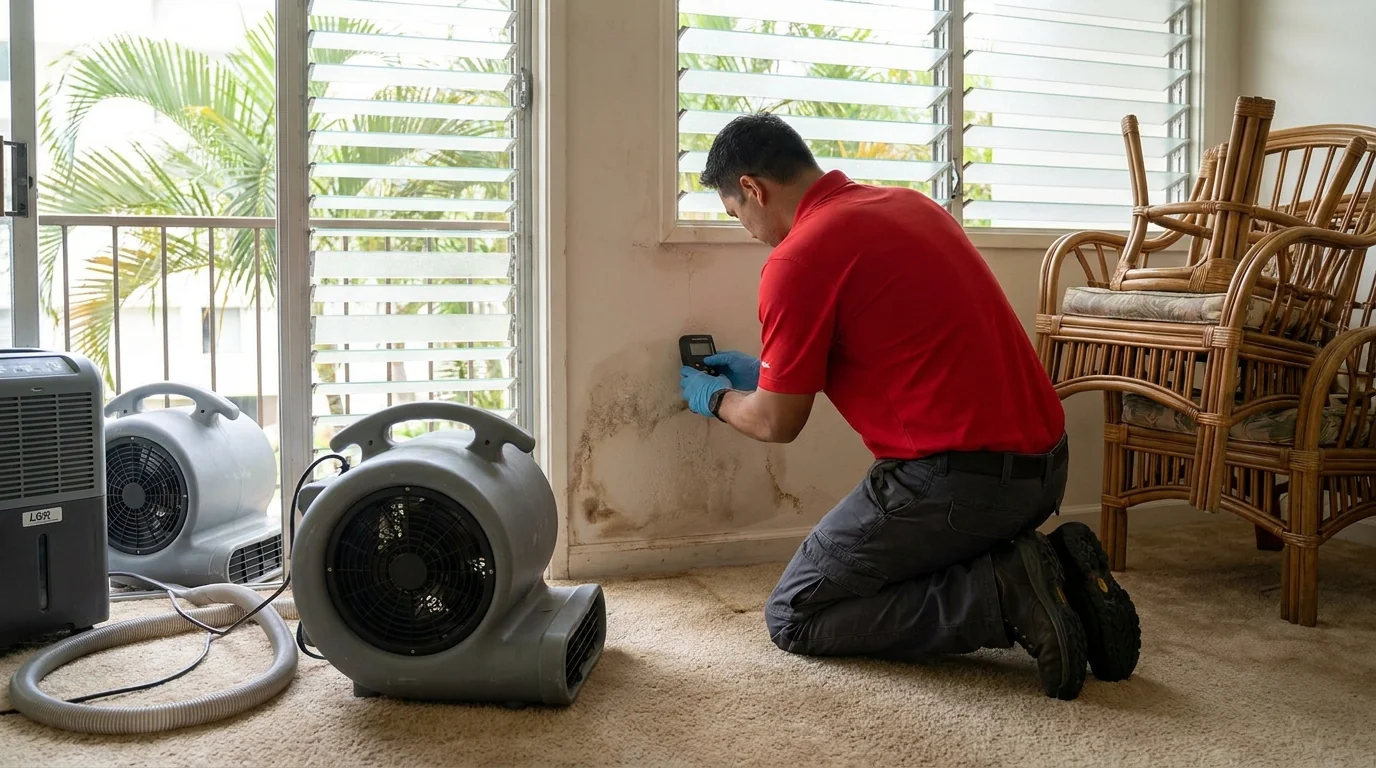
Most homeowners picture water damage as a mop-and-fan situation. The reality is more involved. Effective water mitigation requires commercial-grade truck-mounted or portable extractors that pull hundreds of gallons from carpet, pad, and subfloor in a single pass — equipment that bears no resemblance to a shop vac. After water removal, the drying phase relies on industrial low-grain refrigerant (LGR) dehumidifiers and high-velocity air movers positioned to create a directed airflow pattern across wet structural materials.
The goal isn’t dry air in the room — it’s dry wood, drywall, and concrete at the structural level. That distinction matters because a room can feel comfortable while the framing inside a wall is still sitting at 25% moisture content, well above the 16% threshold where mold growth becomes a serious risk. Moisture meters and thermal imaging cameras reveal what eyes and hands cannot.
Timeline depends heavily on the water category and how long saturation has been occurring. Clean water losses from a supply line — what the IICRC S500 standard classifies as Category 1 — typically dry in 3 to 5 days under proper equipment. Category 2 losses involving gray water (dishwasher overflow, washing machine discharge) require additional antimicrobial treatment and sometimes controlled demolition of saturated materials that can’t be dried in place. Category 3 losses — sewage, floodwater, or any water that has sat long enough to become grossly contaminated — involve containment protocols and the removal of affected porous materials before drying even begins.
Our process
-
Emergency water extraction. The first priority is stopping active water intrusion at the source and removing standing water as fast as possible. Truck-mounted extractors handle large volumes quickly; specialized tools like weighted extraction wands pull water from carpet and pad before they’re written off as unsalvageable.
-
Moisture mapping. Before a single air mover is placed, every affected surface is documented with penetrating and non-penetrating moisture meters and, where wall cavities are suspect, thermal imaging. This creates a baseline map that drives equipment placement and tracks drying progress over subsequent days.
-
Structural drying with daily monitoring. LGR dehumidifiers and air movers are set in a calculated configuration based on the square footage and material types involved. Equipment readings are logged daily — humidity levels, temperature, and grain-per-pound readings — so drying progress is documented rather than estimated.
-
Containment and antimicrobial treatment for Category 2/3 losses. When the water source is gray or black water, physical containment limits cross-contamination to unaffected areas of the home. Affected porous materials are removed and bagged, and antimicrobial agents are applied to structural surfaces before drying continues.
-
Final moisture verification and clearance. Drying is complete when all structural readings return to pre-loss equilibrium moisture content for the material type — not when the surface feels dry to the touch. A final moisture map documents that the structure has been returned to a safe, dry baseline.
What separates a good water damage response from a bad one
The most common failure point in residential water damage work is incomplete drying — specifically, leaving moisture in wall cavities and subfloor assemblies because the equipment count was too low or removed too early. A dehumidifier placed in the center of a room without directed airflow into wall cavities does very little for the framing inside those walls. Proper structural drying requires air movers aimed at baseboard gaps or, in some cases, controlled wall openings to allow airflow through the cavity.
A second common mistake is skipping daily documentation. Without logged moisture readings at each measurement point, there is no objective record that drying was completed — which matters when you’re filing a claim with your insurer and an adjuster asks for the drying log. Photograph the damage before any cleanup begins, and ask your restoration contractor for daily moisture logs as part of the job record.
Insurance adjusters also look closely at water categorization. A loss documented as Category 1 that was actually Category 2 — because the water sat long enough, or because the source was misidentified — can create disputes over scope. Accurate categorization from the start protects everyone.
Seasonal and regional considerations in Honolulu
Honolulu’s climate creates water damage conditions that differ from the mainland in important ways. The islands don’t experience freeze-thaw pipe bursts, but trade wind-driven rain events — particularly on windward-facing properties in areas like Mānoa, Nuʻuanu, and Pālolo — can push water through roof penetrations, window frames, and aging flashing in ways that go unnoticed until a ceiling shows staining. Ambient humidity on Oʻahu runs high year-round, which means structural materials already carry elevated baseline moisture content. That compressed margin between ambient and saturation levels makes it easier for wet materials to stay wet longer without proper dehumidification — and makes mold colonization faster than in drier climates.
Service area
AAA Water Damage Restoration & Carpet Care responds to water damage calls across Honolulu and the surrounding communities — including Pearl City, Kailua, Kāneʻohe, ʻAiea, Mililani, and the North Shore. Dedicated service-area pages cover the specifics for each community.
If you’re watching water spread across your floor right now, call (808) 349-3407 — the line is answered around the clock. The sooner extraction equipment is running, the more of your flooring, drywall, and personal property stays out of the dumpster. Schedule your moisture assessment today.
Frequently Asked Questions
How long does structural drying typically take, and what affects that timeline?
What's the difference between Category 1, 2, and 3 water damage, and why does it matter for cleanup?
My floors feel dry — does that mean the drying is done?
What should I do immediately after discovering water damage, before a restoration crew arrives?
Can water-damaged hardwood floors be saved, or do they always need to be replaced?
Looking for the best water damage restoration company in Honolulu?
AAA Water Damage Restoration & Carpet Care provides water damage restoration in Honolulu, HI and the surrounding area. We answer calls 24/7 — call (808) 349-3407 for immediate help.
Need Water Damage Restoration now?
We respond 24/7 across Honolulu and surrounding HI cities.
Related Coverage
- Our Restoration Services
- Contact AAA Water Damage Restoration & Carpet Care
- Water Damage Restoration in Aiea
- Water Damage Restoration in Aina Haina
- Water Damage Restoration in Diamond Head
- Water Damage Restoration in Ewa Beach
- Water Damage Restoration in Hawaii Kai
- Water Damage Restoration in Honolulu
- Water Damage Restoration in Kahala
- Water Damage Restoration in Kailua
- Water Damage Restoration in Kaimuki
- Water Damage Restoration in Kaneohe
- Water Damage Restoration in Kapolei
- Water Damage Restoration in Mililani
- Burst Pipe Emergency Checklist: Step-by-Step Response
- What To Do in the First 24 Hours After Water Damage
- How To Choose a Restoration Company in (Without Getting Burned)