
Water Damage Restoration in Kahala
24/7 water damage restoration in Kahala, HI. Call (808) 349-3407.
Our technicians are dispatched from our Honolulu, HI headquarters and are typically on-site in Kahala within 60 minutes of your call.
Salt air and slab construction make Kahala’s water damage problems quieter and more expensive than most homeowners expect. A pinhole failure in a copper supply line running beneath a polished concrete or hardwood floor can go undetected for weeks — especially in the second homes and executive rentals along the Kahala Avenue corridor that sit empty between visits. By the time cupped flooring or a musty smell signals the problem, moisture has often migrated well beyond the visible wet zone. If you’re dealing with standing water or a hidden leak in the 96816 area, call (808) 349-3407 any time — we respond around the clock.
Why Kahala Properties See Water Damage Differently
Kahala’s oceanfront position at the base of Diamond Head creates a microclimate that accelerates plumbing corrosion. Salt-laden trade winds work on exposed copper fittings, pool equipment shutoffs, and outdoor hose bibs year-round. Inside, the large single-level slab homes common throughout Waialae-Kahala and Kahala Kua hide their plumbing beneath the pour — there’s no crawl space to inspect, no basement to notice a drip. When a supply line finally gives way, water spreads laterally under tile and engineered hardwood before it finds a drain or a wall cavity to climb.
The housing stock here also tends toward premium finishes: wide-plank hardwood, custom tile work, wool area rugs, and upholstered furniture that would be expensive or impossible to replace. That raises the stakes on every mitigation decision. Aggressive drying that saves a standard builder-grade floor can warp or crack a hand-laid stone threshold. Getting the moisture out thoroughly — and documenting it — matters as much as getting it out fast.
Our Water Damage Restoration Process in Kahala
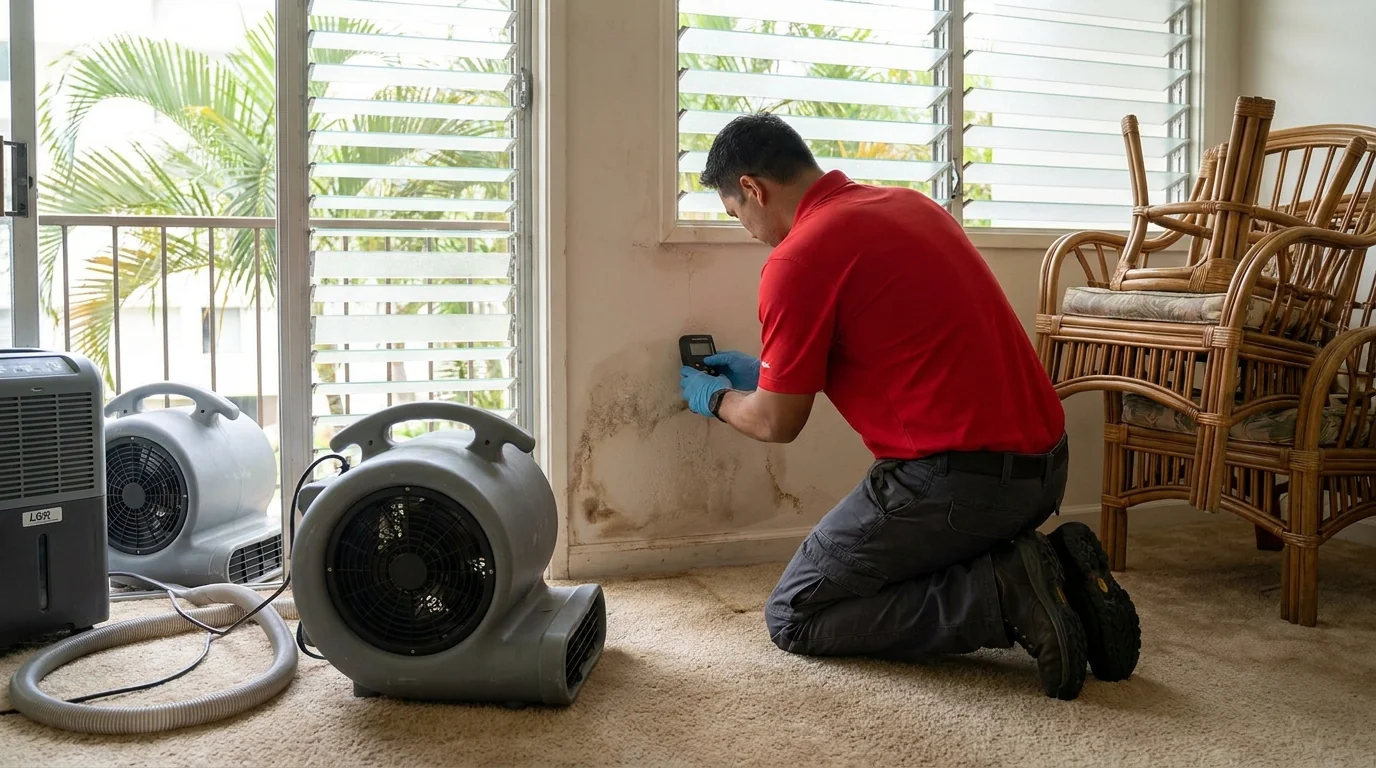
When we arrive, the first priority is stopping any active source and protecting contents. In Kahala homes, that often means moving fine rugs off wet flooring before extraction begins, placing protective padding under equipment feet, and covering built-in cabinetry before dehumidifiers run. We use thermal imaging cameras and calibrated moisture meters to map the full wet boundary — not just the visible damage — because slab construction allows moisture to travel farther than it appears on the surface.
Extraction comes next: truck-mounted and portable units pull standing water and surface moisture from flooring materials. Then we place drying equipment — industrial dehumidifiers and air movers — positioned to create the airflow patterns the material type requires. Hardwood and engineered flooring often benefit from desiccant-assisted drying or targeted floor mat systems that draw moisture upward rather than forcing heated air across the surface. We monitor readings daily and log them, which gives you a clear record of drying progress — useful documentation when you contact your insurer about coverage.
Reaching Kahala from Honolulu
Our team dispatches from Honolulu, and Kahala is a straightforward run via Kalanianaole Highway or through the H-1 interchange at Waialae Avenue. Because we operate 24/7, we can be moving equipment toward your address in the middle of the night when a pipe failure is most likely to go unnoticed longest. Properties near Waialae Beach Park or backing up toward the Waialae Country Club side of the neighborhood are easy to reach from either direction. If you’re managing a property remotely, we can coordinate access with a property manager or key holder — a common situation in this part of Oahu.
Local Note: What Long Vacancies Do to a Leak in Kahala
One pattern we see repeatedly in this neighborhood: a slow supply-line seep begins while a home is between occupants, and the first sign is a spike in the water bill — which the owner may not notice until the next statement arrives. By that point, moisture has had days or weeks to colonize the subfloor assembly and any adjacent wall framing. In slab homes, that moisture has nowhere to drain, so it sits. Mold can begin colonizing porous materials within 24 to 48 hours of saturation, meaning a two-week vacancy leak is a very different job than a same-day response. Thorough moisture mapping and drying documentation aren’t optional here — they’re what separates a clean closeout from a callback six months later when a homeowner notices a smell.
If you manage a Kahala property remotely or own a second home near Kahala Mall or along the Kahala Avenue corridor, setting a low-flow alert through the Board of Water Supply’s online account portal is one of the simplest early-warning tools available — and it costs nothing.
When water damage does happen, the response window matters more in Kahala than almost anywhere else on Oahu. Call (808) 349-3407 — we’ll dispatch immediately, protect what’s worth protecting, and dry the structure completely so you’re not dealing with the same problem twice.
Water Damage Restoration in Kahala: Service Coverage
Frequently Asked Questions
How fast can you arrive for water damage restoration in Kahala?
How quickly can you reach a home in the Kahala Avenue corridor after we call?
Our Kahala home is on a slab — how do you find moisture you can't see?
We have wool rugs and hardwood floors in our Waialae-Kahala home — will drying equipment damage them?
Our property in the 96816 ZIP code is a vacation rental that was unoccupied when the leak started — does that change the scope of work?
How long does structural drying typically take in a large single-level Kahala home?
Will my homeowners insurance cover water damage restoration in Kahala?
Water Damage Restoration response in Kahala
Most Kahala calls see a technician on-site within 60 minutes from our Honolulu headquarters.