
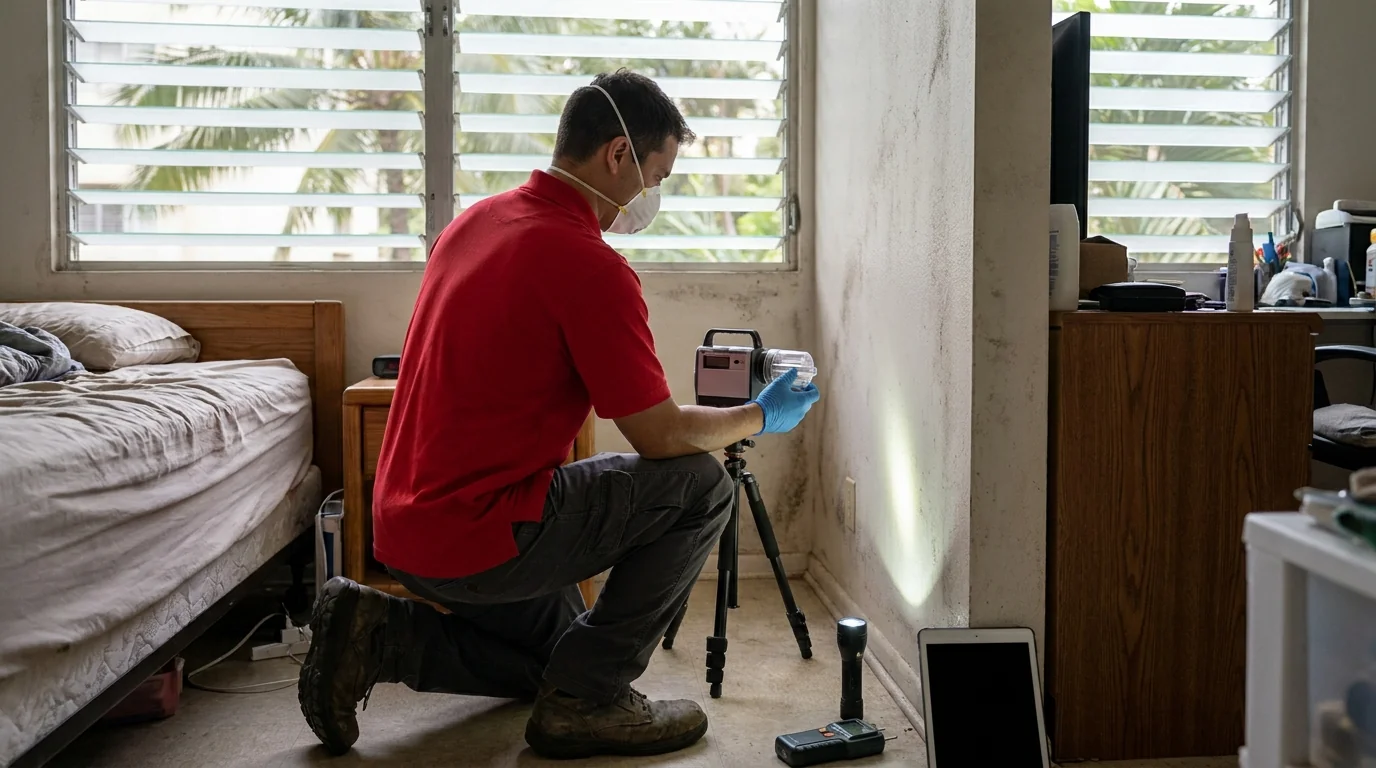
Mold Inspection and Testing in Honolulu
24/7 mold inspection and testing in Honolulu and surrounding areas. Call (808) 349-3407.
You notice a musty smell every time the AC kicks on, or a dark stain has reappeared on the ceiling three months after a roof repair. The damage is visible — but you don’t know how far it goes, whether the spores have spread into the HVAC system, or whether the air your family is breathing right now has elevated spore counts. That’s the exact gap a professional mold inspection and testing service fills: not remediation yet, just answers — documented, defensible answers you can act on.
What mold inspection and testing actually involves
A mold inspection is a systematic physical survey of a structure combined with air and surface sampling sent to an accredited third-party laboratory. It is not a visual walk-through with a flashlight. An inspector checks moisture readings in walls, ceilings, subfloors, and crawl spaces using a calibrated moisture meter and, where warranted, a thermal imaging camera that reveals temperature differentials behind finished surfaces — the signature of hidden moisture that mold colonizes within 24 to 72 hours of a water intrusion.
Air sampling captures what you can’t see. Spore trap cassettes are deployed at multiple locations — typically one outdoor baseline sample and two or more indoor samples in areas of concern — then analyzed by an independent lab for genus identification and spore counts per cubic meter of air. Surface sampling (tape lift or swab) is added when visible growth needs to be speciated or when an adjuster or property manager requires documentation of the specific organism present.
Lab turnaround in Honolulu typically runs 24 to 48 hours for standard analysis, with rush options available. The result is a written report you own: spore counts by species, a comparison against the outdoor baseline, and a map of the areas sampled.
Our process
-
Pre-inspection intake and moisture history review. Before any equipment comes out, we ask about the timeline: when was the leak, what was repaired, has there been prior mold treatment? Oahu’s trade winds and year-round humidity mean a slow roof leak behaves differently than a burst supply line — the history shapes where we look first.
-
Thermal imaging and moisture mapping. We scan suspect surfaces with a thermal camera and confirm anomalies with a pin or pinless moisture meter. Every reading is logged to a floor plan so you can see exactly which wall cavities or ceiling bays are holding moisture above the threshold where mold growth is likely.
-
Air and surface sample collection. Spore trap cassettes are placed in rooms of concern and outdoors for a baseline. If visible growth is present, we collect tape-lift samples for direct microscopy. Samples are chain-of-custody documented and shipped to an accredited laboratory.
-
Laboratory analysis and report delivery. The independent lab report identifies mold genera (Cladosporium, Aspergillus, Stachybotrys, Penicillium, and others common in Hawaii’s climate), quantifies spore concentrations, and flags any indoor-to-outdoor ratio that indicates active amplification inside the structure.
-
Written findings and next-step guidance. We walk you through the report — what the numbers mean, which areas require remediation, and what documentation you should retain for your own records and for your insurer’s review.
What separates a good mold assessment from a bad one
The most common failure in mold inspection is sampling only where mold is already visible. Visible growth is confirmation; the inspection’s job is to find what isn’t visible. An inspector who skips thermal imaging in a Hawaii home with older plaster walls or concrete block construction is likely to miss moisture pockets that have been feeding hidden colonies for months.
A second failure is skipping the outdoor baseline sample. Without it, elevated indoor spore counts can’t be put in context — some genera like Cladosporium are naturally abundant in Hawaii’s outdoor air, and a count that looks alarming indoors may simply reflect what’s coming through open louvers. The baseline is what makes the data meaningful.
Documentation quality matters too. An insurance adjuster reviewing a mold claim needs a lab report with chain-of-custody records, sample location maps, and genus-level identification — not a summary paragraph. If remediation follows, the pre-remediation inspection report becomes the baseline against which clearance testing is measured. A poorly documented inspection creates problems at every step downstream.
Finally, a mold inspector should not also be selling you remediation in the same conversation. Inspection and remediation are separate scopes. Photograph the visible damage yourself before any work begins, and keep copies of all lab reports for your own records and for any insurance claim you may file.
Seasonal and regional considerations
Honolulu’s average relative humidity sits above 70 percent for most of the year, and the windward sides of Oahu — Kailua, Kaneohe, the Pali corridor — see significantly more rainfall than the leeward coast. Concrete block and older wood-frame homes in neighborhoods like Palolo, Manoa, and Nuuanu are particularly prone to chronic moisture infiltration because of their construction era and exposure to orographic rainfall. After a kona storm or a prolonged period of northeast trade-wind rain, mold can begin colonizing wet building materials faster than in drier mainland climates. If you’ve had any water intrusion in the past 72 hours, the inspection clock is already running.
Service area
We conduct mold inspections and indoor air quality testing across Honolulu and throughout Oahu, including Pearl City, Aiea, Kailua, Kaneohe, Ewa Beach, Mililani, and Hawaii Kai. City-specific pages for many of these communities link back here for the full process detail.
If you’re seeing staining, smelling something that doesn’t clear after ventilation, or you’ve had a water event in the last few weeks, the right move is to get the air tested before drawing conclusions. Call (808) 349-3407 to schedule your indoor air quality assessment — and get a written report you can actually use.
Frequently Asked Questions
What's the difference between a mold inspection and mold testing, and do I need both?
What mold genera are most commonly found in Honolulu homes, and does the species matter?
How do I interpret the spore count numbers in a mold lab report?
What should I do — and not do — between noticing possible mold and the inspection appointment?
If remediation is recommended after the inspection, does the same report serve as the pre-remediation baseline for clearance testing?
Looking for the best mold inspection and testing company in Honolulu?
AAA Water Damage Restoration & Carpet Care provides mold inspection and testing in Honolulu, HI and the surrounding area. We answer calls 24/7 — call (808) 349-3407 for immediate help.
Need Mold Inspection and Testing now?
We respond 24/7 across Honolulu and surrounding HI cities.
Related Coverage
- Our Restoration Services
- Contact AAA Water Damage Restoration & Carpet Care
- Mold Inspection and Testing in Aiea
- Mold Inspection and Testing in Aina Haina
- Mold Inspection and Testing in Diamond Head
- Mold Inspection and Testing in Ewa Beach
- Mold Inspection and Testing in Hawaii Kai
- Mold Inspection and Testing in Honolulu
- Mold Inspection and Testing in Kahala
- Mold Inspection and Testing in Kailua
- Mold Inspection and Testing in Kaimuki
- Mold Inspection and Testing in Kaneohe
- Mold Inspection and Testing in Kapolei
- Mold Inspection and Testing in Mililani
- How To Test for Mold in Your Home (DIY Kits vs a Pro Inspection)