
Mold Inspection and Testing in Honolulu
24/7 mold inspection and testing in Honolulu, HI. Call (808) 349-3407.
Our technicians are headquartered right here in Honolulu and are typically on-site within 60 minutes of your call.
Honolulu’s combination of year-round tropical humidity and dense high-rise construction creates mold conditions unlike almost anywhere else in the country. When a supply line fails on the 18th floor of a Kakaako tower, soaked drywall can show visible mold colonies within 24 to 48 hours — sometimes before the unit owner even realizes there’s a problem. A professional mold inspection and testing assessment tells you exactly what you’re dealing with: where growth is occurring, what species are present, and whether the air inside your home or unit has already been compromised.
Why Honolulu Properties Are Especially Vulnerable to Mold
The trade winds that make Honolulu comfortable most of the year also carry salt-laden moisture that accelerates corrosion on angle stops, supply valves, and appliance connections throughout the city. In older walk-up buildings in Makiki and Moiliili — many built with single-wall construction — water that enters a wall cavity wicks through framing and finishes faster than it would in a double-wall mainland home. That compressed timeline between a leak event and active mold growth is the defining challenge for property owners in ZIP codes like 96822 and 96826.
High-rise condos in Waikiki and along the Kakaako waterfront add another layer of complexity. A single failed water heater or washing machine hose can cascade through multiple units below, meaning mold risk isn’t limited to the unit where the leak originated. Neighbors two or three floors down may have elevated spore counts in their air before they notice any visible damage.
Our Mold Inspection and Testing Process in Honolulu
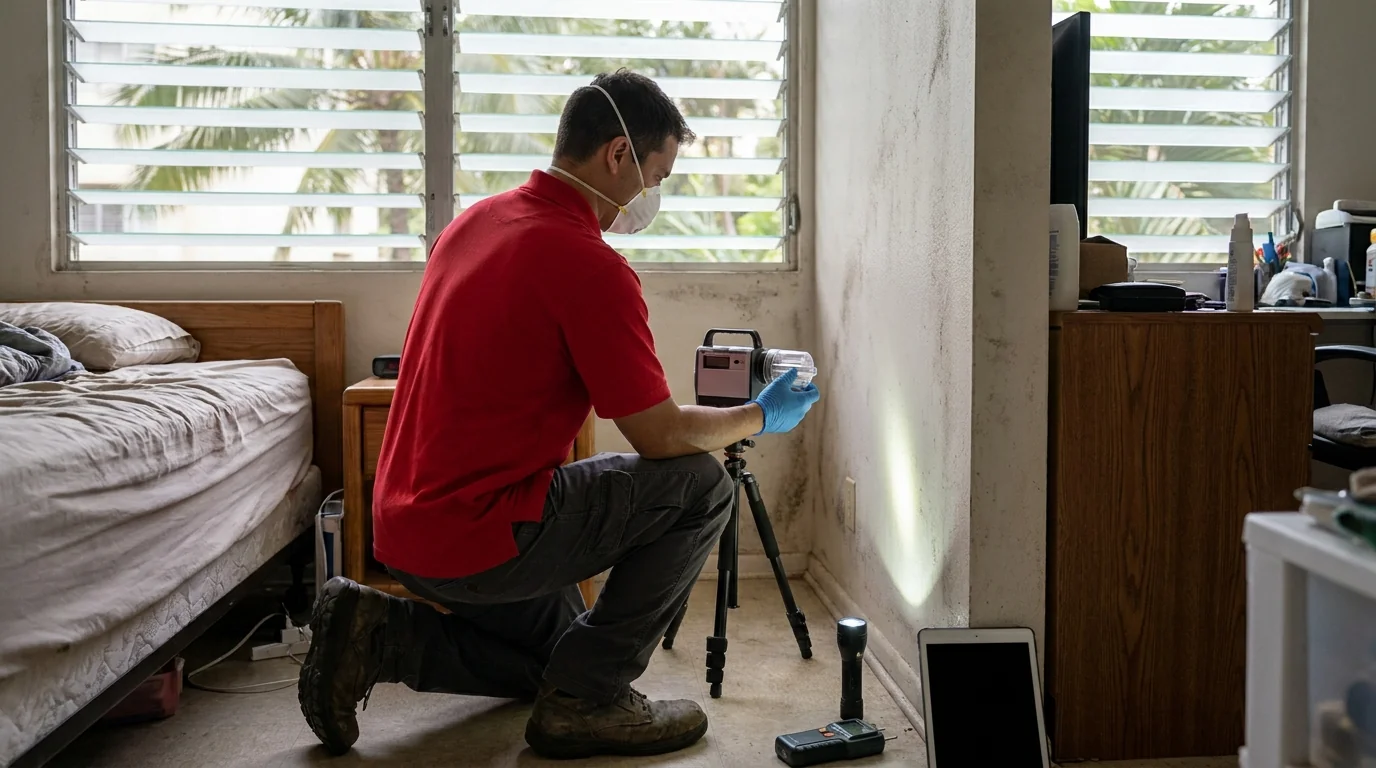
A thorough mold assessment here isn’t a quick visual walk-through. The process starts with a detailed inspection of moisture-prone areas: bathroom ceilings, under-sink cabinets, HVAC air handlers, and any wall or floor surfaces adjacent to plumbing chases. Moisture meters and thermal imaging help identify hidden saturation behind finishes — critical in Honolulu’s older building stock where galvanized pipes can weep slowly inside walls for weeks before a visible stain appears.
Once the inspection is complete, air samples and surface samples are collected and sent to an accredited third-party laboratory. Air sampling captures the spore count and species composition inside the property and compares it to an outdoor baseline — a comparison that matters in Honolulu, where ambient outdoor spore levels are already elevated relative to drier climates. Surface swabs or tape-lift samples from suspect areas confirm whether what looks like mold actually is mold, and what genus is present. Lab results typically return within a few business days, and a written assessment report details findings and recommended next steps.
HOA and AOAO Coordination in Honolulu’s Condo Communities
Many Honolulu properties — particularly in Waikiki, Ala Moana, and Kakaako — are governed by associations of apartment owners (AOAOs) or homeowners associations with their own insurance structures and documentation requirements. When mold is discovered following a water intrusion event that crosses unit lines, the inspection report often becomes a critical document for AOAO claims coordination and for establishing which party’s coverage applies to which portion of the damage.
A written mold inspection report with laboratory-backed findings gives unit owners, property managers, and their respective insurers a factual baseline. Photographing all visible damage and preserving the inspection report for your insurance claim is one of the most important steps you can take before any remediation work begins. If your AOAO requires a formal written assessment before authorizing contractor access, the inspection report from a professional assessment satisfies that requirement.
Local Note: What Honolulu’s Climate Means for Air Sampling Baselines
One thing that catches property owners off guard during mold testing in Honolulu is the outdoor control sample. Because Manoa Valley and other windward-facing neighborhoods sit in some of the wettest microclimates in the state — Manoa averages over 150 inches of rain annually — the ambient outdoor spore count used as a baseline is naturally higher than what a lab might see in Phoenix or Denver. A result that looks alarming on paper may be within an acceptable range once it’s compared to the local outdoor baseline collected the same day. Conversely, certain interior spore counts that seem modest in absolute numbers can still indicate a problem if the indoor-to-outdoor ratio is elevated. This is why the comparison sample matters, and why interpreting Honolulu results requires familiarity with local ambient conditions rather than applying a one-size-fits-all threshold.
If you’re seeing discoloration on walls or ceilings, noticing a musty odor that persists even with windows open, or dealing with the aftermath of a water event in your unit, call AAA Water Damage Restoration & Carpet Care at (808) 349-3407. The team is available around the clock, and a mold inspection in Honolulu is the clearest first step toward understanding what’s in your air and what needs to happen next.
Mold Inspection and Testing in Honolulu: Service Coverage
Frequently Asked Questions
How fast can you arrive for mold inspection and testing in Honolulu?
How quickly can AAA Water Damage Restoration & Carpet Care respond to a mold inspection request in Honolulu?
My Waikiki condo had a leak from the unit above. Does the mold inspection need to cover my unit, the unit above, or both?
Are older walk-up buildings in Makiki and Moiliili more likely to have hidden mold problems?
What does a mold air quality test actually measure, and how is the result interpreted in a place like Honolulu?
What does mold inspection and testing typically cost for a Honolulu condo versus a single-family home?
Will my homeowners insurance cover mold inspection and testing in Honolulu?
Mold Inspection and Testing response in Honolulu
Most Honolulu calls see a technician on-site within 60 minutes from our Honolulu headquarters.