
Mold Inspection and Testing in Aiea
24/7 mold inspection and testing in Aiea, HI. Call (808) 349-3407.
Our technicians are dispatched from our Honolulu, HI headquarters and are typically on-site in Aiea within 60 minutes of your call.
The stretch of Aiea climbing from the Pearl Harbor shoreline up through Aiea Heights sits in one of Oahu’s more humid microclimates — Kona storms push warm, moisture-laden air straight up those hillside grades, and it has to go somewhere. In older plantation-era homes built in the 1950s and ’60s, that somewhere is often behind bathroom tile, inside wall cavities above carports, and beneath the raised flooring common in Waimalu and Halawa. If you’ve noticed a musty smell that doesn’t clear after opening windows, or you’ve had any water intrusion in the past year, a professional mold inspection is the right first step before that problem gets harder to ignore.
Why Aiea Properties Are Prone to Hidden Mold
Aiea’s housing stock tells a story in two chapters. The first is the plantation-era single-family homes — many in the 96701 ZIP code — built with materials and ventilation standards that made sense in their era but weren’t designed for decades of Hawaii’s humidity. End-of-life galvanized plumbing in these homes drips slowly inside walls for months before anyone notices, giving mold colonies a long runway to establish. The second chapter is the newer townhome and condo complexes concentrated around Pearlridge Center, where shared plumbing chases and common-wall construction mean a leak in one unit can quietly migrate into the unit next door or below. Association-managed buildings in particular tend to have delayed reporting — a resident assumes the HOA is handling it, the HOA assumes the resident reported it, and mold grows in the gap.
Aiea Heights adds another layer: the steep grades that make the neighborhood scenic also funnel heavy Kona rain into carports and ground-floor spaces faster than drainage can handle. That kind of rapid, repeated wetting — even without a dramatic flood event — is exactly the condition mold needs to colonize porous materials within 24 to 48 hours of saturation.
Our Mold Inspection and Testing Process
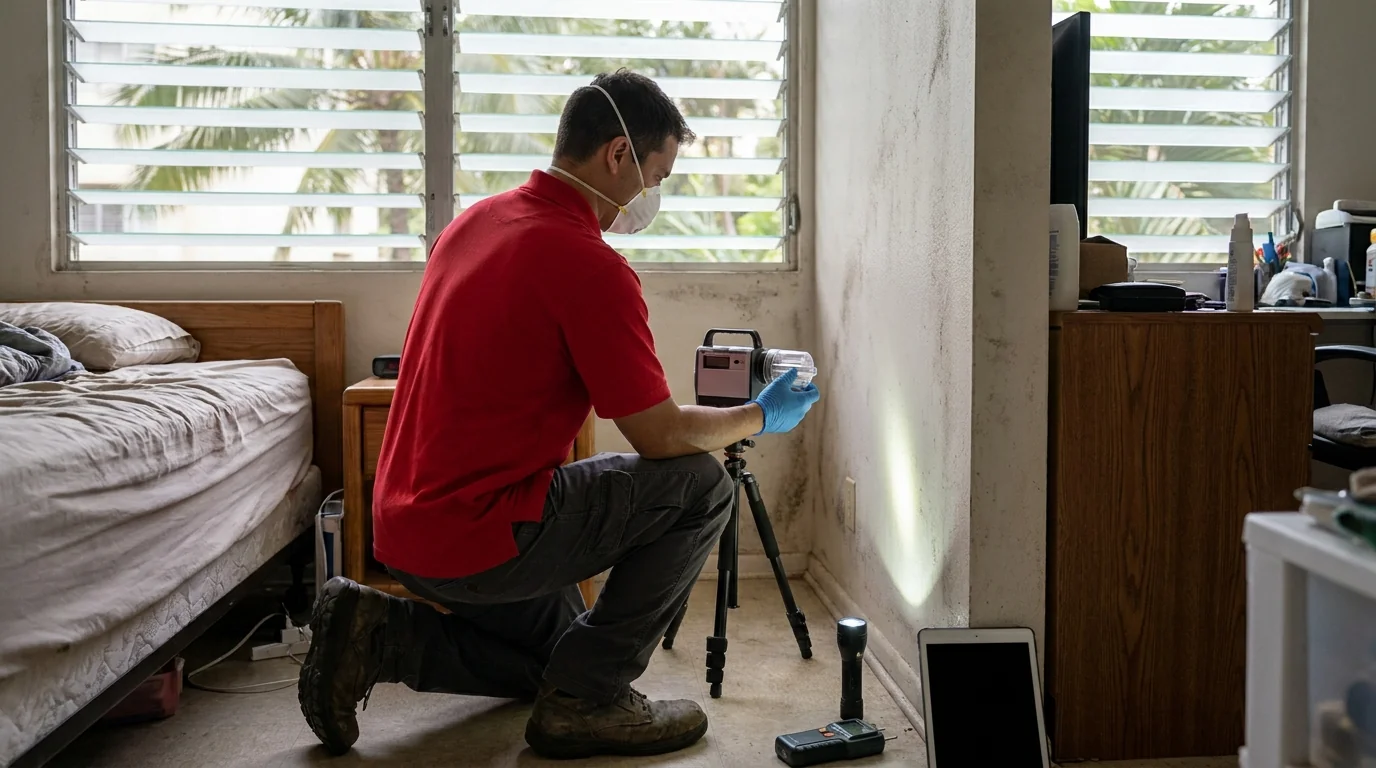
A mold inspection isn’t a visual scan and a handshake. The process starts with a thorough walkthrough to identify moisture patterns — we use thermal imaging and calibrated moisture meters to find wet areas behind drywall and under flooring that look dry on the surface. In Aiea’s older homes, that step is especially important because plaster and older wood-frame construction hold moisture differently than modern drywall; a surface can feel dry while the substrate behind it remains elevated.
Where mold growth is suspected but not visible, or where you need documentation for an insurance claim or HOA dispute, we collect air samples and surface swab samples and send them to an accredited third-party laboratory. The lab results identify the species present and the spore concentration — information that matters both for understanding the health context of the space and for scoping any remediation work accurately. We walk you through the report in plain language so you know exactly what was found, where, and what the next step looks like.
Navigating HOA and Multi-Unit Considerations in Aiea
If you’re in one of the condo or townhome associations near Pearlridge, mold testing often becomes a documentation exercise as much as a technical one. HOAs frequently require written inspection reports before approving remediation work, and some require independent air quality testing before a unit can be cleared for occupancy after remediation. We produce inspection reports formatted to meet those documentation requests, and we can coordinate with your association’s property manager directly to keep the process moving. If your situation involves a dispute over which unit is the moisture source, the sampling data we collect can help establish where the problem originated — useful information when liability questions come up between neighbors or between a unit owner and the association.
Local Note
One pattern we see specifically in Aiea Heights is moisture intrusion through the uphill wall of a structure rather than the roof or plumbing — rainwater running down a steep grade saturates the soil against a foundation or stem wall, and that moisture wicks inward. Homeowners often assume the problem is a roof leak because they see staining near the ceiling, but the actual entry point is at grade level on the uphill side of the house. A mold inspection that includes exterior moisture mapping and foundation-level readings catches this pattern; one that only looks inside misses it entirely.
If you’re in the Aiea Heights area and have noticed staining or musty odors on an interior wall that faces the hillside, that’s worth mentioning when you call — it helps us bring the right equipment and focus the inspection where the problem is most likely hiding.
Ready to get a clear picture of what’s happening in your home or unit? Call AAA Water Damage Restoration & Carpet Care at (808) 349-3407. We answer around the clock, serve the full Aiea area including Aiea Heights, Waimalu, and Halawa, and can schedule an inspection to fit your timeline — not the other way around.
Mold Inspection and Testing in Aiea: Service Coverage
Frequently Asked Questions
How fast can you arrive for mold inspection and testing in Aiea?
How quickly can you reach Aiea Heights or Waimalu for a mold inspection?
I'm in a condo near Pearlridge Center and my HOA is asking for a mold inspection report. What does that look like?
Are plantation-era homes in Aiea more likely to have serious mold problems than newer construction?
What does air sampling actually tell me, and is it worth doing in an Aiea home?
How much does a mold inspection typically cost for a home in the 96701 area?
Will my homeowners insurance cover mold inspection and testing in Aiea?
Mold Inspection and Testing response in Aiea
Most Aiea calls see a technician on-site within 60 minutes from our Honolulu headquarters.