Water Damage Restoration in Aiea
24/7 water damage restoration in Aiea, HI. Call (808) 349-3407.
Our technicians are dispatched from our Honolulu, HI headquarters and are typically on-site in Aiea within 60 minutes of your call.
When Kona storm rain hammers the ridgeline above Aiea Heights, water doesn’t politely find a drain — it sheets down steep grades, pours through carport openings, and pushes into ground-floor slabs before most homeowners realize anything is wrong. Whether you’re dealing with a fast-moving storm intrusion or a supply line that quietly failed overnight in a Pearlridge condo, standing water in a Hawaii home moves fast from inconvenience to structural problem. Call (808) 349-3407 any hour — the team dispatches around the clock.
Why Aiea Properties See More Water Damage Than You’d Expect
Aiea’s geography does a lot of the damage before a single pipe fails. The community climbs sharply from the Pearl Harbor shoreline up through Waimalu and Newtown to the higher elevations of Aiea Heights, and that elevation change means stormwater accelerates rather than disperses. Plantation-era homes built in the 1950s and 60s — common throughout the lower hillside streets — were plumbed in an era when galvanized steel and early copper were standard. That plumbing is now at or past end-of-life, and pinhole leaks or sudden burst events are a regular pattern in the area.
The newer condo and townhome complexes clustered near Pearlridge Center present a different challenge: unit-to-unit water intrusion. When a washing machine supply line fails on the third floor, the water doesn’t stay on the third floor. Association-managed buildings often have shared wall cavities and stacked mechanical chases that carry water silently through multiple units before anyone sees a wet ceiling. In those situations, the scope of damage is almost always larger than what’s visible on the surface.
Our Water Damage Restoration Process in Aiea
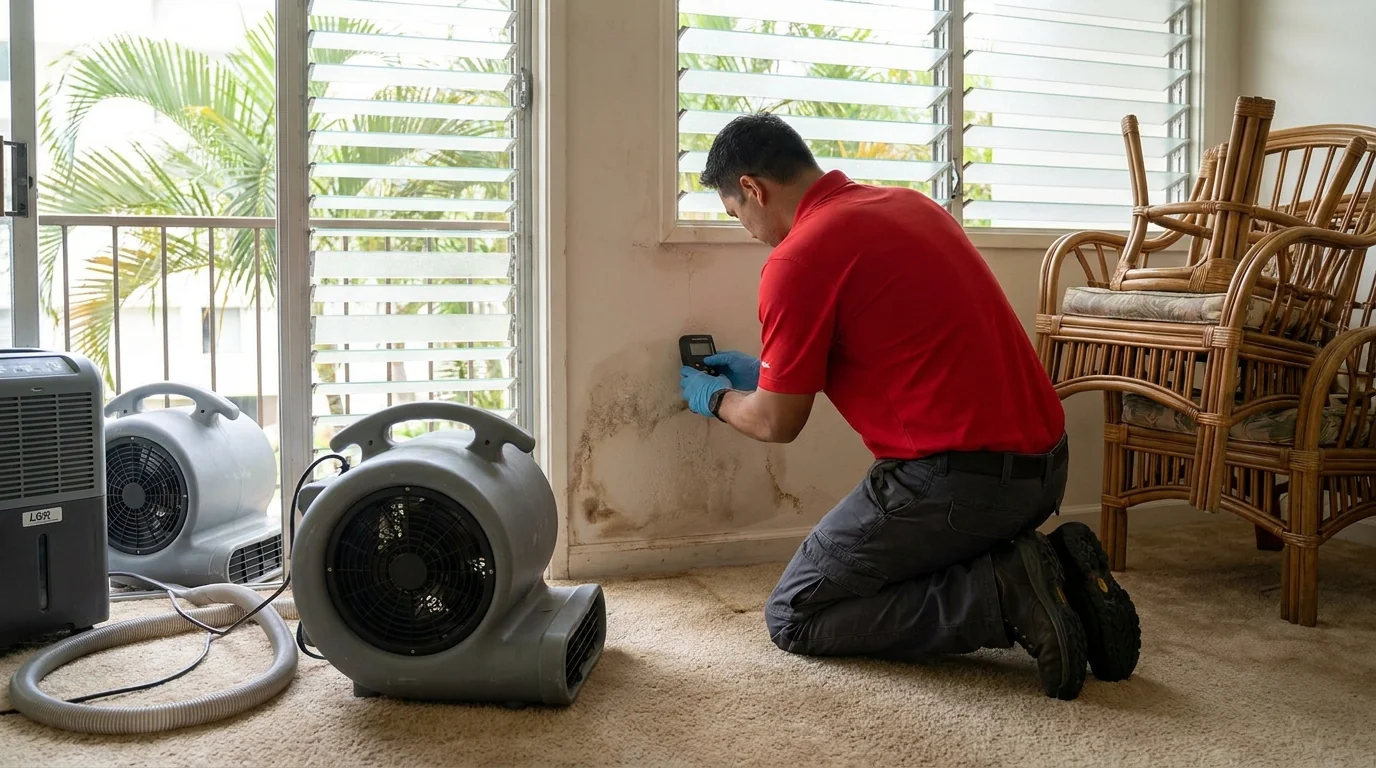
Every job starts with a thorough assessment — not a visual scan, but moisture readings taken with calibrated meters at walls, subfloors, and ceiling cavities. In older plantation homes, this matters especially because the original hardwood subfloors and tongue-and-groove wall paneling common in that era absorb and hold moisture differently than modern OSB or drywall. Water can wick several feet laterally through those materials before showing a visible stain.
Once the scope is mapped, extraction comes first. Commercial-grade truck-mounted and portable extractors pull standing water from carpet, flooring, and crawl spaces. After extraction, drying equipment — high-velocity air movers and refrigerant dehumidifiers calibrated for Hawaii’s ambient humidity — is positioned to create directed airflow through the structure. In Aiea’s climate, ambient relative humidity rarely drops below 60–70%, which means passive drying is not a realistic option; the equipment has to do the work the climate won’t.
Moisture readings are logged daily. Equipment is adjusted or repositioned based on what the numbers show, not on a fixed schedule. Drying is complete when readings return to pre-loss baselines for that specific material — not when the floor feels dry underfoot.
Reaching Aiea from Honolulu
The team operates 24/7 and dispatches from Honolulu. Aiea sits just off H-1 and the Moanalua Freeway corridor, which keeps drive times short from central Honolulu under most conditions. The Halawa area near Aloha Stadium is typically the first part of Aiea reachable on that route, with Waimalu and the Pearlridge corridor just beyond. Aiea Heights addresses require the additional climb up Aiea Heights Drive, which is navigable for service vehicles but worth noting when you call — mentioning your cross street helps the dispatcher route equipment efficiently.
For commercial losses along the Pearlridge retail corridor, overnight response is available for situations requiring equipment to be running before a business opens. Call (808) 349-3407 to describe the situation and get a realistic arrival window.
Local Note: Plantation-Era Walls and Drying Time
One detail that surprises Aiea homeowners unfamiliar with restoration work: the older homes in Waimalu and lower Aiea Heights frequently have interior walls finished with a skim-coat plaster over wood lath rather than standard drywall. Plaster walls absorb water more slowly than drywall, which sounds like good news — but they also release moisture more slowly during drying. A wall cavity that would reach baseline in two to three days with modern drywall can take four to five days with plaster construction. Knowing this upfront prevents the frustration of equipment running longer than expected and helps set accurate timelines with your insurance adjuster.
If you’re in the 96701 ZIP code and your home has that older wall construction, mention it when you call. It changes how drying equipment is staged from the start.
Water damage in Aiea doesn’t wait for a convenient time, and the longer saturation continues, the deeper it goes into framing, subfloor, and insulation. If you’re seeing water — or smelling the early signs of moisture in a space that should be dry — call (808) 349-3407 now. The team is available around the clock and knows what Aiea’s housing stock and climate actually demand.
Water Damage Restoration in Aiea: Service Coverage
Frequently Asked Questions
How fast can you arrive for water damage restoration in Aiea?
How quickly can you reach Aiea Heights or the Pearlridge area after I call?
My Pearlridge condo has water coming through the ceiling from the unit above — how does that kind of loss get handled in an association-managed building?
Are older plantation-era homes in Waimalu and lower Aiea harder to dry out after a water loss?
What does the structural drying process actually involve, and how long does it take in Aiea's climate?
What should I do right now while I wait for the crew to arrive at my Aiea home?
Will my homeowners insurance cover water damage restoration in Aiea?
Water Damage Restoration response in Aiea
Most Aiea calls see a technician on-site within 60 minutes from our Honolulu headquarters.