
Mold Remediation in Honolulu
24/7 mold remediation in Honolulu and surrounding areas. Call (808) 349-3407.
You notice it first as a smell — something damp and earthy behind the bathroom wall, or a musty undertone in a closet that never quite goes away. Then you see the discoloration: gray-green patches creeping along drywall, dark streaks under a windowsill, or a fuzzy bloom spreading across ceiling tile. Mold can colonize a wet surface in as little as 24 to 48 hours after moisture arrives, and once it’s established inside a wall cavity or under flooring, wiping the visible surface does almost nothing. Effective mold remediation means finding the full extent of growth, cutting off its moisture source, and removing contaminated material under conditions that keep spores from spreading to clean areas of the home.
What mold remediation actually involves
Mold remediation is not the same as mold cleaning. Cleaning — spraying a surface with an antimicrobial and wiping it down — addresses what you can see. Remediation addresses the colony, including the portion you can’t see: hyphae penetrating porous materials like drywall paper, wood framing, and insulation. When those materials are compromised, they have to come out.
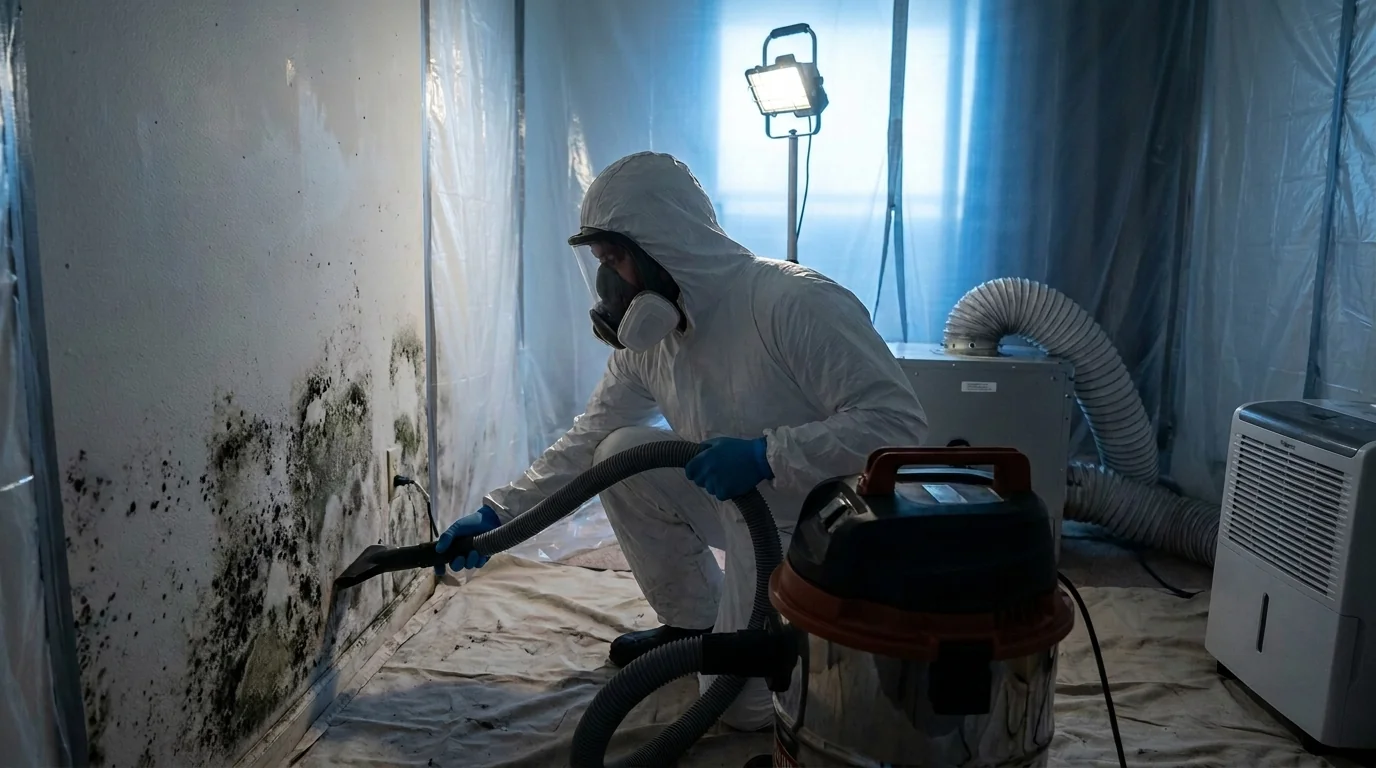
The work typically involves sealing off the affected area with polyethylene sheeting and negative air pressure so that disturbed spores don’t migrate into living spaces. HEPA-filtered air scrubbers run continuously during demolition and removal, pulling particulates down to 0.3 microns from the air. Contaminated drywall, insulation, and sometimes framing lumber are bagged and removed. Remaining structural surfaces are HEPA-vacuumed and treated with an EPA-registered antimicrobial. Then the area is allowed to dry — and verified dry — before any reconstruction begins.
Timeline varies with the scope of growth. A contained bathroom ceiling job might wrap in one to two days. Mold that has migrated through a wall system into adjacent rooms, or that has been growing undetected for months beneath flooring, can take a week or more of active remediation before clearance testing confirms the space is ready to rebuild.
Our process
-
Inspection and moisture mapping. Before any material comes out, we locate the moisture source driving the growth. Thermal imaging and moisture meters identify wet framing and saturated insulation behind finished surfaces. Skipping this step is the single most common reason mold comes back — the visible mold gets removed but the wet cavity stays wet.
-
Containment setup. We seal the work zone with poly sheeting, establish a decontamination chamber at the entry point, and set negative air pressure using HEPA-filtered negative air machines. This keeps spores from traveling through HVAC registers or open doorways into unaffected rooms during demolition.
-
Controlled demolition and removal. Contaminated materials — drywall, insulation, baseboards, subfloor sections — are removed in manageable sections, double-bagged in 6-mil poly, and transported out through the containment. Remaining structural surfaces are HEPA-vacuumed before any chemical treatment is applied.
-
Antimicrobial treatment and drying. EPA-registered antimicrobial agents are applied to cleaned structural surfaces. Drying equipment — dehumidifiers and air movers — runs until moisture readings in framing and subfloor return to acceptable baselines. We do not close walls until the structure is dry.
-
Post-remediation verification. Before containment comes down and before reconstruction begins, the remediated area should be tested to confirm spore counts have returned to normal background levels. We can coordinate with a third-party industrial hygienist for air sampling and clearance testing — an independent result that carries more weight with insurance adjusters and future buyers than a self-issued clearance.
What separates a good mold remediation response from a bad one
The most common failure in mold remediation is inadequate containment. When a crew tears out moldy drywall in an open room without negative air pressure, disturbed spores aerosolize and settle throughout the house — sometimes creating secondary contamination in rooms that were previously clean. A proper containment setup is not optional; it is the foundation of the entire job.
The second most common failure is treating the symptom without fixing the cause. Mold is always a moisture problem first. If the leaking pipe fitting, the failed pan liner under the water heater, or the chronically humid crawl space isn’t addressed before remediation begins, regrowth is essentially guaranteed.
Insurance adjusters and industrial hygienists reviewing remediation documentation look for several things: a written scope of work that describes what materials were removed and why, moisture readings taken before and after drying, and a clearance test performed by a party independent of the remediation contractor. Homeowners who want to protect their claim — or their home’s resale history — should request this documentation in writing.
One detail that often gets missed on Oahu: mold behind tile in older homes frequently involves Hardiebacker or, in pre-1980s construction, materials that warrant additional testing before demolition begins. Honolulu’s housing stock includes a significant number of homes built during the post-war construction boom, and older wall assemblies don’t always behave the way modern drywall does when wet.
Seasonal and regional considerations
Honolulu’s trade winds keep many homes feeling comfortable, but they mask a humidity reality that favors mold year-round. Average relative humidity on Oahu sits between 60 and 70 percent, and the windward sides of the island — Kailua, Kaneohe, the North Shore — run consistently higher. Homes without mechanical dehumidification in crawl spaces, attics, or interior bathrooms are operating close to mold’s preferred growth threshold at all times. After any water intrusion event, whether from a plumbing failure, roof leak during Kona storm season, or flooding from heavy rain, the window to prevent mold from establishing is shorter here than in drier climates. Acting within the first 24 to 48 hours after water exposure significantly changes the remediation scope.
Service area
We respond to mold remediation calls throughout Honolulu and across Oahu, including Pearl City, Aiea, Kailua, Kaneohe, Ewa Beach, Mililani, and Hawaii Kai. The city-specific pages linked from this site cover local details for each area.
If you’re seeing visible mold growth, smelling persistent musty odors, or dealing with the aftermath of a recent water event, call (808) 349-3407 to request an air quality assessment and get a clear picture of what’s actually in your walls before the problem grows any further.
Frequently Asked Questions
What is the difference between mold remediation and mold removal, and why does it matter?
At what point does a mold job require full containment with negative air pressure?
What should I do — and not do — while waiting for a remediation crew to arrive?
What is post-remediation verification, and do I actually need it?
Can mold grow back after professional remediation, and what prevents it?
Looking for the best mold remediation company in Honolulu?
AAA Water Damage Restoration & Carpet Care provides mold remediation in Honolulu, HI and the surrounding area. We answer calls 24/7 — call (808) 349-3407 for immediate help.
Need Mold Remediation now?
We respond 24/7 across Honolulu and surrounding HI cities.
Related Coverage
- Our Restoration Services
- Contact AAA Water Damage Restoration & Carpet Care
- Mold Remediation in Aiea
- Mold Remediation in Aina Haina
- Mold Remediation in Diamond Head
- Mold Remediation in Ewa Beach
- Mold Remediation in Hawaii Kai
- Mold Remediation in Honolulu
- Mold Remediation in Kahala
- Mold Remediation in Kailua
- Mold Remediation in Kaimuki
- Mold Remediation in Kaneohe
- Mold Remediation in Kapolei
- Mold Remediation in Mililani
- How To Choose a Restoration Company in (Without Getting Burned)
- How To Test for Mold in Your Home (DIY Kits vs a Pro Inspection)
- 7 Signs You Have Hidden Mold (and What To Do Next)