Choosing a restoration company after water damage, a fire, or a mold discovery is one of the worst decisions you’ll ever have to make quickly. You’re stressed, possibly displaced, and your phone is ringing with contractors you’ve never heard of. The short answer: verify credentials before you sign anything, get the scope of work in writing, and be cautious of anyone who shows up uninvited at your door. The rest of this guide walks you through exactly what to look for — and what should send you walking away.
Why the Stakes Are Higher Than a Normal Contractor Hire
Hiring a bad plumber might mean a leaky fitting. Hiring the wrong restoration company can mean incomplete drying that hides moisture behind walls for months, mold colonies taking hold in cavities you can’t see, or a fire-damaged structure that passes a visual inspection but still carries embedded smoke odors and compromised framing.
Restoration work — whether it’s water damage extraction, fire and smoke remediation, or mold removal — involves specialized equipment, documented drying logs, and industry protocols that most general contractors simply aren’t trained to follow. The IICRC S500 standard for water damage, for example, specifies psychrometric targets (temperature, humidity, and airflow ratios) that have to be hit and recorded daily. A company that just runs fans and declares the job done in two days is not following that standard.
In Hawaii, the stakes are compounded by climate. Honolulu’s humidity rarely drops below 60%, which means materials that would dry in three days on the mainland can take five or six here — and mold can begin colonizing damp organic material in as little as 24 to 48 hours. The company you hire needs to understand that, not just apply a mainland playbook.
The Credentials That Actually Matter
Not every certification in this industry carries equal weight. Here’s what to ask about and why it matters:
IICRC S500/S520 standards — The Institute of Inspection, Cleaning and Restoration Certification (IICRC) publishes the S500 water-damage and S520 mold standards most of the industry runs on. The relevant designations are Water Damage Restoration (WRT), Applied Structural Drying (ASD), and Fire and Smoke Restoration (FSRT), each mapped to an IICRC standard. Ask the company how their on-site crews — not just the owner — are trained to the S500 and S520 standards, and how recently. Training to a standard has to be kept current.
State licensing — In Hawaii, contractors performing certain types of structural work need to be licensed through the Department of Commerce and Consumer Affairs (DCCA). Ask for the license number and verify it at hawaii.gov/dcca before signing.
Mold-specific credentials — Mold remediation sits in a regulatory gray zone in many states. Ask whether the company follows EPA guidelines for mold remediation and whether they use a third-party industrial hygienist to conduct post-remediation clearance testing. A company that does both the remediation and its own clearance testing has an obvious conflict of interest.
Insurance — Ask for a certificate of liability insurance and workers’ compensation. If a technician is injured on your property and the company isn’t properly insured, you may be exposed.
Red Flags That Should Stop You Cold
The restoration industry has a well-documented problem with storm chasers and opportunistic contractors who appear after a disaster and pressure homeowners into signing assignment-of-benefits agreements or authorization forms before the full scope of damage is even assessed. Here’s what to watch for:
- Unsolicited door-knocking after a storm or news of local flooding. Legitimate companies don’t canvas neighborhoods looking for jobs.
- Pressure to sign before you’ve spoken to your insurer. Photograph all damage first. Contact your insurance company to understand your coverage before authorizing any work.
- Vague or verbal-only scope of work. Every reputable company should provide a written estimate that details what will be removed, what will be dried in place, what equipment will be used, and how long the job is expected to take.
- No moisture readings on day one. A proper water damage assessment starts with a moisture meter and thermal imaging, not a visual walk-through. If a technician can’t show you readings, they’re guessing.
- Guarantees that mold won’t return. No honest company can promise that. They can promise proper remediation per protocol. Anyone offering a lifetime mold-free guarantee is either uninformed or hoping you won’t read the fine print.
- Asking you to sign over your insurance claim. Assignment of benefits (AOB) agreements transfer your claim rights to the contractor. In some cases this is legitimate; in many it is not. Talk to your insurer and possibly an attorney before signing one.
What a Legitimate Restoration Process Actually Looks Like
Knowing what good work looks like helps you evaluate whether a company is doing it.
For water damage: The first visit should include moisture mapping — readings at multiple points across affected walls, floors, and ceilings — followed by extraction of standing water, then placement of air movers and dehumidifiers calibrated to the square footage and material types. The crew should return daily (or every other day at minimum) to take readings and adjust equipment. You should receive a drying log at the end of the job. If no one is tracking daily readings, the job isn’t being managed.
For fire and smoke damage: Smoke residue isn’t just a smell — it’s acidic and corrosive, and it penetrates porous materials like drywall, insulation, wood framing, and HVAC ductwork. A proper fire restoration assessment goes beyond what’s visibly charred. Expect air quality testing, content inventory (what can be cleaned versus what must be replaced), and odor neutralization using equipment like thermal foggers or hydroxyl generators — not just ozone machines left running for a weekend.
For mold remediation: Containment comes first — plastic sheeting and negative air pressure to prevent spores from spreading to unaffected areas during removal. Affected materials are removed, bagged, and disposed of properly. After remediation, an independent clearance test (air sampling or surface swabs, analyzed by a lab) should confirm the area is within normal spore counts before containment is removed. If a company skips the clearance test, you have no objective confirmation the job worked.
Questions to Ask Before You Hire Anyone
Bring this list to every conversation:
- Which certifications do your on-site technicians hold, and can I see documentation?
- Are you licensed with the Hawaii DCCA? What’s your license number?
- Can you provide a written scope of work before I authorize anything?
- How will you document moisture readings throughout the drying process?
- For mold jobs: do you use a third-party industrial hygienist for post-remediation clearance testing?
- What does your daily or every-other-day monitoring look like — will someone be on-site, or are you checking remotely?
- Can you provide references from jobs of similar size and type?
You’re not being difficult by asking these questions. Any company worth hiring will answer them without hesitation.
Making the Call
If you’re dealing with active water damage, visible mold growth, or smoke and soot after a fire, the window for preventing secondary damage is short. Mold doesn’t wait for you to finish your research. Use this guide to vet quickly — not to delay.
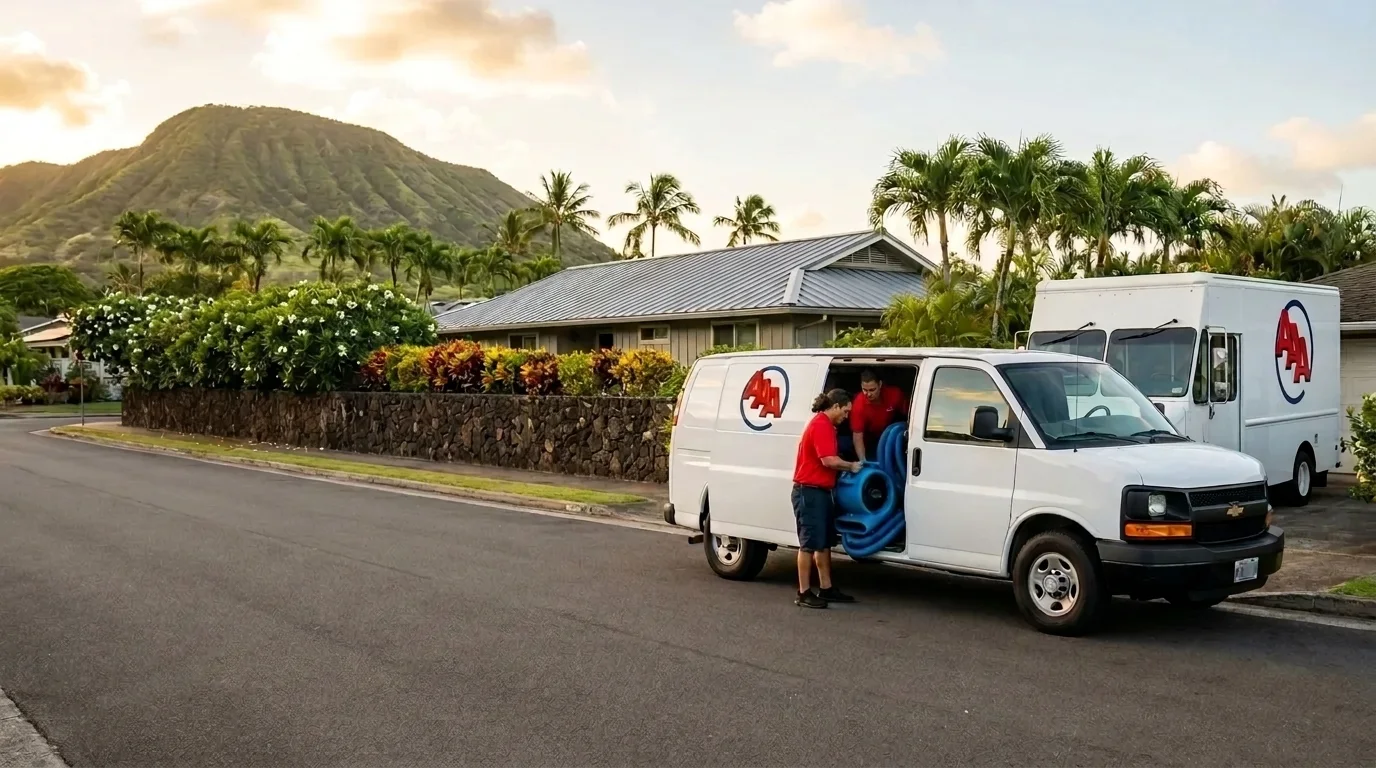
If you’re in Honolulu and want to talk through what you’re seeing before committing to anything, AAA Water Damage Restoration & Carpet Care is available at (808) 349-3407. Ask the questions above. Ask them of us too.