Burst Pipe Cleanup and Repair in Honolulu
24/7 burst pipe cleanup and repair in Honolulu and surrounding areas. Call (808) 349-3407.
A pipe doesn’t burst gently. One moment your home is dry; the next, water is sheeting down a wall, pooling under flooring, or soaking into ceiling drywall before you’ve even located the shutoff valve. The clock starts the second water makes contact with building materials — within hours, particleboard swells and delaminates, drywall paper begins to wick moisture upward, and any organic material in the path becomes a candidate for mold colonization within 24 to 48 hours. Getting the water stopped is only the beginning. What happens in the next few hours determines whether you’re looking at a targeted repair or a gut renovation.
What burst pipe cleanup and repair actually involves
Burst pipe cleanup sits at the intersection of plumbing and structural drying — two disciplines that have to work in sequence, not in parallel. The plumbing side stops the source: isolating the failed section, cutting out the damaged pipe, and restoring water service to the rest of the house. The restoration side addresses everything the water touched after it escaped.
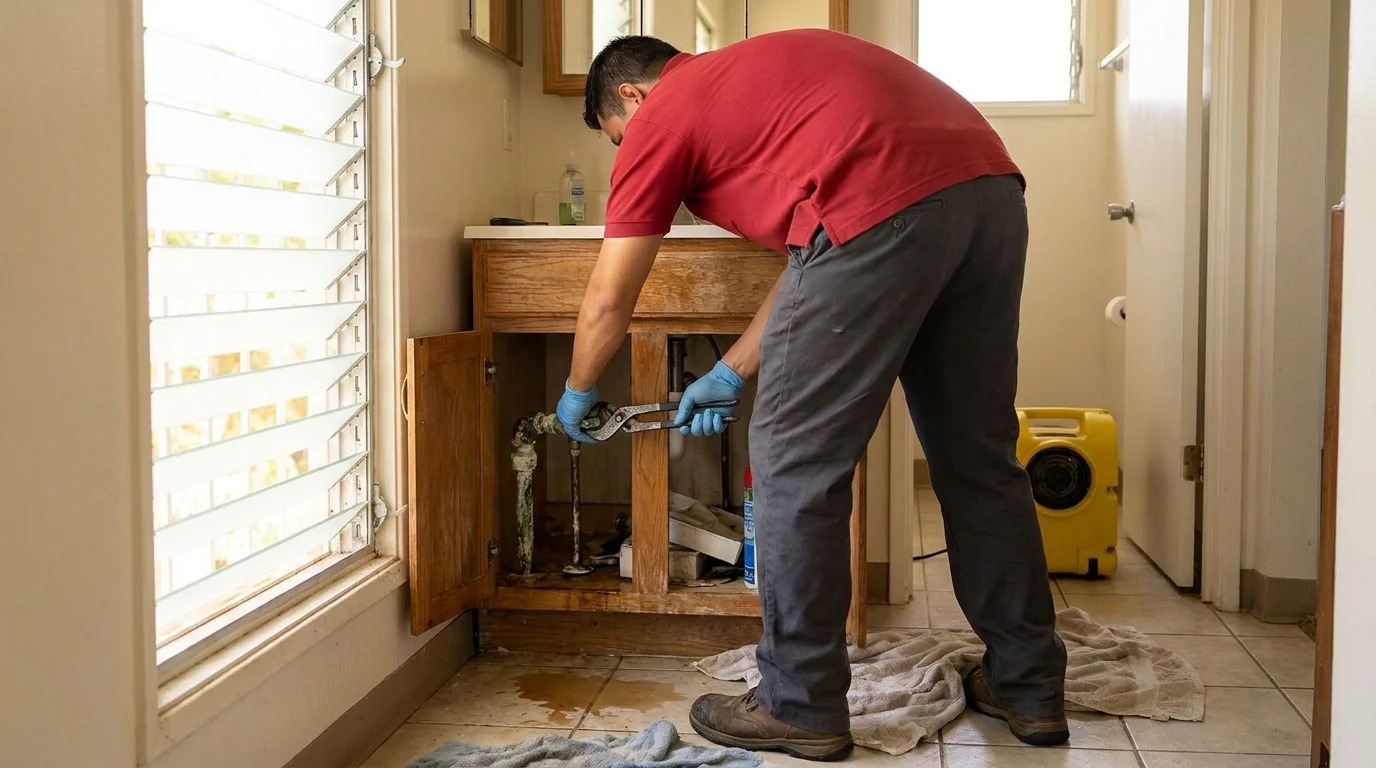
In practice, that means deploying truck-mounted or portable extraction equipment to pull standing water from flooring, then setting industrial air movers and low-grain refrigerant dehumidifiers to drive moisture out of wall cavities, subfloor assemblies, and insulation bays. Thermal imaging cameras and calibrated moisture meters map exactly how far water traveled — because water follows gravity and capillary action, not straight lines. A supply line that burst inside a wall on the second floor may have saturated the floor assembly, traveled down a stud bay, and pooled inside a first-floor ceiling before anyone noticed a drip.
Drying timelines vary by material and saturation depth. Hardwood flooring typically requires 5–10 days of active drying with daily moisture readings to confirm progress. Concrete slabs can hold moisture for weeks without proper desiccant equipment. Wall cavities behind tile may need flood cuts — horizontal drywall removal at the waterline — to allow airflow to reach framing that would otherwise stay wet and rot from the inside.
Our process
-
Source isolation and site assessment. Before any equipment is staged, the failed pipe section is identified and isolated. Water service is restored to unaffected areas of the home where possible. A full site walk with moisture meters and a thermal camera establishes the actual boundary of water intrusion — which is almost always larger than the visible wet area.
-
Standing water extraction. Truck-mounted extraction or portable wet-vac systems remove bulk water from hard floors, carpet, and subfloor cavities. This step is done before drying equipment is placed, because air movers running over standing water accomplish nothing except spreading contamination.
-
Structural drying setup. Air movers are positioned to create a vortex effect along wet walls and floors. Dehumidifiers are sized to the affected cubic footage and set to maintain low grain-referenced humidity targets. If wall cavities are saturated, drywall flood cuts or injection-drying systems are used to introduce airflow directly into the stud bay.
-
Daily moisture monitoring. Readings are logged at the same measurement points each visit — typically every 24 hours — using pin-type and pinless moisture meters. Drying is not complete when the surface feels dry; it’s complete when meter readings return to equilibrium moisture content for the material and the local ambient conditions. Documentation of this progression matters if you’re filing a claim with your insurer.
-
Pipe repair and material restoration. Once structural drying is confirmed, the failed pipe section is repaired or replaced, affected drywall and insulation are removed or restored, and finish materials are matched and reinstalled. Permits are pulled where required by Honolulu’s Department of Planning and Permitting.
What separates a good burst pipe response from a bad one
The most common failure in burst pipe cleanup is stopping work too early. Surfaces dry faster than cavities, and a moisture meter reading taken only at the surface will show acceptable numbers while framing and sheathing behind the drywall remain saturated. Mold can begin colonizing that hidden wet wood within 48 hours, and it won’t be visible until it’s already a remediation problem.
A second common mistake is skipping category classification. Water from a clean supply line is Category 1 at the moment of loss — but it degrades quickly once it contacts soil, subfloor debris, or sits for more than 24 hours. Cleanup protocols for Category 2 water (which may carry contaminants from building materials or standing conditions) are more involved than for fresh supply-line water, and treating degraded water as Category 1 creates health and liability exposure.
Insurance adjusters reviewing a burst pipe claim will look for a written moisture log with dated readings, a clear scope of work that distinguishes drying from repair, and photo documentation of the damage before any materials are removed. Keeping that record organized from day one shortens the claims process considerably — photograph the source, the affected rooms, and any personal property in the water’s path before cleanup begins.
Seasonal and regional considerations
Honolulu doesn’t face freeze-thaw pipe failures the way mainland climates do, but the islands have their own burst pipe patterns. Older homes in neighborhoods like Kaimuki, Manoa, and Nuuanu frequently have galvanized or cast-iron supply lines that have been corroding from the inside for decades — a pressure spike or even normal aging can split them without warning. Hawaii’s high ambient humidity (typically 60–80% relative humidity year-round) means wet building materials don’t dry passively the way they might in a drier climate; active dehumidification isn’t optional, it’s essential. During heavy rain seasons, a burst pipe event compounded by roof or window intrusion can push moisture loads beyond what residential-grade equipment can handle.
Service area
AAA Water Damage Restoration & Carpet Care responds to burst pipe emergencies across Honolulu and the surrounding communities — including Pearl City, Aiea, Kailua, Kaneohe, Ewa Beach, Kapolei, and Mililani. Dedicated service-area pages cover each community in detail.
If a pipe has already let go, call (808) 349-3407 now. The sooner extraction and drying equipment is running, the narrower the scope of structural damage — and the smaller the repair bill on the other side.
Frequently Asked Questions
How far can water actually travel from a burst pipe before it stops?
What is a flood cut, and when is one necessary after a pipe burst?
What should I do in the first 15 minutes after a pipe bursts, before help arrives?
How does water from a burst supply line become a contamination concern?
Why do moisture readings need to be logged daily rather than just checked at the end of drying?
Looking for the best burst pipe cleanup and repair company in Honolulu?
AAA Water Damage Restoration & Carpet Care provides burst pipe cleanup and repair in Honolulu, HI and the surrounding area. We answer calls 24/7 — call (808) 349-3407 for immediate help.
Need Burst Pipe Cleanup and Repair now?
We respond 24/7 across Honolulu and surrounding HI cities.
Related Coverage
- Our Restoration Services
- Contact AAA Water Damage Restoration & Carpet Care
- Burst Pipe Cleanup and Repair in Aiea
- Burst Pipe Cleanup and Repair in Aina Haina
- Burst Pipe Cleanup and Repair in Diamond Head
- Burst Pipe Cleanup and Repair in Ewa Beach
- Burst Pipe Cleanup and Repair in Hawaii Kai
- Burst Pipe Cleanup and Repair in Honolulu
- Burst Pipe Cleanup and Repair in Kahala
- Burst Pipe Cleanup and Repair in Kailua
- Burst Pipe Cleanup and Repair in Kaimuki
- Burst Pipe Cleanup and Repair in Kaneohe
- Burst Pipe Cleanup and Repair in Kapolei
- Burst Pipe Cleanup and Repair in Mililani