Commercial Restoration in Honolulu
24/7 commercial restoration in Honolulu and surrounding areas. Call (808) 349-3407.
When a commercial property goes down, every hour is revenue walking out the door
A burst supply line flooding a Honolulu office suite at 6 a.m. is a different problem than a flooded bedroom. There are employees who can’t work, clients who can’t be served, liability exposure for the property manager, and a building system — HVAC, electrical, plumbing — that interacts with water in ways a residential job never does. Commercial restoration means getting a functioning business back online, not just drying a structure. That requires a different scope, a different crew size, and a different conversation with your building’s stakeholders from the first hour on site.
What commercial restoration actually involves
Commercial water, fire, and mold events share one trait residential jobs rarely do: scale compounds everything. A Category 2 water loss on a single floor of a multi-tenant building can affect shared HVAC ducts, elevator shafts, and the tenant two floors below before anyone notices the ceiling tiles sagging. Fire soot in a restaurant kitchen doesn’t stay in the kitchen — it migrates through the ventilation system into the dining room, the storage area, and sometimes the neighboring suite.
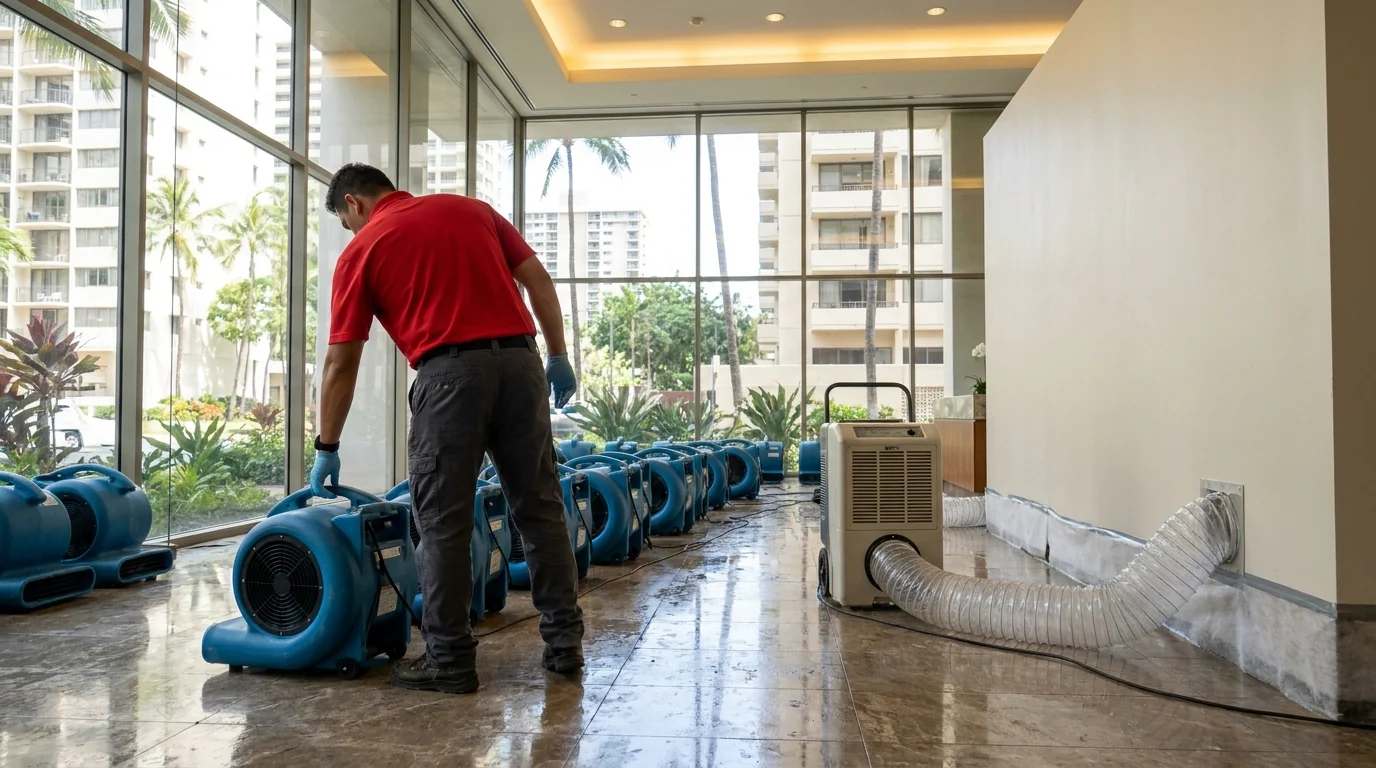
The equipment footprint is larger: commercial-grade desiccant dehumidifiers, high-capacity axial air movers, and negative-air machines running in tandem rather than the handful of units a residential job needs. Drying timelines are governed by the same physics — wood equilibrium moisture content, vapor pressure, dew point — but the monitoring grid is more complex when you’re covering 8,000 square feet of concrete slab under carpet tile rather than 400 square feet of hardwood.
Documentation requirements are also heavier. Insurance adjusters on commercial losses frequently request moisture-mapping logs, psychrometric data, and daily drying reports. Tenants may have their own carriers. The building owner may have a separate policy. Getting the paperwork right from day one protects everyone.
Our process
-
Rapid loss assessment and stakeholder briefing. Before equipment rolls in, we walk the affected area with the property manager or facilities director, identify all impacted systems (plumbing, HVAC, electrical panels), and establish a clear chain of communication. You’ll know the scope, the estimated timeline, and what areas need to be vacated before work starts.
-
Containment and business-continuity planning. Where possible, we isolate the loss area so unaffected parts of the building stay operational. Poly barriers, negative-air pressure zones, and phased work schedules — including after-hours or weekend shifts — are planned around your business hours, not ours.
-
Extraction, debris removal, and structural exposure. Standing water is extracted first. Saturated materials — drop ceilings, carpet tile, drywall — are removed to the wet line, not beyond it. Over-demolition on a commercial loss is expensive and unnecessary; under-demolition leaves hidden moisture that produces mold within 24 to 48 hours in Hawaii’s humidity.
-
Drying, air quality control, and daily monitoring. Industrial desiccant dehumidifiers and air movers run in a calculated configuration based on the cubic footage and material types present. We log temperature, relative humidity, and material moisture readings daily and adjust equipment placement as the drying curve progresses. For fire losses, thermal fogging or hydroxyl generation runs concurrently to address smoke odor in the HVAC system before it re-deposits on clean surfaces.
-
Clearance documentation and restoration handoff. When materials reach target moisture content — or air quality samples clear for mold events — we produce a written drying report and moisture-map log. This documentation is what your insurer, your tenants’ insurers, and any future property inspector will rely on. We hand it off with the job, not weeks later.
What separates a good commercial response from a bad one
The most common failure on a commercial loss is treating it like a large residential job. Residential crews often set equipment and check back in two days. On a commercial slab-on-grade building, concrete can read dry at the surface while holding significant moisture at depth — a problem that doesn’t show up without a concrete moisture meter or calcium chloride test. Mold colonization can begin inside wall cavities within 48 hours in Honolulu’s trade-wind humidity, even when surface readings look acceptable.
A second common failure is ignoring the HVAC system. Smoke, mold spores, and Category 2 or 3 water contaminants all travel through ductwork. Restoring the visible loss area without inspecting and cleaning the air-handling system means the problem recirculates the moment the building goes back to normal operation.
Insurance adjusters on commercial losses look for three things: a documented scope that matches the visible damage, daily drying logs that justify the equipment line items on the invoice, and a clear moisture-mapping diagram showing where readings were taken and what the final numbers were. Missing any of these creates delays, disputes, and sometimes denials.
Seasonal and regional considerations
Honolulu’s climate doesn’t have a freeze-thaw cycle, but it has its own commercial restoration calendar. The trade winds that keep the islands comfortable most of the year slow or reverse during Kona wind periods — typically fall and winter — trapping humidity against the leeward sides of buildings and dramatically slowing evaporative drying. Commercial jobs that start during a Kona wind event need more dehumidification capacity and longer drying windows than the same job in trade-wind season. Heavy rain events associated with Kona conditions also increase the frequency of roof-intrusion and storm-drain-backup losses across older commercial inventory in downtown Honolulu, Kalihi, and the industrial corridors near the airport.
Service area
AAA Water Damage Restoration & Carpet Care responds to commercial losses throughout Honolulu and the surrounding communities — including Kailua, Kaneohe, Pearl City, Aiea, Ewa Beach, and Kapolei. Individual service-area pages detail local response logistics for each community.
If your commercial property is dealing with active water intrusion, smoke damage, or a mold event that’s keeping tenants out of their space, call (808) 349-3407 now. We answer around the clock, dispatch from Honolulu, and can begin the loss assessment the same day. The sooner the scope is defined, the sooner your building is back in service.
Frequently Asked Questions
How do you minimize business disruption during a commercial restoration job?
What documentation should a commercial property manager collect immediately after a loss?
Why does a commercial water loss sometimes require drying equipment on multiple floors even when only one floor flooded?
How does smoke damage behave differently in a commercial building compared to a house?
What is psychrometric monitoring and why does it matter on a large commercial drying job?
Looking for the best commercial restoration company in Honolulu?
AAA Water Damage Restoration & Carpet Care provides commercial restoration in Honolulu, HI and the surrounding area. We answer calls 24/7 — call (808) 349-3407 for immediate help.
Need Commercial Restoration now?
We respond 24/7 across Honolulu and surrounding HI cities.
Related Coverage
- Our Restoration Services
- Contact AAA Water Damage Restoration & Carpet Care
- Commercial Restoration in Aiea
- Commercial Restoration in Aina Haina
- Commercial Restoration in Diamond Head
- Commercial Restoration in Ewa Beach
- Commercial Restoration in Hawaii Kai
- Commercial Restoration in Honolulu
- Commercial Restoration in Kahala
- Commercial Restoration in Kailua
- Commercial Restoration in Kaimuki
- Commercial Restoration in Kaneohe
- Commercial Restoration in Kapolei
- Commercial Restoration in Mililani
- Commercial Water Damage: Protecting Business Continuity After a Loss