A burst pipe, a roof leak during a storm, a malfunctioning sprinkler head — commercial water damage can halt operations within hours and cost far more in lost revenue than it does in repair bills. The single most important thing a business owner or property manager can do is act in the first 24 to 48 hours, before saturated drywall starts to delaminate, before subfloor materials begin to buckle, and before mold has the opportunity to colonize. This guide walks through exactly what to do, what to avoid, and how to think about recovery in a way that keeps your business moving.
Why Commercial Water Damage Hits Differently Than a Residential Leak
In a home, a slow leak under a kitchen sink is an inconvenience. In a commercial building, the same type of failure can shut down a restaurant, compromise a server room, or force a retail space to close during its busiest season.
A few factors make commercial losses more complex:
- Scale. Commercial buildings have more square footage, more layers of flooring, and more concealed plumbing runs. Water travels farther before it becomes visible.
- Occupancy and liability. Wet floors, damaged electrical systems, and airborne mold spores create real safety exposure for employees and customers.
- Inventory and equipment. Water doesn’t distinguish between your stock room and your sales floor. Electronics, paper records, and perishable inventory are often the first casualties.
- Lease and insurance obligations. Depending on your lease structure, you may have reporting requirements to a building owner within a specific window — missing that window can complicate your claim.
Hawaii’s climate adds another layer. Honolulu’s humidity rarely drops below 60 percent, which means wet materials dry more slowly than they would on the mainland and mold can begin to appear within 24 to 48 hours of a moisture event rather than the 72-hour window often cited in temperate climates.
The First Two Hours: What to Do Right Now
If you’re reading this in the middle of an active loss, here’s the sequence that matters:
- Stop the source. Locate and shut off the water supply to the affected area. If you don’t know where the zone shutoffs are, go to the main shutoff. Every business owner and facilities manager should know where this valve is before an emergency happens.
- Cut power to affected areas — carefully. If water has reached electrical panels, outlets, or equipment, do not enter the area until a licensed electrician confirms it’s safe. Water and live current are a fatal combination.
- Document everything before you touch it. Walk the perimeter with your phone and record video of standing water, saturated materials, damaged inventory, and any visible structural damage. This footage is the foundation of your insurance claim.
- Move salvageable inventory and equipment to a dry area. Elevate anything that can be elevated. Paper records, electronics, and upholstered furniture absorb water quickly and become unsalvageable within hours.
- Call your commercial property insurer. Report the loss as soon as the immediate safety issues are addressed. Ask specifically about your policy’s requirements for mitigation — most policies require you to take reasonable steps to prevent further damage, which means you can’t simply wait for an adjuster before beginning drying.
- Begin ventilation if safe. Open windows and doors if outdoor humidity is lower than indoor humidity. Run HVAC on fan mode if the system itself wasn’t affected. Moving air slows secondary damage.
Time is the variable you can control most directly. Every hour that standing water remains in contact with concrete, drywall, or wood flooring increases both the scope of damage and the cost of restoration.
What Not to Do After a Commercial Water Loss
Some of the most expensive mistakes happen in the first few hours, usually because someone is trying to help.
- Don’t use a standard wet/dry shop vac as your primary extraction tool on large losses. Consumer-grade vacuums move too little volume to meaningfully dry a commercial space. They can give a false sense of progress while water continues to wick into wall cavities and subfloor assemblies.
- Don’t run dehumidifiers without also measuring moisture levels. A dehumidifier running in a sealed room with saturated walls will cycle endlessly without drying the structure. Professional drying requires psychrometric readings — measuring temperature, relative humidity, and dew point — to set equipment correctly.
- Don’t assume the damage is limited to what you can see. If the leak is behind drywall, you’ll often see only a soft spot or a faint stain. The actual wet zone can extend several feet in every direction. Cutting an inspection hole before calling a professional is reasonable; assuming the visible area is the full extent of damage is not.
- Don’t discard damaged materials before your insurer documents them. Photograph and, where possible, retain samples of damaged flooring, drywall, and inventory until your adjuster has confirmed the documentation is sufficient.
- Don’t delay mitigation waiting for an adjuster visit. Most commercial policies include a duty-to-mitigate clause. Waiting 48 hours for an adjuster while water sits in your building can result in claim complications if secondary damage — particularly mold — is deemed preventable.
When the Situation Requires Professional Restoration
Some commercial water losses are manageable with in-house facilities staff and rental equipment. Most are not. Call a professional restoration team when:
- Standing water covers more than a few hundred square feet
- Water has been present for more than 12 hours
- The affected area includes HVAC ductwork, electrical systems, or structural framing
- The water source is a sewage backup or contaminated drain (Category 3 water requires specialized handling and protective equipment)
- You’re seeing or smelling early signs of mold — a musty odor, visible discoloration on walls or ceilings, or a persistent damp smell in the air
- Your lease or insurance policy requires documentation of professional mitigation
Professional commercial restoration involves more than extraction and fans. A qualified team will use thermal imaging to locate moisture behind walls without demolition, set calibrated drying equipment based on measured atmospheric conditions, and provide the documentation — moisture logs, drying records, equipment placement maps — that your insurer needs to process a structural claim.
The Longer Recovery: Getting Back to Business
Once the structure is dry — typically three to five days for a well-executed commercial drying project, longer if structural materials required removal — the reconstruction phase begins. This is where business continuity planning pays off.
A few things to think through before you need them:
- Know your critical operations. Which functions can be relocated temporarily? Which require the physical space? A professional services firm can often work remotely; a restaurant cannot. Map this out now so decisions are faster in a crisis.
- Maintain a current inventory of equipment and stock. A spreadsheet or cloud-based asset list with purchase dates and approximate values makes insurance documentation dramatically faster.
- Ask your insurer about business interruption coverage. If your policy includes it, understand what triggers it, what the waiting period is, and what documentation you’ll need to file a claim. This is a conversation to have before a loss, not during one.
- Build relationships with vendors in advance. Knowing which restoration company you’d call before the ceiling starts dripping means you’re not making that decision under stress at 2 a.m.
Recovery from a commercial water loss is rarely a single event — it’s a sequence of decisions made under pressure, each one affecting the next. The businesses that return to normal operations fastest are almost always the ones that moved quickly in the first 24 hours and worked with experienced professionals who could document the process for insurers and building owners.
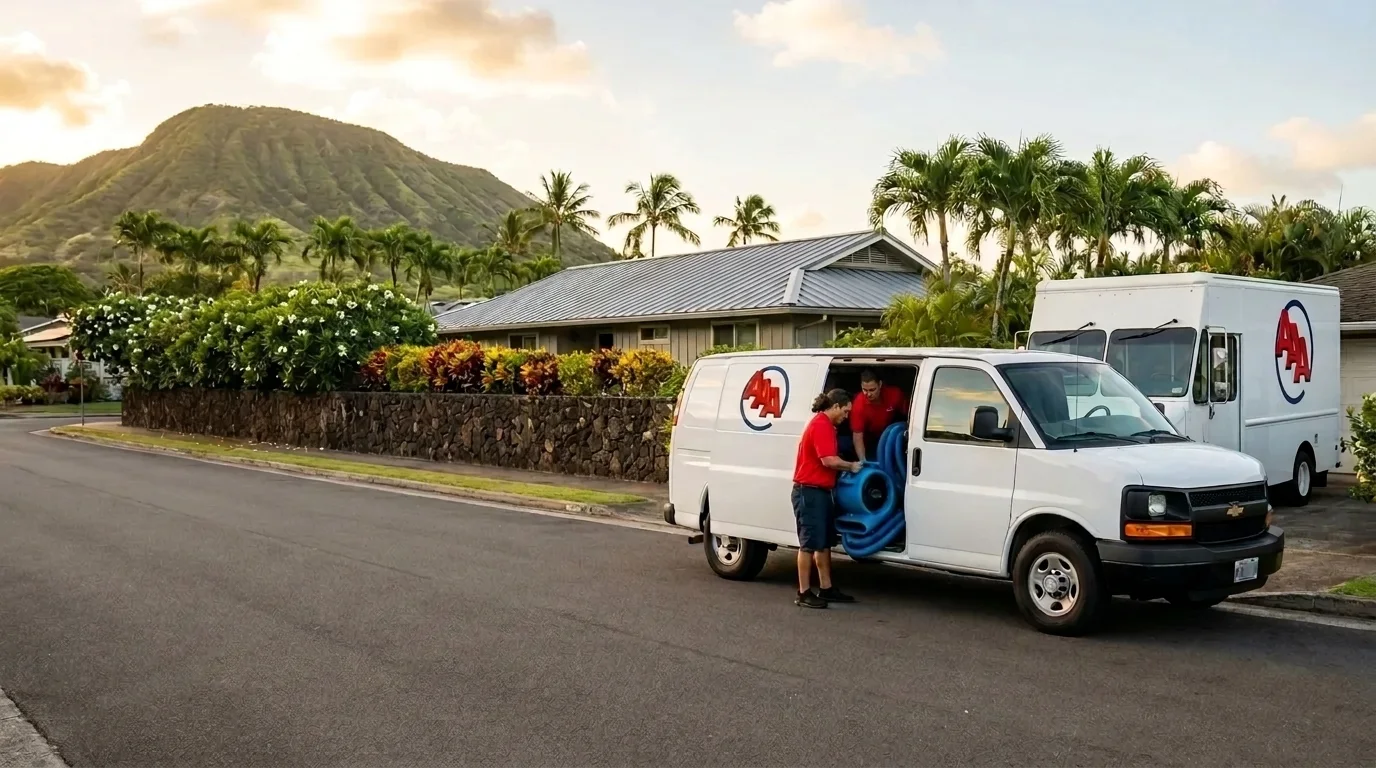
If your Honolulu commercial property has experienced a water loss and you’re not sure what the next step looks like, the team at AAA Water Damage Restoration & Carpet Care can walk through the situation with you. Reach them at (808) 349-3407.