Flood Damage Restoration in Honolulu
24/7 flood damage restoration in Honolulu and surrounding areas. Call (808) 349-3407.
Floodwater doesn’t wait for business hours, and neither does the damage it leaves behind. Within the first hour, water migrates under baseboards, wicks up drywall, and begins saturating subfloor assemblies that you can’t see from the surface. Within 24 to 48 hours, the conditions for mold colonization are already in place. Flood damage restoration is a race against a biological clock — and the decisions made in the first few hours determine how much of your home can be saved and how much has to be rebuilt.
What flood damage restoration actually involves
Flood cleanup is not the same as mopping up a burst pipe. Floodwater — whether it entered through storm surge, an overflowing drainage channel, or surface runoff from Honolulu’s steep valley terrain — is almost always contaminated. It carries sediment, bacteria, sewage backflow, pesticides, and whatever else was sitting on the ground before the water picked it up. That contamination changes everything: the protective equipment required on site, the way materials are handled, and what can realistically be dried versus what has to come out.
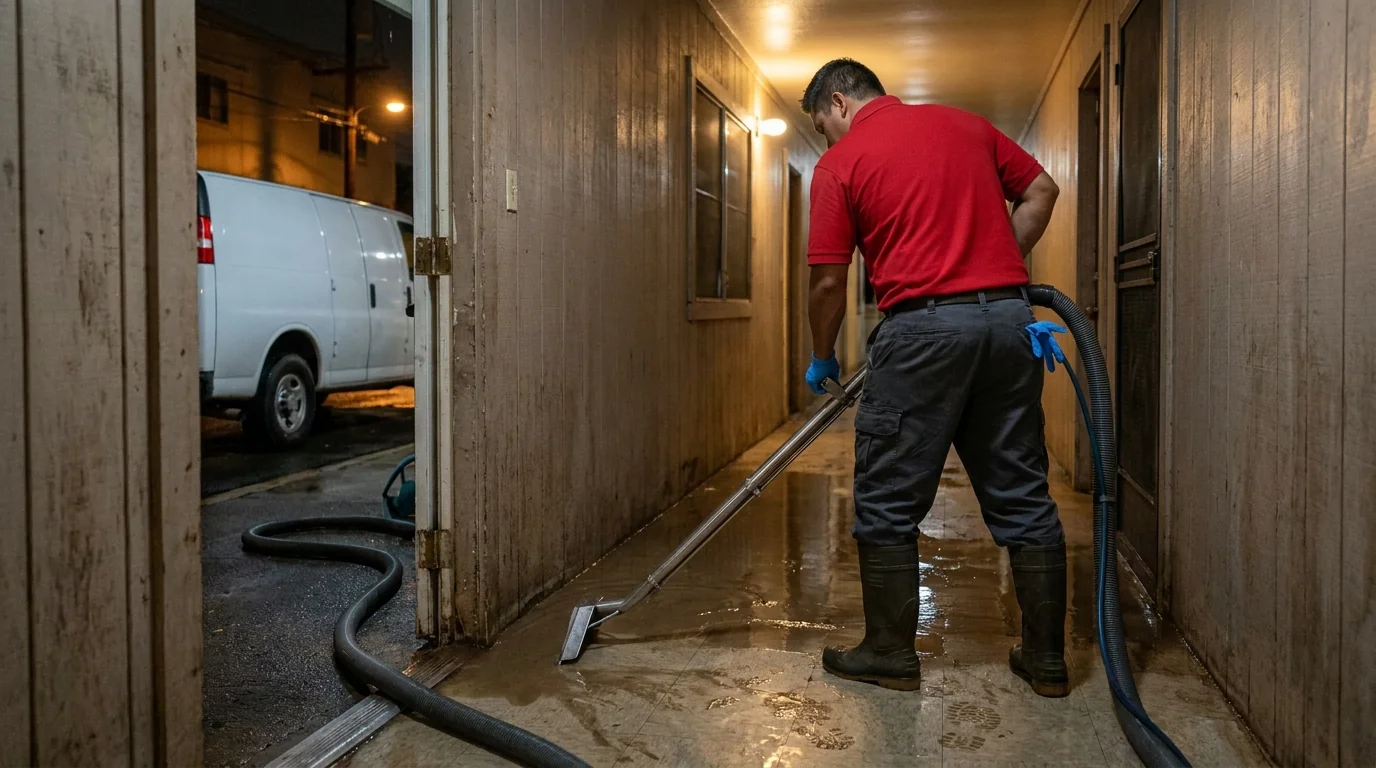
The physical work involves high-capacity truck-mounted or portable extraction units pulling standing water from floors and cavities, industrial air movers positioned to create directional airflow through wall assemblies, and low-grain refrigerant or desiccant dehumidifiers running continuously to pull moisture out of the air and building materials simultaneously. Thermal imaging cameras map moisture migration behind walls and under flooring without requiring immediate demolition. Moisture meters track readings across multiple structural materials — concrete slab, wood subfloor, drywall, framing — so drying progress is measured, not guessed.
In Honolulu’s climate, ambient humidity rarely drops below 60–70%, which means drying conditions are harder here than on the mainland. Equipment has to work against the environment, not with it.
Our process
-
Floodwater extraction and contamination assessment. The first priority is removing standing water and categorizing the contamination level. Category 3 “black water” — the classification that covers most flood events from storm surge or drainage overflow — requires full personal protective equipment, and any porous materials that absorbed it (carpet, drywall below the waterline, insulation) are typically non-restorable and must be removed rather than dried in place.
-
Controlled demolition and material removal. Contaminated drywall is cut back to a safe height — typically 12 to 24 inches above the visible waterline, because water travels upward through capillary action. Flooring, baseboard, and insulation are bagged and removed. This step feels destructive, but leaving contaminated material inside a wall cavity and attempting to dry over it creates a hidden mold and odor problem that surfaces months later.
-
Structural drying with continuous monitoring. Once the contaminated material is out, drying equipment is deployed and moisture readings are logged at each monitoring point — typically every 24 hours. Drying is complete when structural materials return to normal moisture content for their material type, not simply when the surface feels dry. In Honolulu’s humidity, this process commonly takes 3 to 5 days for standard wood-frame construction, longer for concrete block or homes with limited airflow.
-
Antimicrobial application. After drying, exposed framing, subfloor, and concrete are treated with an EPA-registered antimicrobial solution to address any microbial load introduced by the floodwater. This is applied to the structural shell, not to finished surfaces, and it’s a documented step — not a precautionary spray that gets skipped when the crew is running behind.
-
Documentation and drying logs. Every moisture reading, every equipment placement, and every material removed is recorded. Those records matter when you’re filing with your insurer — photograph the damage yourself before any work begins, and ask for copies of the drying logs for your own files.
What separates a good flood response from a bad one
The most common mistake in post-flood restoration is treating Category 3 water intrusion like a Category 1 clean-water event. An inexperienced crew may extract the standing water, run fans for a few days, and call the job dry — leaving contaminated drywall and insulation sealed behind freshly painted walls. The smell returns in six weeks. The mold shows up in three months. By then, the original contractor is unreachable.
A second common failure is incomplete moisture mapping. Floodwater follows the path of least resistance, which in Honolulu’s older plantation-era and post-war housing stock often means it travels laterally through slab cracks, through wall bottom plates, and into adjacent rooms that showed no visible water. Thermal imaging and systematic meter readings catch this. A visual inspection alone does not.
Insurance adjusters reviewing flood claims look for documented moisture readings at the start and end of drying, a clear contamination category determination, and a material removal log. Gaps in that documentation create disputes. Thorough records protect you.
Seasonal and regional considerations
Honolulu’s flood risk isn’t limited to hurricane season, though the period from June through November does bring the most significant storm activity. Winter Kona storms — low-pressure systems that push moisture onshore from the south — produce some of the heaviest multi-day rainfall events on record and regularly overwhelm storm drains in low-lying neighborhoods like Kalihi, Mapunapuna, and parts of Ewa. Homes in valley corridors near Manoa, Nuuanu, and Palolo are particularly exposed to rapid surface runoff during intense rain events. Year-round humidity means that any water intrusion, regardless of season, carries a compressed timeline for secondary damage.
Service area
AAA Water Damage Restoration & Carpet Care responds to flood damage throughout Honolulu and the surrounding communities, including Pearl City, Aiea, Kailua, Kaneohe, Ewa Beach, Kapolei, and Mililani. Dedicated service-area pages cover the specific conditions and response logistics for each community.
If your home or property took on floodwater — whether from storm surge, drainage backup, or surface runoff — call (808) 349-3407 to begin your flood damage assessment. We answer around the clock, and extraction equipment can be on site the same day.
Frequently Asked Questions
What is the difference between Category 1, 2, and 3 floodwater, and why does it change what gets removed?
How long does structural drying take after a flood, and what determines the timeline?
What should I do in the hours before a restoration crew arrives after a flood?
Why is the waterline cut height on drywall sometimes higher than where the water actually reached?
What documentation should I keep from the flood restoration process for my own records?
Looking for the best flood damage restoration company in Honolulu?
AAA Water Damage Restoration & Carpet Care provides flood damage restoration in Honolulu, HI and the surrounding area. We answer calls 24/7 — call (808) 349-3407 for immediate help.
Need Flood Damage Restoration now?
We respond 24/7 across Honolulu and surrounding HI cities.
Related Coverage
- Our Restoration Services
- Contact AAA Water Damage Restoration & Carpet Care
- Flood Damage Restoration in Aiea
- Flood Damage Restoration in Aina Haina
- Flood Damage Restoration in Diamond Head
- Flood Damage Restoration in Ewa Beach
- Flood Damage Restoration in Hawaii Kai
- Flood Damage Restoration in Honolulu
- Flood Damage Restoration in Kahala
- Flood Damage Restoration in Kailua
- Flood Damage Restoration in Kaimuki
- Flood Damage Restoration in Kaneohe
- Flood Damage Restoration in Kapolei
- Flood Damage Restoration in Mililani