
Flood Damage Restoration in Aiea
24/7 flood damage restoration in Aiea, HI. Call (808) 349-3407.
Our technicians are dispatched from our Honolulu, HI headquarters and are typically on-site in Aiea within 60 minutes of your call.
When Kona storms roll in and rain hammers the slopes above Pearl Harbor, Aiea’s steep terrain doesn’t give water anywhere gentle to go. It sheets down through Aiea Heights, cuts across carports, and pushes into ground floors before most homeowners realize what’s happening. If you’re dealing with flood damage right now — standing water on tile, soaked drywall, or the damp-earth smell that follows a fast-moving runoff event — AAA Water Damage Restoration & Carpet Care is available around the clock at (808) 349-3407.
Why Aiea Properties See Flood Damage Differently
Aiea’s geography is the first factor. The community climbs sharply from the Pearl Harbor shoreline up through Waimalu and Newtown to the ridgelines of Aiea Heights, and that elevation change means stormwater accelerates rather than disperses. Shallow lot grades and aging concrete drainage channels can’t always keep up with a heavy Kona rain event, so water finds the next available path — often a carport, a garage slab, or a home’s lowest-level living space.
The housing stock compounds the problem. A significant share of Aiea’s single-family homes were built during the plantation era of the 1950s and 1960s. Plumbing in those homes is approaching or past its design life, and when a flood event stresses already-corroded supply lines or overwhelms floor drains, you can end up with a combined intrusion: stormwater from outside and a plumbing failure from within. That combination saturates subfloor assemblies fast.
Around Pearlridge Center and the condo and townhome complexes nearby, the dynamic shifts. Multi-story buildings with shared plumbing stacks see unit-to-unit water migration — a flood event on an upper floor becomes a ceiling stain, then a saturated wall cavity, then active dripping in the unit below. Association-managed buildings in this corridor often have specific documentation requirements before any restoration contractor can begin work, which is worth understanding before you make your first call.
Our Flood Damage Restoration Process in Aiea
Every flood job starts with a thorough inspection — not just the visible wet surface, but the structure underneath it. We use moisture meters and thermal imaging to map how far water has traveled through wall cavities, under flooring, and into subfloor framing. In Aiea’s older plantation-style homes, that migration path is often longer than it looks, because original hardwood and tongue-and-groove subfloor materials wick moisture laterally before showing surface signs.
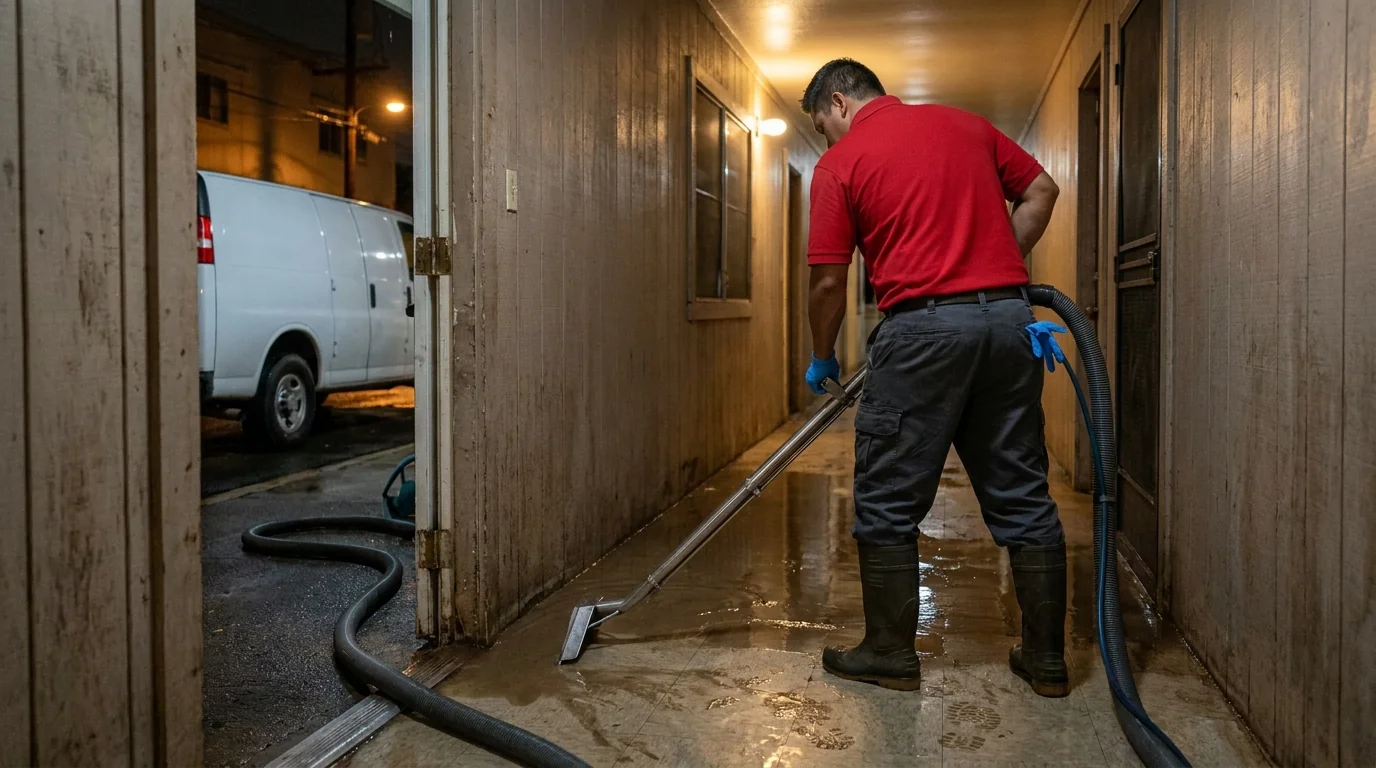
Once the scope is mapped, we extract standing water and deploy commercial-grade drying equipment — high-capacity dehumidifiers and directed airflow systems positioned to pull moisture out of the structure, not just the surface. Drying timelines vary by material and saturation depth, but we monitor readings daily and adjust equipment placement as conditions change. We don’t pull equipment on a fixed schedule; we pull it when the readings confirm the structure is dry.
For condo and townhome losses near Pearlridge, we document conditions with photos and written moisture logs at each visit — the kind of records that HOA property managers and their insurance adjusters typically need before authorizing repairs.
Reaching Aiea from Honolulu
Our team dispatches from Honolulu and reaches Aiea via H-1 West, exiting toward Aiea and Halawa depending on where the loss is located. The 96701 ZIP code covers the full Aiea community, from the commercial corridor near Aloha Stadium down through Halawa and up into the Heights. We answer calls at any hour — flood damage doesn’t wait for business hours, and neither do we.
For losses in the upper reaches of Aiea Heights, access can involve narrow residential streets with limited turnaround space for larger vehicles. We account for that when dispatching, sending the right equipment configuration for the address rather than a one-size fleet.
Local Note: What Aiea’s Soil Does After a Flood Event
One thing that catches homeowners off guard in Aiea Heights specifically: the red laterite soil common on those upper slopes holds moisture long after the rain stops. When that saturated soil sits against a foundation wall or under a slab, it keeps feeding moisture into the structure even after the surface appears dry. We’ve seen cases where interior readings looked acceptable within a few days, but the slab-adjacent framing was still elevated a week later because the soil hadn’t released. If your home sits on a hillside lot in Aiea Heights, we extend our monitoring window and check perimeter readings, not just interior ones — it’s the kind of detail that prevents a callback mold problem three months later.
Flood damage in Aiea moves fast, but the drying process has to be methodical. If you’re in 96701 and you’re looking at standing water or a soaked structure right now, call (808) 349-3407. We’ll walk you through what to do while we’re on the way, and we’ll get equipment running as quickly as the job can safely support it.
Flood Damage Restoration in Aiea: Service Coverage
Frequently Asked Questions
How fast can you arrive for flood damage restoration in Aiea?
How quickly can you reach Aiea Heights or Halawa after a flood call?
My condo near Pearlridge had water come in from the unit above — does the HOA affect how restoration work gets started?
Are older plantation-era homes in Waimalu and Newtown harder to dry out after a flood?
What should I do right now while I wait for your crew to arrive in Aiea?
How long does flood drying typically take in Aiea's climate, and does the humidity affect the timeline?
Will my homeowners insurance cover flood damage restoration in Aiea?
Flood Damage Restoration response in Aiea
Most Aiea calls see a technician on-site within 60 minutes from our Honolulu headquarters.