
Flood Damage Restoration in Kaneohe
24/7 flood damage restoration in Kaneohe, HI. Call (808) 349-3407.
Our technicians are dispatched from our Honolulu, HI headquarters and are typically on-site in Kaneohe within 60 minutes of your call.
Kaneohe sits on the windward face of the Koʻolau Range, where rainfall totals routinely dwarf anything on Oahu’s leeward side — and when a heavy storm rolls through, the valleys between Ahuimanu and Kahaluu don’t drain gently. Water moves fast, it carries red laterite soil from the hillsides, and it finds every gap in a foundation, every aging floor drain, every low-set doorway in the older ranch homes that line the stream corridors. If you’re dealing with standing water or saturated flooring right now, call (808) 349-3407 — we respond around the clock.
Why Kaneohe Properties See Flood Damage Differently
The numbers tell the story: parts of the Koʻolau Range above Kaneohe receive upward of 200 inches of rain annually, and that moisture doesn’t stay on the ridge. It sheets down into subdivisions built in the 1960s and 1970s — homes with original cast-iron or galvanized plumbing, crawl spaces that were never designed for today’s storm intensities, and lots that sit just a few feet above seasonal stream channels. Kahaluu and Ahuimanu are particularly vulnerable: properties along those stream corridors can go from dry to knee-deep in under an hour during a flash-flood advisory. Hillside runoff also carries a heavy sediment load, which means flood water here isn’t just water — it’s a slurry that stains concrete, clogs floor drains, and leaves a fine clay film on every surface it touches.
The chronically high humidity compounds everything. Mold colonization that might take 72 hours in a drier climate can begin in 24 to 48 hours in Kaneohe’s windward air, especially inside wall cavities and under flooring where ventilation is poor. That compressed timeline changes how urgently extraction and structural drying need to begin.
Our Flood Damage Restoration Process in Kaneohe
When we arrive, the first priority is safety — confirming utilities are isolated before anyone steps into standing water. From there, the process moves in a deliberate sequence:
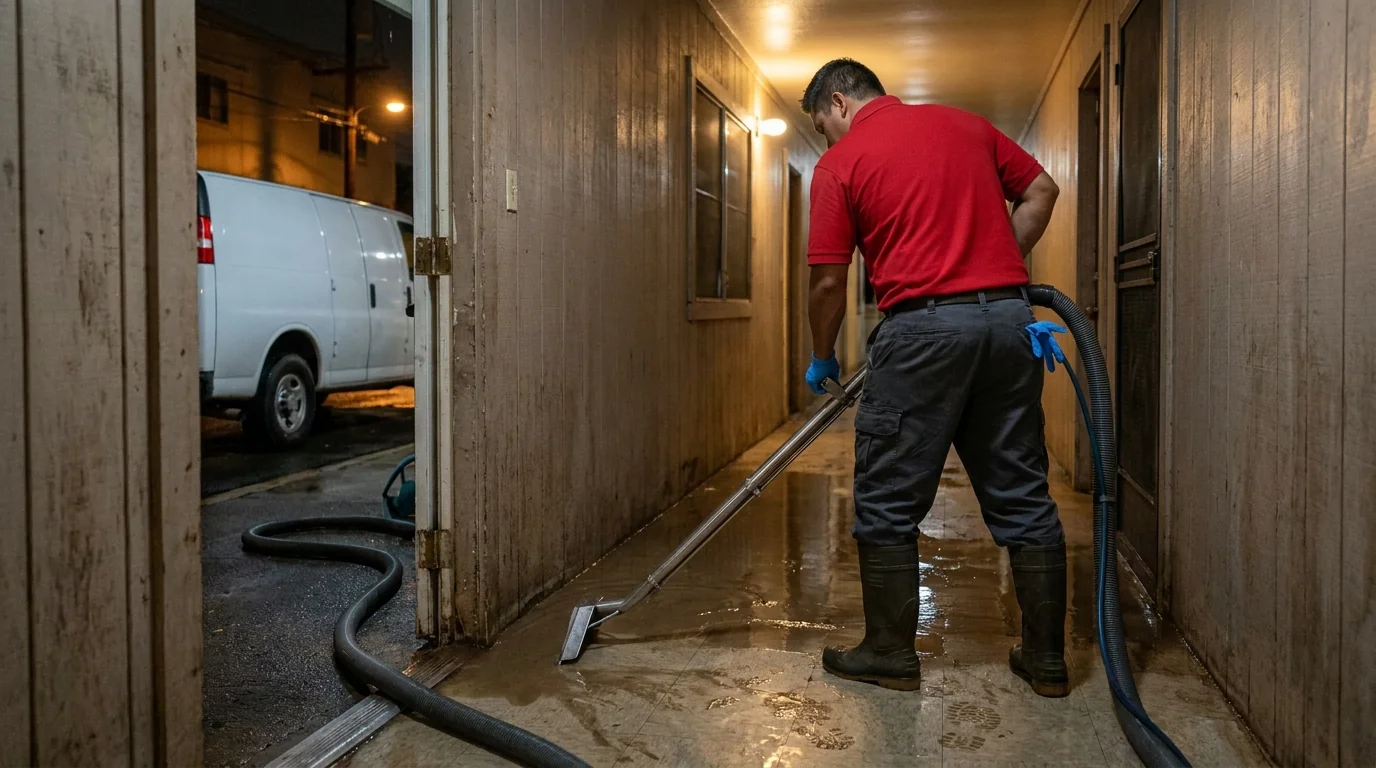
Extraction — Truck-mounted and portable extractors pull bulk water from flooring, subfloor assemblies, and crawl spaces. In homes along the Kaneohe Bay Drive corridor, we frequently encounter concrete slab construction over compacted fill, which holds water differently than a wood-framed subfloor and requires longer extraction passes.
Moisture mapping — Thermal imaging cameras and calibrated moisture meters document exactly how far saturation has migrated into walls, framing, and cabinetry. This documentation matters for your insurance claim records, so photograph the visible damage yourself before we begin as well.
Structural drying — Industrial desiccant and refrigerant dehumidifiers, paired with high-velocity air movers, drive moisture out of structural materials. Drying logs are recorded daily. In Kaneohe’s ambient humidity, dehumidifier capacity has to be sized up — a unit that would dry a comparable room in a drier climate may need to be supplemented here.
Antimicrobial treatment — Given the accelerated mold risk on the windward side, affected surfaces receive EPA-registered antimicrobial application after drying targets are confirmed.
Debris removal and scope documentation — Materials that cannot be dried to standard (saturated insulation, buckled hardwood, compromised drywall) are removed and documented for your records.
Reaching Kaneohe from Honolulu
Our team dispatches from Honolulu and routes through the H-3 or the Pali Highway depending on time of day and traffic conditions — both corridors bring us directly into central Kaneohe. We’re available 24 hours a day, seven days a week, so a call at 2 a.m. during a flash-flood warning gets the same response as a weekday afternoon call. If your address is in the 96744 ZIP code, we know the area and can navigate to you without delay.
For properties near Hoʻomaluhia Botanical Garden or the upper Haiku Village roads, access can narrow significantly after heavy rain — we’ll confirm your address and any access considerations when you call so we’re not troubleshooting logistics when we should be extracting water.
Local Note: What the Clay Soil Means for Your Drying Timeline
Kaneohe’s red laterite soil is dense and nearly impermeable when saturated, which is part of why surface flooding happens so quickly here. But it also means that water driven under a slab or into a crawl space has nowhere to go on its own — it doesn’t percolate away the way it might in sandier soil. In the older subdivisions around Ahuimanu, we routinely find that crawl spaces hold measurable moisture for days after the surface has dried, and that hidden reservoir keeps feeding humidity into the living space above. We always include crawl space inspection in our Kaneohe assessments, not as an add-on, but because skipping it means missing the source.
If your home has a post-and-pier foundation — common in the hillside lots above Marine Corps Base Hawaii — we bring equipment specifically configured for low-clearance access so the crawl space gets the same drying attention as the rooms above it.
Flood damage in Kaneohe moves faster than most homeowners expect, and the window for preventing secondary mold damage is short. Call (808) 349-3407 now — our team is available around the clock and ready to dispatch to your Kaneohe address today.
Flood Damage Restoration in Kaneohe: Service Coverage
Frequently Asked Questions
How fast can you arrive for flood damage restoration in Kaneohe?
Are homes in Kahaluu and Ahuimanu at higher risk for flood damage than other parts of Kaneohe?
How quickly can you reach a flooding home in Kaneohe's 96744 ZIP code?
Why does flood drying seem to take longer in Kaneohe than what I've read online?
The flood water in my Kaneohe home had red sediment in it — does that change the cleanup process?
My home near Haiku Village has a narrow access road — can your equipment still reach it?
Will my homeowners insurance cover flood damage restoration in Kaneohe?
Flood Damage Restoration response in Kaneohe
Most Kaneohe calls see a technician on-site within 60 minutes from our Honolulu headquarters.