
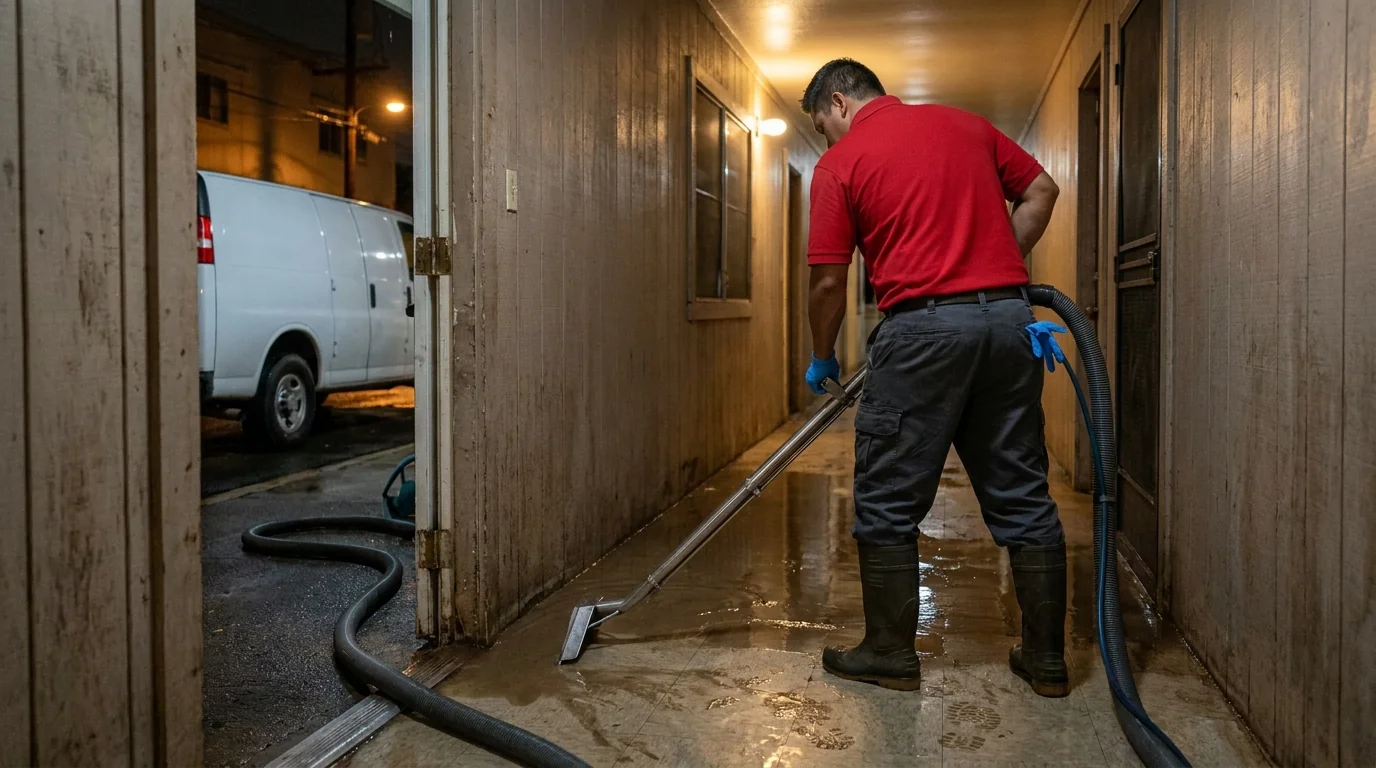
Flood Damage Restoration in Honolulu
24/7 flood damage restoration in Honolulu, HI. Call (808) 349-3407.
Our technicians are headquartered right here in Honolulu and are typically on-site within 60 minutes of your call.
When a flash flood or burst supply line sends water pouring through your home, Honolulu’s tropical humidity turns a bad situation into a race against the clock. Soaked drywall and saturated carpet in a Manoa bungalow or a Kakaako high-rise can begin showing visible mold growth within 24 to 48 hours — faster than almost anywhere on the mainland — because the air here never really dries out on its own. AAA Water Damage Restoration & Carpet Care answers the phone around the clock and dispatches extraction equipment the same day you call, because in Honolulu, hours genuinely matter.
Why Honolulu Properties Are Especially Vulnerable to Flood Damage
Honolulu’s building stock creates a perfect storm of flood risk factors that mainland restoration crews rarely encounter. In older walk-up buildings across Makiki and Moiliili, galvanized supply lines corrode from the inside out — and the salt-laden trade winds that make Honolulu beautiful accelerate corrosion on angle stops, valve stems, and appliance connections far faster than inland climates. When one of those fittings finally fails, single-wall construction wicks water horizontally through wall cavities before it ever pools on the floor, making the visible damage a fraction of the actual soaked area.
Up in the high-rise towers concentrated along the Kakaako waterfront and in Waikiki, a single failed water heater or supply line on an upper floor can cascade through multiple units in minutes. That’s not just a restoration problem — it’s an HOA and AOAO coordination problem, and it requires documentation that satisfies multiple parties simultaneously.
Heavy rainfall events compound all of this. Honolulu’s Ko’olau-facing neighborhoods funnel runoff quickly, and older drainage infrastructure in areas like Nuuanu can back up and push water into ground-floor units and parking structures before residents realize what’s happening.
Our Flood Damage Restoration Process in Honolulu
Every flood job starts with a thorough moisture assessment — not just the wet floor you can see, but the wall cavities, subfloor, and ceiling assemblies that absorbed water silently. In single-wall construction common to older Honolulu neighborhoods, that assessment extends further than it would in a standard mainland home, because there’s no insulation layer to slow lateral wicking.
Once we understand the full scope, we move to extraction. Standing water comes out first with truck-mounted or portable extraction units, depending on access — high-rise elevators and narrow walk-up stairwells in ZIP codes like 96822 and 96826 sometimes dictate which equipment we bring in. After extraction, we set a calibrated drying system: industrial air movers positioned to create directed airflow through wall cavities, paired with commercial dehumidifiers sized for Honolulu’s ambient humidity levels rather than the drier baselines used on the mainland.
We monitor moisture readings daily and adjust equipment placement until structural materials reach target dryness. Nothing gets closed up until the numbers confirm it — because in this climate, trapping residual moisture behind a repaired wall is how a flood job becomes a mold job three weeks later.
Condo, HOA, and AOAO Considerations in Honolulu
If your flood damage happened in a Waikiki or Ala Moana high-rise, you’re likely navigating a layer of complexity that single-family homeowners don’t face. Most Honolulu AOAOs have specific requirements about who performs work in common areas, what documentation must be submitted before repairs begin, and how affected neighboring units get notified. We’ve worked in Honolulu’s condo environment long enough to know that showing up without the right paperwork can stall a job by days.
We recommend photographing all visible damage thoroughly before any cleanup begins — those images are the foundation of your insurance claim and any AOAO dispute resolution. Your insurer and the building’s master policy may both be involved, and clear documentation of the source, spread, and affected units protects you in both conversations. We can provide written moisture logs and drying records that meet the documentation standards most Honolulu property managers and adjusters expect.
Local Note: What Honolulu Crews Know That Others Don’t
In Waikiki’s vacation-rental towers, flood response often has a hard deadline: the next guest check-in. We regularly perform overnight dry-outs in short-term rental units — extraction and equipment set in the evening, a return visit in the morning to assess progress and adjust — because a unit that’s out of service for a week costs real money in a market where nightly rates run high. That kind of schedule-driven restoration requires equipment that can move fast and a crew that’s comfortable working around building management’s access windows. It’s a rhythm specific to Honolulu’s rental economy, and it shapes how we plan every condo flood job from the first call.
If your property is affected by flooding — whether it’s a ground-floor unit near Honolulu Harbor, a hillside home in Nuuanu, or a mid-rise in Ala Moana — call (808) 349-3407 now. The faster water comes out, the less of your home has to come apart to dry it.
Flood Damage Restoration in Honolulu: Service Coverage
Frequently Asked Questions
How fast can you arrive for flood damage restoration in Honolulu?
How quickly can you reach a flooded unit in Waikiki or Kakaako?
Does Honolulu's humidity change how long flood drying actually takes?
My Makiki walk-up has old galvanized pipes — does that affect the flood restoration process?
What documentation should I gather for my AOAO or insurance claim after a flood in a Honolulu condo?
Are homes in Nuuanu and Manoa at higher flood risk than other Honolulu neighborhoods?
Flood Damage Restoration response in Honolulu
Most Honolulu calls see a technician on-site within 60 minutes from our Honolulu headquarters.