
Mold Remediation in Honolulu
24/7 mold remediation in Honolulu, HI. Call (808) 349-3407.
Our technicians are headquartered right here in Honolulu and are typically on-site within 60 minutes of your call.
Honolulu’s year-round humidity rarely dips low enough to slow mold down. When a water heater fails on the 14th floor of a Kakaako high-rise, or a slow leak hides behind the single-wall construction common in Makiki and Moiliili, visible mold colonies can establish themselves on drywall and carpet backing within 24 to 48 hours — faster than most mainland markets where drier winters buy extra time. If you’re seeing discoloration, catching a musty odor that wasn’t there last week, or dealing with the aftermath of a recent water event, the window to act is short.
Why Honolulu Properties See Mold Issues
The trade winds that make Oahu so livable also carry salt-laden moisture inland, accelerating corrosion on angle stops, supply line fittings, and appliance connections throughout the city. In older walk-up buildings in Moiliili and Makiki — many built with single-wall construction that uses no vapor barrier — water that penetrates an exterior wall or a failed pipe fitting wicks directly into framing and interior finishes. There’s no insulation cavity to slow it down.
In the high-rise towers concentrated along the Kakaako waterfront and in Waikiki, a single failed supply line on an upper floor can send water cascading through multiple units before anyone notices. By the time the water is shut off and the source is found, porous materials on several floors may already be saturated. In those buildings, mold isn’t a future risk — it’s a present one, often beginning to colonize within the first day.
Vacation-rental units in Waikiki add a layer of urgency: a unit that sits unoccupied between guest stays, especially if a slow leak went unreported, can develop significant mold growth that only becomes apparent at turnover — sometimes hours before the next check-in.
Our Mold Remediation Process in Honolulu
Every job starts with a thorough assessment of the affected area — tracing moisture not just where it’s visible but where it’s traveled through walls, under flooring, and into adjacent spaces. In concrete high-rises, water often migrates horizontally through floor assemblies in ways that aren’t obvious from the surface. In wood-framed walk-ups, it follows framing members vertically.
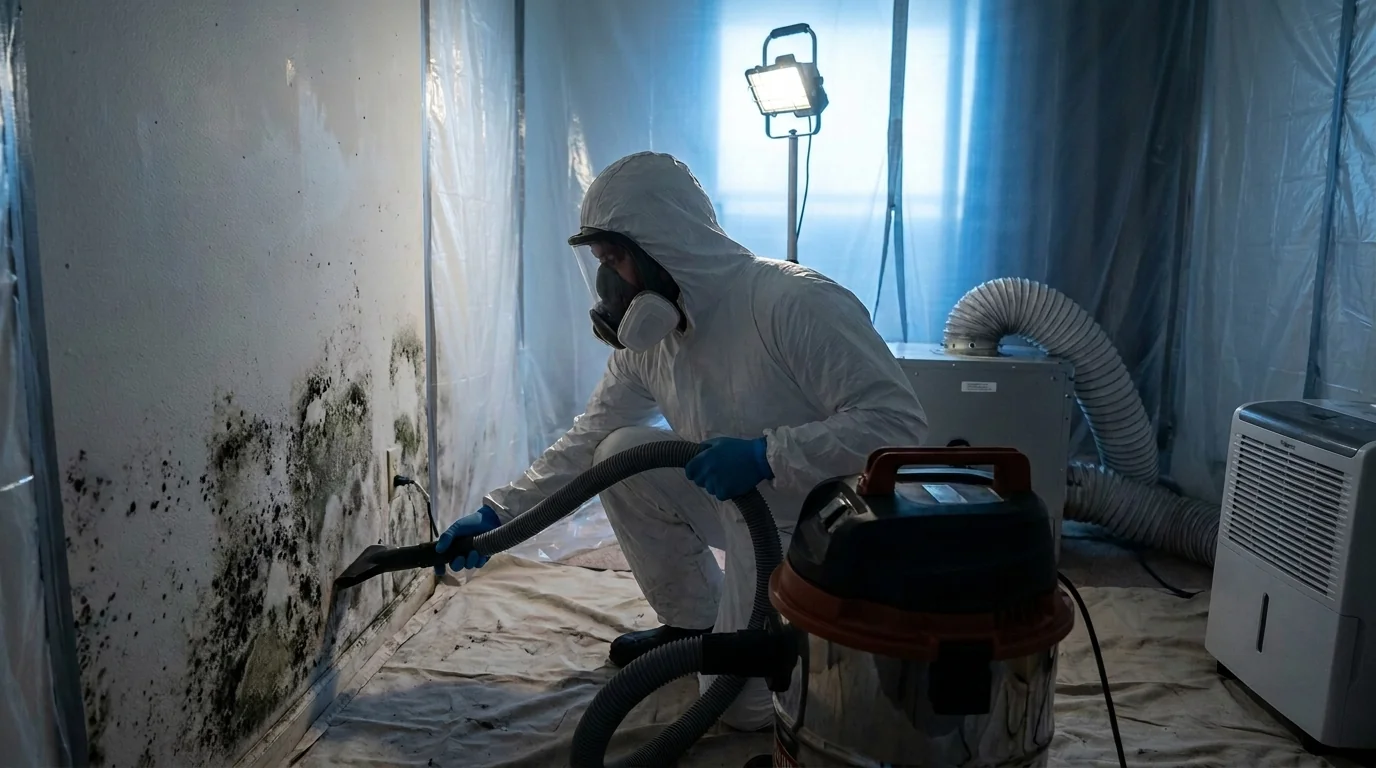
Once the scope is clear, the affected area is isolated with physical containment barriers and negative air pressure to prevent spores from spreading to clean areas of the unit or building. Contaminated porous materials — drywall sections, carpet, insulation — are removed, bagged, and disposed of according to applicable guidelines. Structural surfaces are then treated and dried to documented moisture levels before any reconstruction begins.
Because Honolulu’s ambient humidity stays elevated year-round, simply removing visible mold without achieving proper dry-out creates conditions for rapid recurrence. Commercial-grade dehumidifiers and air movers are sized to the actual cubic footage and ambient conditions of each space, not a one-size estimate.
HOA and AOAO Coordination in Honolulu’s High-Rises
If you live in one of the condominium towers in Ala Moana, Kakaako, or Waikiki, your remediation project almost certainly involves parties beyond just you and your contractor. Hawaii’s AOAO (Association of Apartment Owners) structure means the building’s master policy may cover common elements and certain unit components, while your individual policy covers others — and the line between them isn’t always obvious.
Documentation matters enormously in these situations. Detailed moisture mapping, photographs of affected areas before work begins, and written records of materials removed all support the insurance coordination process on your end. Photograph the damage thoroughly and contact your insurer early to understand what your policy covers — the more documentation you have from the start, the smoother that conversation tends to go.
For multi-unit water intrusion events, we coordinate access and scheduling across affected units to contain the remediation efficiently and minimize disruption to other residents.
Local Note
Something that comes up repeatedly in Honolulu’s older ZIP codes — particularly in the 96822 corridor near the University of Hawaii at Manoa — is that single-wall construction buildings often have no clear separation between interior and exterior wall cavities. When mold is found on an interior surface, it’s worth checking whether the source is an exterior moisture intrusion rather than a plumbing leak. Trade wind-driven rain, especially during Kona wind events when storms approach from the south, can push water through aged window frames and wall penetrations in ways that mimic a plumbing leak. Misidentifying the source leads to incomplete remediation and rapid recurrence.
If you’re in Manoa or the surrounding neighborhoods and mold keeps coming back after prior treatment, the moisture source — not just the mold itself — is worth a closer look.
Call (808) 349-3407 any time — the team is available around the clock — to schedule a mold assessment for your Honolulu property. Whether you’re managing a single-family home in Nuuanu, a condo unit near Ala Moana Center, or a vacation rental in Waikiki, getting the moisture source identified and the affected area properly remediated is the step that prevents this from becoming a recurring problem.
Mold Remediation in Honolulu: Service Coverage
Frequently Asked Questions
How fast can you arrive for mold remediation in Honolulu?
How quickly can you respond to a mold emergency in Waikiki or Kakaako?
Does Honolulu's humidity affect how long mold remediation takes compared to the mainland?
My condo building in Ala Moana had a pipe burst on an upper floor and water came into my unit. Am I responsible for mold remediation, or is the AOAO?
Are older homes in Makiki and Moiliili more prone to recurring mold problems?
What does the mold containment process actually involve, and how disruptive is it to a unit in ZIP code 96814 or 96815?
Will my homeowners insurance cover mold remediation in Honolulu?
Mold Remediation response in Honolulu
Most Honolulu calls see a technician on-site within 60 minutes from our Honolulu headquarters.