Water Damage Restoration in Honolulu
24/7 water damage restoration in Honolulu, HI. Call (808) 349-3407.
Our technicians are headquartered right here in Honolulu and are typically on-site within 60 minutes of your call.
When a supply line fails on the 18th floor of a Kakaako high-rise, the water doesn’t stop at the unit where it started — it follows concrete seams, elevator shafts, and shared walls until multiple floors are soaked and the building’s AOAO is on the phone with adjusters. That’s the reality of water damage in urban Honolulu, where dense condominium towers, year-round tropical humidity, and salt-corroded plumbing create a combination that turns a slow leak into a structural emergency faster than almost anywhere else in the country. AAA Water Damage Restoration & Carpet Care answers calls around the clock and dispatches extraction equipment the same day — because in this climate, hours matter.
Why Honolulu Properties Are Especially Vulnerable to Water Damage
Honolulu’s building stock tells two very different stories. In Waikiki, Kakaako, and Ala Moana, the dominant structure is the high-rise condominium — towers where a single failed water heater or angle stop on an upper floor sends water cascading through multiple units below. The concrete and tile construction common in these buildings channels water efficiently and invisibly, pooling inside wall cavities and under flooring long before a resident notices staining on the ceiling.
In older neighborhoods like Makiki and Moiliili, the picture shifts. Walk-up apartments and single-family homes built decades ago often rely on galvanized steel supply lines that have been corroding quietly for years. Single-wall construction — a building method common in older Honolulu residential stock — offers almost no barrier between a wet exterior and interior framing. When those walls get wet, they wick moisture from top plate to sill plate with very little resistance.
Layered on top of both scenarios is Honolulu’s climate. Trade winds carry salt air inland from the coast, accelerating corrosion on valves, hose bibs, and appliance connections. And because average relative humidity rarely drops below 60% even on dry days, wet materials don’t self-dry the way they might in a drier mainland city. Soaked drywall and carpet can show visible mold colonization within 24 to 48 hours year-round — a timeline that makes fast extraction not just helpful but necessary.
Our Water Damage Restoration Process in Honolulu
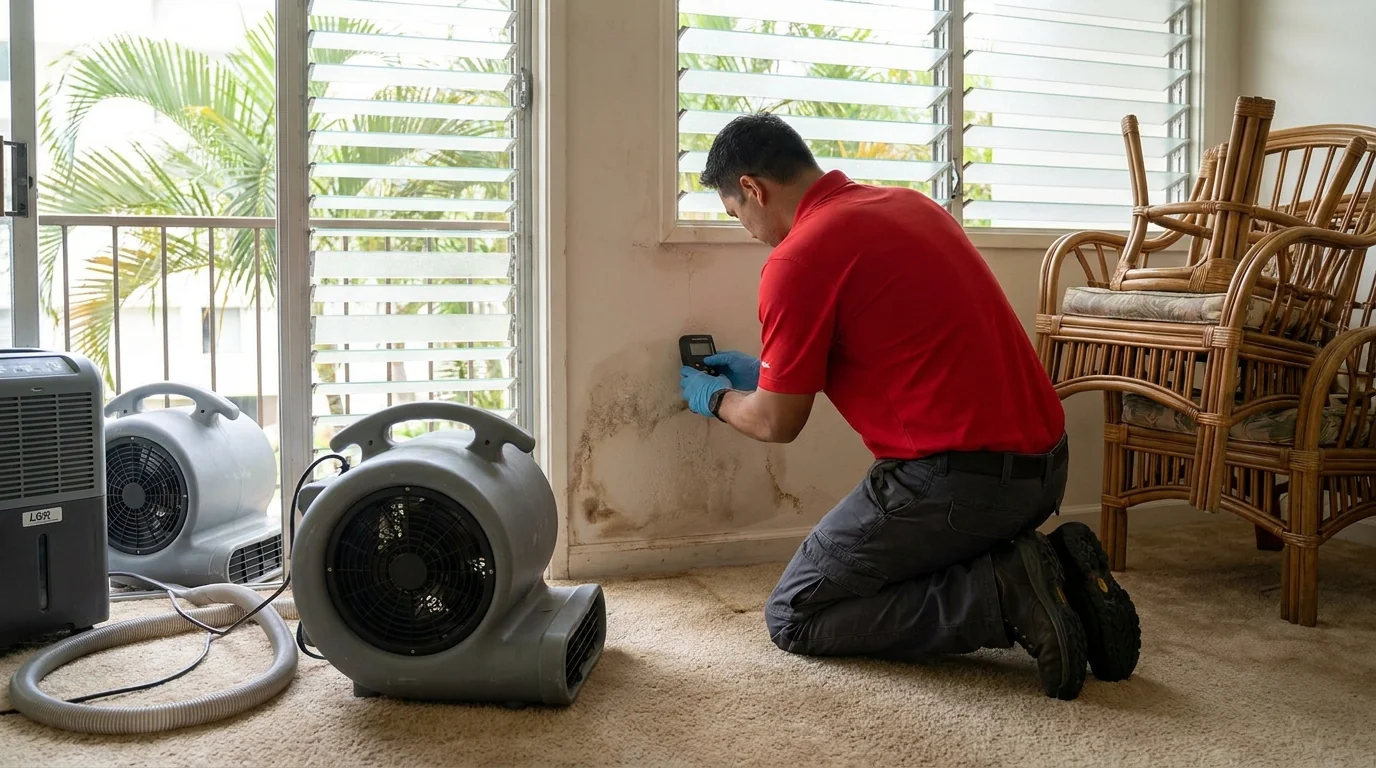
Every job starts with a thorough moisture assessment. Technicians use thermal imaging cameras and calibrated moisture meters to map how far water has traveled — including inside wall cavities, under tile, and beneath raised flooring. In Honolulu’s high-rise units, this step often reveals water migration that has crossed unit boundaries, which matters both for the scope of work and for documentation.
Once the extent of damage is mapped, standing water is removed with truck-mounted and portable extraction equipment. Portable units are essential in high-rise work — elevator access and building loading-dock rules in towers near the Kakaako waterfront and Ala Moana Center often make truck-mount setups impractical above the ground floor.
After extraction, the drying phase begins. Industrial air movers and commercial-grade dehumidifiers are positioned based on the moisture map, not guesswork. In Honolulu’s ambient humidity, dehumidifier capacity matters significantly — undersized equipment simply recirculates humid air without pulling meaningful moisture from the structure. Drying progress is logged daily with moisture readings so there’s a clear record of when materials reach acceptable levels.
Demolition of unsalvageable material — saturated drywall, swollen baseboards, compromised subfloor — is performed when drying alone won’t bring materials back to safe moisture content. The goal is always to preserve as much structure as possible while eliminating conditions that support mold growth.
Condo, HOA, and AOAO Coordination in Honolulu
Water damage in a Honolulu condominium rarely involves just one unit owner. When water migrates from one floor to another, the building’s AOAO (Association of Apartment Owners) typically has a role in authorizing access to common areas and adjacent units, and their master insurance policy may cover portions of the damage depending on the building’s declaration documents.
Documentation is critical in these situations. Detailed moisture maps, timestamped photographs, and written drying logs give unit owners and AOAO boards the records they need when coordinating with adjusters. Photographing damage thoroughly before any work begins is one of the most useful things an owner can do for their own insurance claim — and something technicians can assist with during the initial assessment.
For Waikiki vacation-rental units operating on tight guest-turnover schedules, the priority is often an overnight or same-day dry-out. While full structural drying always takes the time the materials require, rapid extraction and aggressive equipment placement can dramatically reduce the visible impact and allow a unit to return to service sooner.
Local Note: Salt Air and Angle Stops
One pattern that comes up repeatedly in Honolulu water damage calls — particularly in buildings within a mile or two of the coast — is the failure of angle stops and supply line braided connectors that look fine on the outside but have been weakening from salt-air corrosion for years. A valve that would last 20 years in a dry inland climate may fail in 8 to 10 years in a building exposed to Honolulu’s coastal trade winds. Homeowners and property managers in ZIP codes like 96815 and 96814 who haven’t had supply lines and shut-off valves inspected recently are carrying more risk than they may realize. It’s worth asking a licensed plumber to check angle stops under sinks and behind toilets — especially in units above the ground floor where a failure affects neighbors below.
If water damage has already happened, call (808) 349-3407. The crew is available around the clock, and getting extraction equipment running the same day is the single most effective way to limit the damage Honolulu’s humidity can do once a structure is wet.
Water Damage Restoration in Honolulu: Service Coverage
Frequently Asked Questions
How fast can you arrive for water damage restoration in Honolulu?
How quickly can you reach a water damage emergency in Waikiki or Kakaako?
Why does mold seem to appear so quickly after water damage in Honolulu compared to the mainland?
My condo in the 96814 ZIP code had a water heater leak that affected the unit below mine. How does that complicate the restoration process?
What does the structural drying process actually look like inside a Honolulu high-rise unit?
Are older homes in Makiki and Moiliili harder to dry out after water damage?
Will my homeowners insurance cover water damage restoration in Honolulu?
Water Damage Restoration response in Honolulu
Most Honolulu calls see a technician on-site within 60 minutes from our Honolulu headquarters.