
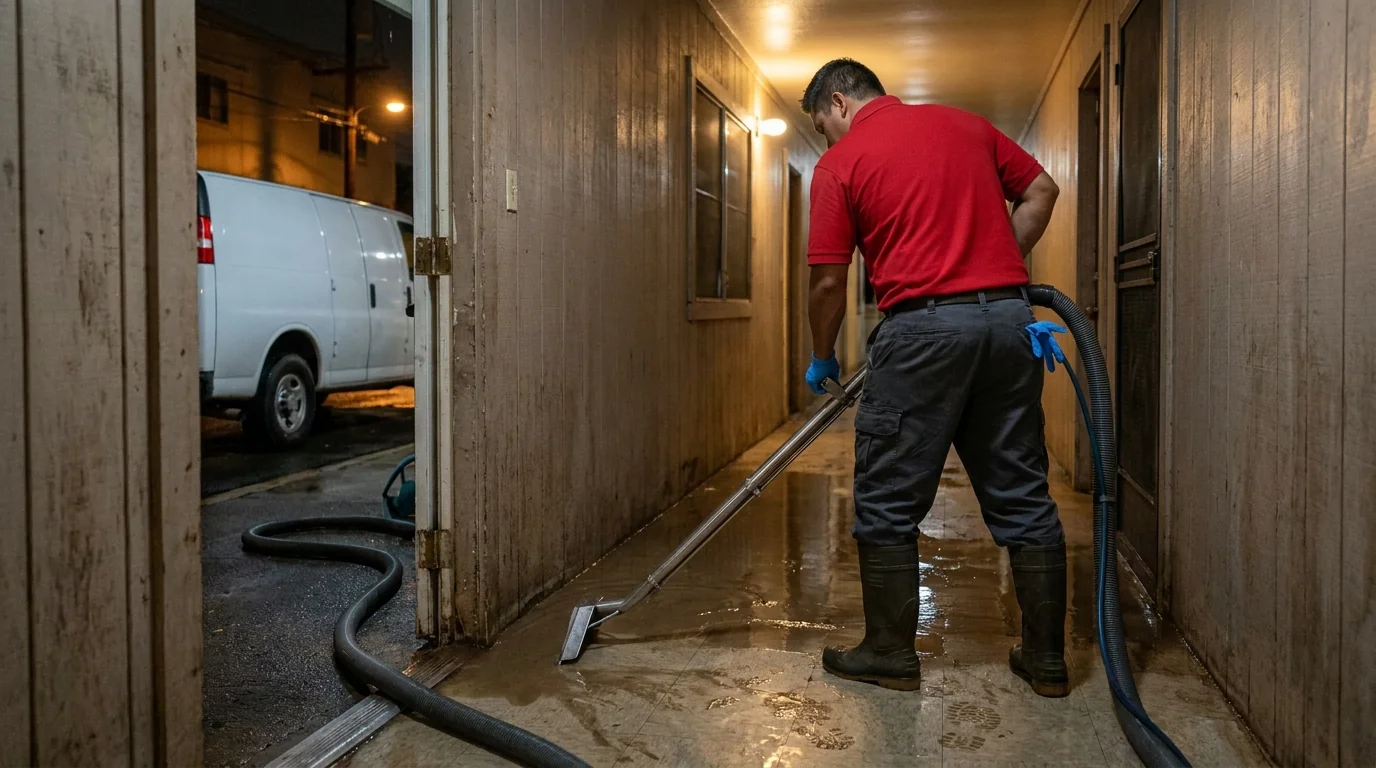
Flood Damage Restoration in Kapolei
24/7 flood damage restoration in Kapolei, HI. Call (808) 349-3407.
Our technicians are dispatched from our Honolulu, HI headquarters and are typically on-site in Kapolei within 60 minutes of your call.
When a Kona low stalls over the Waianae Range, Makakilo’s hillside grades can funnel runoff into garages and ground-floor entries faster than most homeowners expect — and in Kapolei’s newer slab-on-grade subdivisions, that water has nowhere to go but under flooring and into wall cavities. If you’re dealing with standing water in a home in Kapolei Villages, Mehana, or anywhere else in the 96707 ZIP code, the clock starts the moment the flooding stops. Mold colonization can begin within 24 to 48 hours on wet drywall, and Oahu’s leeward humidity keeps materials damp long after the visible water is gone.
Why Kapolei Properties See Flood Damage Differently
Kapolei is Oahu’s fastest-growing city, and its housing stock reflects that — most of the residential builds here are two-story townhomes and single-family plans built on concrete slabs within the last two decades. That construction style creates a specific flood damage pattern: laundry rooms and bathrooms are often placed on the second floor, so a supply-line failure or washing machine overflow doesn’t just damage one room. It saturates the subfloor, soaks the ceiling below, and can track along interior wall framing before anyone notices a drip. By the time a homeowner spots water staining on a first-floor ceiling, the cavity above may already hold several gallons.
Along the Ko Olina corridor, vacation villas and timeshare units face a different pressure entirely. A flooded unit between guest stays needs same-day water extraction and overnight carpet drying — a two-day turnaround that would be acceptable elsewhere isn’t workable when the next reservation checks in at 3 p.m. the following afternoon. Kapolei’s leeward sun is an asset here: outdoor humidity is lower than windward Oahu, which supports faster structural drying when equipment is set up correctly.
Summer months add another layer. Extended AC runtime in the heat pushes condensate drain lines hard, and clogged or cracked drain pans are a common source of slow, hidden leaks inside walls and under air handlers — damage that often goes unnoticed until flooring starts to buckle.
Our Flood Damage Restoration Process in Kapolei
Every flood job starts with moisture mapping — not a visual inspection, but thermal imaging and calibrated moisture meters used across walls, floors, and ceilings to find water that isn’t visible. In Kapolei’s slab-on-grade homes, we pay particular attention to the interface between the concrete slab and the bottom plate of interior walls, where water wicks upward and stays trapped.
Once the scope is clear, we extract standing water, then set a drying system calibrated to the structure — typically a combination of commercial-grade low-grain refrigerant dehumidifiers and high-velocity air movers positioned to create directed airflow through wall cavities and under flooring. We monitor moisture readings daily and adjust equipment placement until the structure reaches its dry standard. Flooring decisions — whether to lift and dry in place or remove — are made based on those readings, not a blanket policy.
For carpet, particularly in Ko Olina Resort & Marina villas and vacation units near Ka Makana Alii, we use truck-mounted extraction followed by in-place drying when the pad and subfloor readings support it. When they don’t, we pull and replace rather than risk a mold problem under a surface that looks dry.
Reaching Kapolei from Honolulu
Our team dispatches from Honolulu and routes to Kapolei via H-1 West. We answer calls around the clock, and for flood emergencies we prioritize same-day dispatch — getting extraction equipment running the same day you call is the single biggest factor in limiting secondary damage. If you’re in Makakilo or farther up the hillside, let us know when you call so we can confirm the best access route, especially after heavy rain when lower roads near Kalaeloa can see temporary ponding.
Local Note
Kapolei’s newer HOA communities — particularly the townhome complexes in Kapolei Villages and Mehana — often have shared wall assemblies and common-area utility chases. When a flood originates in one unit and migrates into an adjacent unit through a shared wall, the HOA’s master policy and the individual unit owner’s policy may both be involved. Before any demolition of shared assemblies, it’s worth confirming with your HOA board which party authorizes that work. We’ve seen jobs stall because a wall that needed to come down sat on a property line neither party had documented clearly. Photograph the damage thoroughly before any cleanup begins, and contact your insurer early so they can advise you on documentation requirements for your specific policy.
If your home or unit in Kapolei is showing signs of flood damage — soaked flooring, water-stained ceilings, or the faint smell of standing water under carpet — call (808) 349-3407 any time, day or night. The sooner extraction equipment is running, the narrower the window for mold to take hold in Oahu’s warm, humid conditions.
Flood Damage Restoration in Kapolei: Service Coverage
Frequently Asked Questions
How fast can you arrive for flood damage restoration in Kapolei?
How quickly can you get extraction equipment running at a Kapolei address?
Are two-story townhomes in Kapolei Villages at higher risk for ceiling damage during a flood?
Does Makakilo's hillside location change how flood damage restoration works compared to flatter parts of Kapolei?
How long does flood damage restoration typically take for a vacation villa near Ko Olina Resort?
What does flood damage restoration typically cost for a home in the 96707 ZIP code?
Will my homeowners insurance cover flood damage restoration in Kapolei?
Flood Damage Restoration response in Kapolei
Most Kapolei calls see a technician on-site within 60 minutes from our Honolulu headquarters.