
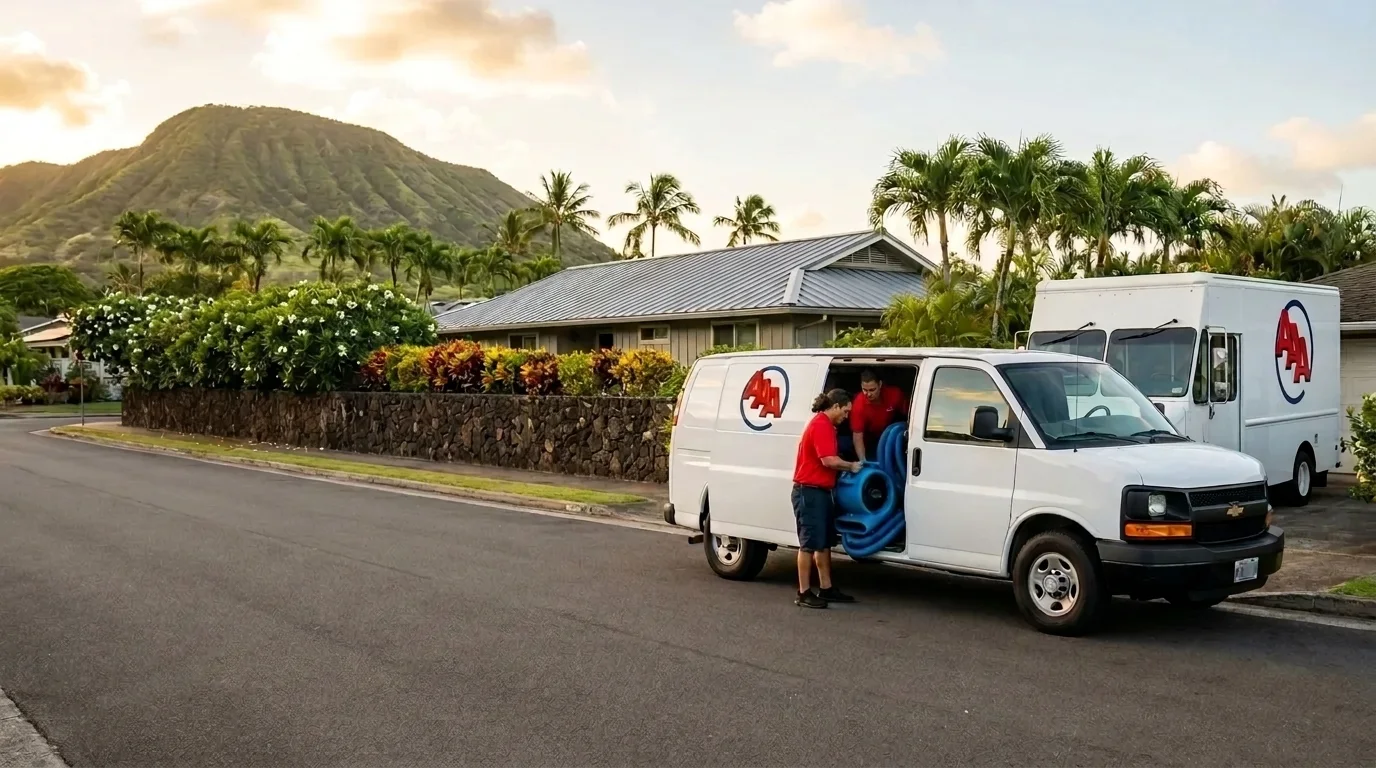
If water has entered your home — whether from a burst pipe, an appliance failure, or a roof leak during a heavy Honolulu rain — the decisions you make in the next 24 hours will determine how much damage you’re left dealing with a week from now. Stop the source first, then move fast: mold can begin colonizing wet building materials in as little as 24 to 48 hours, and saturated drywall, insulation, and subfloor absorb water faster than most people expect. Here is a clear, step-by-step guide to what you should do right now.
Step 1 — Stop the Water and Make the Space Safe
Before you touch anything, locate the source and shut it off.
- Burst or leaking pipe: Turn off the main water shutoff valve. In most Honolulu homes it’s near the street at the meter box, or along the exterior wall closest to the street. Once the main is off, open a faucet on the lowest floor to drain pressure from the lines.
- Appliance failure (washing machine, dishwasher, water heater): Pull the supply hose connection at the back of the unit or turn the dedicated shutoff valve, usually located directly behind or beneath the appliance.
- Roof or window leak during a storm: You can’t stop rain, but you can move furniture and belongings away from the wet zone and place buckets or plastic sheeting to limit spread.
- Sewage backup: Do not enter the space without rubber boots and gloves. Sewage water is a Category 3 contamination hazard — it contains bacteria and pathogens that can make you sick. Ventilate the room and call a professional before doing anything else.
Next, check whether it’s safe to stay in the space. If water is near your electrical panel, outlets, or any plugged-in appliances, turn off the circuit breaker for that area before entering. Standing water and live electricity are a lethal combination.
Step 2 — Document Everything Before You Move It
Once the space is safe, resist the urge to immediately start throwing things out or ripping up carpet. Spend 10 to 15 minutes photographing and video-recording the damage first. Walk every affected room. Capture:
- Wide shots showing the full extent of water spread across floors and walls.
- Close-ups of water stains, bubbling paint, warped baseboards, and soaked materials.
- The source of the water (the broken pipe fitting, the appliance, the ceiling stain).
- Any personal property that has been damaged — furniture, electronics, rugs, clothing.
This documentation matters for your insurance claim. Contact your insurer as soon as possible to report the loss and ask what they need from you. Keep all receipts for any emergency supplies or services you purchase.
Step 3 — Remove Standing Water and Begin Drying Immediately
Every minute water sits on your floors, it is wicking into the subfloor, traveling under baseboards, and soaking into wall cavities. Here’s what you can do with what you have on hand:
- Mop and bail any standing water you can reach safely.
- Use a wet/dry shop vacuum to extract water from carpet and hard flooring. Make multiple passes — carpet holds far more water than it looks like it does.
- Pull up saturated area rugs and move them outside or to a dry area. Wall-to-wall carpet is harder to save without professional extraction equipment, but getting air moving under it helps.
- Open windows and interior doors to increase airflow, unless outdoor humidity is extremely high (which it often is in Honolulu — in that case, keep windows closed and run your air conditioning, which dehumidifies as it cools).
- Run fans pointed at wet surfaces. Box fans, ceiling fans, and portable fans all help, but they work best once standing water is already removed.
- Remove soaked items from the wet zone: cardboard boxes, books, clothing, cushions. These hold moisture and slow the drying of the space around them.
What you likely cannot do on your own: dry out the wall cavities, the subfloor beneath tile or hardwood, or the insulation inside exterior walls. Water travels into these spaces through capillary action, and without moisture meters and commercial drying equipment, you won’t know how far it has gone.
What NOT to Do in the First 24 Hours
Some common instincts make water damage significantly worse:
- Don’t use a regular household vacuum to suck up water. It isn’t designed for it and can damage the motor or create an electrical hazard.
- Don’t run a dehumidifier before standing water is removed. Dehumidifiers work on airborne moisture — they won’t pull water out of carpet or flooring and will run continuously without making a meaningful dent.
- Don’t turn up the heat thinking it will dry things faster. High heat in a humid, wet space encourages mold growth. Moderate airflow and air conditioning are more effective.
- Don’t rip out materials impulsively. Removing drywall, flooring, or cabinets before a professional assesses the damage can complicate your insurance claim and may not be necessary if drying is done correctly.
- Don’t assume it’s dry because the surface feels dry. Hardwood floors can look fine on top while the subfloor beneath is saturated. Drywall can feel dry to the touch while the insulation behind it holds moisture for weeks.
When to Call a Water Damage Professional
Some water events are genuinely manageable with DIY effort — a small appliance leak caught within an hour that affected a few square feet of vinyl flooring, for example. Most are not. Call a professional restoration company when:
- The affected area is larger than roughly 10 square feet, or you aren’t sure how far the water traveled.
- The water came from a toilet, sewage line, or any source that may be contaminated.
- The water has been sitting for more than a few hours.
- You see or smell anything that suggests mold — a musty, earthy odor, dark spotting on walls or ceilings, or a persistent smell that doesn’t go away after drying.
- Water has reached wall cavities, insulation, or the subfloor.
- The structure itself is affected — doors that won’t close, floors that feel soft or spongy, ceilings that are sagging.
Professional restoration teams use thermal imaging cameras and calibrated moisture meters to find water that isn’t visible to the eye, then place commercial-grade air movers and desiccant or refrigerant dehumidifiers to dry the structure from the inside out. The goal isn’t just dry surfaces — it’s getting the moisture content of wood and drywall back to acceptable levels before mold has a chance to establish.
The Days After — What Recovery Actually Looks Like
If drying is handled correctly in the first 24 to 48 hours, a typical water damage event takes three to five days of active drying before materials reach their target moisture levels. During that window, expect loud equipment running continuously — this is normal and necessary. A restoration technician should be checking moisture readings daily and adjusting equipment placement.
Once the structure is dry, you’ll move into the repair phase: replacing drywall, reinstalling flooring, repainting, and addressing any structural repairs. The scope depends entirely on how quickly the drying started and how far the water traveled.
If you’re in Honolulu and you’re not sure whether your situation needs professional help, a phone call costs nothing. AAA Water Damage Restoration & Carpet Care can be reached at (808) 349-3407 — describe what you’re seeing and get a straight answer about your next step.