Water Damage Restoration in Hawaii Kai
24/7 water damage restoration in Hawaii Kai, HI. Call (808) 349-3407.
Our technicians are dispatched from our Honolulu, HI headquarters and are typically on-site in Hawaii Kai within 60 minutes of your call.
Salt air off Maunalua Bay doesn’t just corrode boat hardware — it quietly eats through the galvanized supply lines and water heater connections tucked inside Hawaii Kai’s Kaiser-era homes, often until the day a fitting lets go and water is spreading across a slab floor with nowhere to drain. When that happens in a Koko Marina townhome or a Portlock single-family, the clock starts immediately: in Hawaii’s humid trade-wind climate, mold can begin colonizing wet framing within 24 to 48 hours. AAA Water Damage Restoration & Carpet Care answers the phone around the clock and dispatches from East Honolulu — close enough to matter when every hour counts.
Why Hawaii Kai Properties See Water Damage Differently
Homes built during the Kaiser development boom of the 1960s and ’70s carry plumbing that was never designed to last this long in a marine environment. Galvanized steel supply lines corrode from the inside out; copper fittings develop pinhole leaks behind tile walls for months before anyone notices the stain. Slab-on-grade construction — common throughout West Marina and Mariners Cove — means there’s no crawl space to catch a slow drip. Water migrates laterally under the slab and surfaces feet away from the actual break, making the source harder to locate without moisture mapping equipment.
The HOA dimension adds another layer. Many of Hawaii Kai’s marina-front townhome complexes share wall assemblies, and a leak in one unit routinely wets the framing in the units on either side. HOA bylaws often dictate which party is responsible for what portion of the repair, and documentation — moisture readings, scope of work, photo logs — becomes essential for sorting out those claims.
Kona Low storm events bring a different problem entirely. Low-lying lots near the Hawaii Kai Marina can take on storm runoff faster than the city’s drainage infrastructure handles it, pushing water under doors and into garages. That’s not a plumbing failure; it’s a flood-category event, and the extraction and drying approach is calibrated accordingly.
Our Water Damage Restoration Process in Hawaii Kai
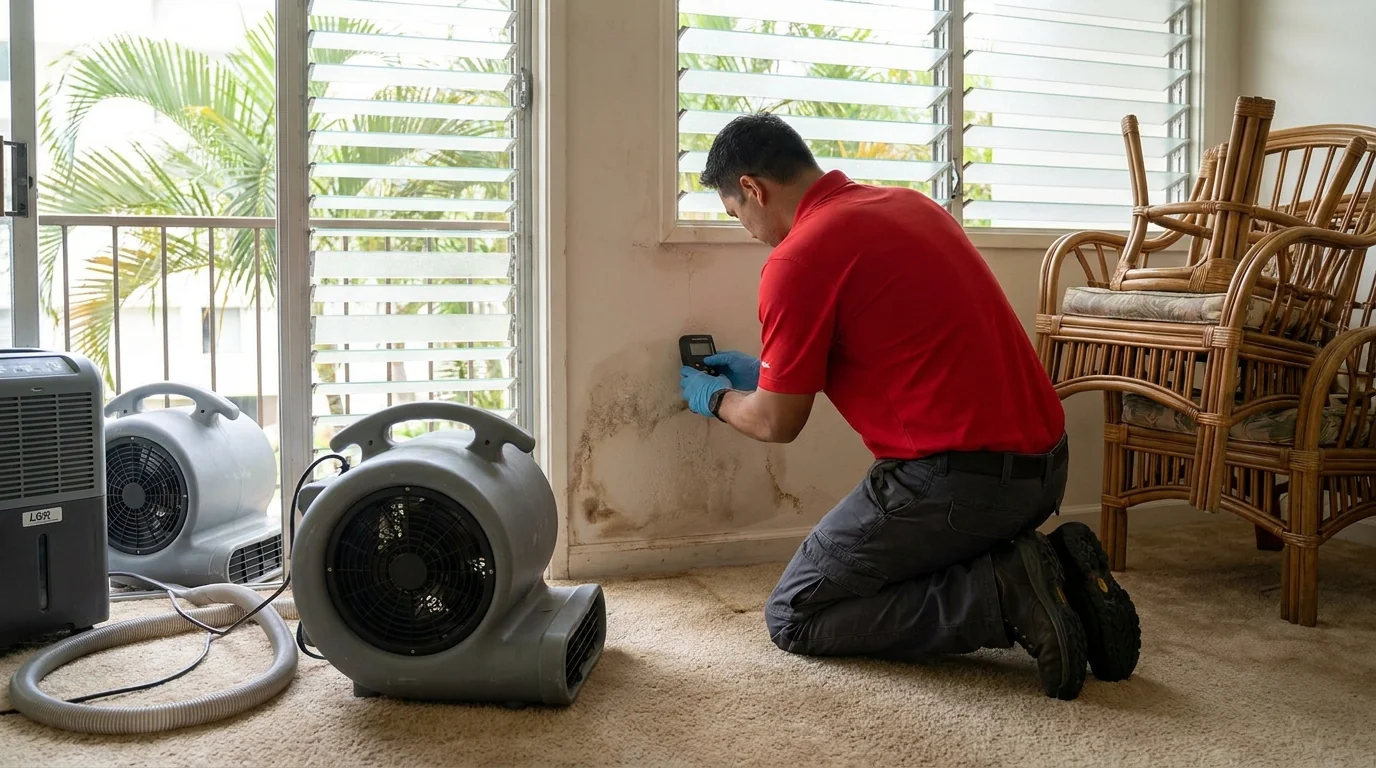
The first step on any job is finding all the water — not just the visible puddle. We use thermal imaging cameras and calibrated moisture meters to map how far saturation has traveled through walls, subflooring, and slab edges. In slab-on-grade homes, this step often reveals that water has traveled several feet from the source, which changes the drying plan significantly.
Once the scope is clear, extraction comes first: truck-mounted and portable extraction units pull standing water from carpet, hardwood, and tile. From there, we place industrial air movers and dehumidifiers in a calculated pattern based on the room geometry and measured humidity levels — not just one unit per room. Drying logs are taken every 24 hours so progress is documented and the equipment configuration can be adjusted if a wall cavity or subfloor is drying slower than expected.
For affected drywall and insulation that can’t be dried in place, controlled demolition removes only what needs to go. In townhome units where a neighboring HOA unit shares the wall, we coordinate with the property manager before opening any shared assembly.
Reaching Hawaii Kai from Our East Honolulu Base
Because we operate 24/7 and stage from East Honolulu, Hawaii Kai addresses in the 96825 ZIP code are among the fastest we can reach. Whether the call comes from a Kalama Valley single-family or a Koko Marina Center-area condo, we’re dispatching extraction equipment — not just a truck to assess. The goal is to have drying equipment running the same day you call, because in this climate, waiting until morning is not a neutral decision.
Local Note: What the Trade Winds Mean for Your Drying Timeline
Contractors who work primarily on the mainland sometimes underestimate how much Hawaii’s ambient humidity slows structural drying. Even on a clear trade-wind day, outdoor relative humidity in Hawaii Kai hovers between 60 and 75 percent — well above the threshold where building materials release moisture efficiently into the air. That means the dehumidification load here is heavier than a comparable job in a drier climate, and equipment that would dry a room in two days on the mainland may need three or four days to hit the same dry standard in a Portlock or Koko Kai home. We account for this in our initial drying plan rather than discovering it mid-job.
If you’re dealing with water damage in Hawaii Kai — whether it’s a burst supply line, an appliance failure, or storm runoff after a Kona Low — call (808) 349-3407 any time. We’ll walk you through what to do right now, and we’ll get equipment moving toward your address in 96825 as fast as the road allows.
Water Damage Restoration in Hawaii Kai: Service Coverage
Frequently Asked Questions
How fast can you arrive for water damage restoration in Hawaii Kai?
How quickly can you reach a Hawaii Kai address like Koko Marina or Mariners Cove?
My Hawaii Kai townhome shares a wall with a neighboring HOA unit — how do you handle that during water damage restoration?
Are older Kaiser-era homes in Hawaii Kai harder to dry after a water loss?
How does Hawaii Kai's humidity affect how long structural drying takes?
What should I do right now while I wait for your crew to arrive at my Portlock or Koko Kai home?
Will my homeowners insurance cover water damage restoration in Hawaii Kai?
Water Damage Restoration response in Hawaii Kai
Most Hawaii Kai calls see a technician on-site within 60 minutes from our Honolulu headquarters.