
Water Damage Restoration in Kaimuki
24/7 water damage restoration in Kaimuki, HI. Call (808) 349-3407.
Our technicians are dispatched from our Honolulu, HI headquarters and are typically on-site in Kaimuki within 60 minutes of your call.
Kaimuki’s single-wall wood-frame homes — many of them built before World War II along the Waialae Avenue corridor and up into Wilhelmina Rise — were never designed to survive a burst galvanized supply pipe or a backed-up kitchen drain line. When water gets into century-old Douglas fir framing, it doesn’t pool on the surface the way it does in a modern home with concrete board and vapor barriers; it wicks straight into the wood grain, and mold can begin colonizing within 24 to 48 hours. If you’re dealing with standing water or a soaked wall in the 96816 ZIP code right now, call (808) 349-3407 — we’re available around the clock.
Why Kaimuki Properties Are Especially Vulnerable to Water Damage
The housing stock here tells the story. Plantation-era and early-1900s construction throughout Kaimuki relied on single-wall framing — one layer of tongue-and-groove boards between you and the outside. There’s no insulated cavity to slow water migration, which means a slow leak from an undersized galvanized supply pipe (still common in homes on the hillside lots of Maunalani Heights) can saturate an entire wall section before a stain appears on the interior surface.
Storm runoff compounds the problem. Kaimuki’s hillside geography funnels rainwater downslope through carports, under slab foundations, and into crawl spaces faster than flat-lot neighborhoods absorb it. A heavy Kona storm event can push water through foundation gaps that were perfectly dry the week before. And along the Waialae Avenue business district, commercial kitchens running late into the evening are a consistent source of grease-line backups and overnight water losses — damage that sits undetected until the next morning’s opening walk-through.
Multigenerational homes with ohana units add another layer of complexity. Occupied-home mitigation means coordinating drying equipment placement around residents who may have nowhere else to go — something we factor into every job here.
Our Water Damage Restoration Process in Kaimuki
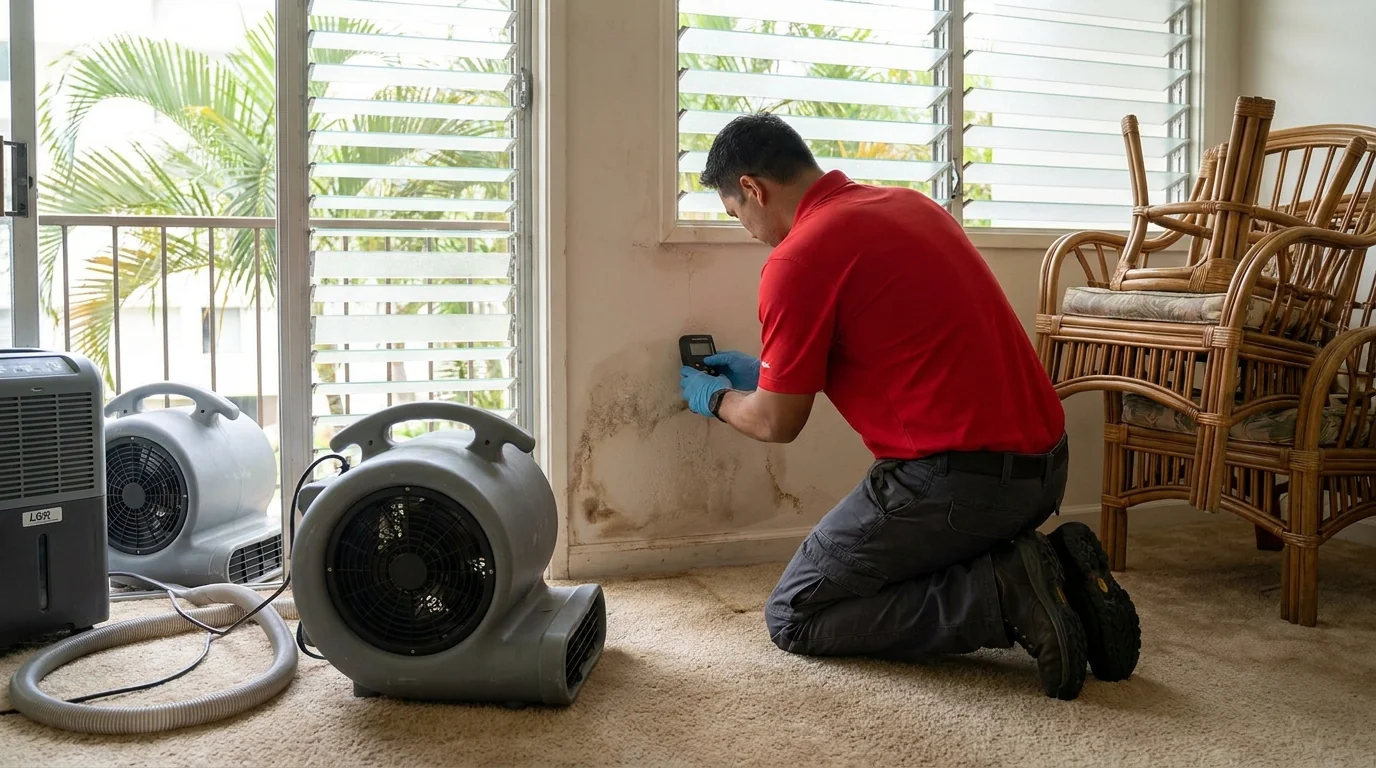
Every job starts with a thorough moisture assessment. In Kaimuki’s older homes, that means going beyond the visible damage — we use thermal imaging and calibrated moisture meters to map how far water has traveled through single-wall framing, subfloors, and original hardwood. What looks like a two-foot wet patch on the wall is often a six-foot moisture plume inside the structure.
Once we understand the scope, we move to water extraction. Standing water comes out first with truck-mounted or portable extraction equipment, depending on site access. Hillside lots on Wilhelmina Rise sometimes require portable units when a truck can’t stage close enough to the affected area.
Structural drying follows extraction. We place industrial air movers and dehumidifiers calibrated to Honolulu’s ambient humidity — Kaimuki’s elevation and trade-wind exposure affect drying rates differently than coastal Honolulu neighborhoods, and we adjust equipment counts and placement accordingly. Drying logs are recorded daily so you have documentation for your insurance claim.
If building materials are too saturated to dry in place — common with original plaster, subfloor decking, or heavily wicked single-wall boards — we perform targeted demolition to expose framing for drying, keeping removal as limited as possible to preserve the character of older homes.
Reaching Kaimuki from Honolulu
Our team dispatches from Honolulu and can reach most of Kaimuki — whether that’s a home near Kaimuki Community Park, a commercial space along Waialae Avenue, or a hillside property up toward Chaminade University — at any hour. We’re available 24/7, so an overnight kitchen line failure or a 2 a.m. pipe burst doesn’t have to wait until morning to start getting addressed. When you call, we’ll confirm your address and give you an honest estimate of when equipment will be on site.
Local Note: What Single-Wall Construction Means for Drying Timelines
If you’ve had water damage remediated in a mainland home before, the drying timeline you remember probably doesn’t apply here. Single-wall construction in Kaimuki dries differently than double-stud framing with fiberglass insulation — in some ways faster (no insulation cavity trapping moisture), in other ways slower (original-growth fir is dense and releases moisture gradually). Homes on the Palolo Valley fringe, which tend to sit in lower-airflow microclimates, often need an extra day or two of drying compared to properties with better trade-wind exposure. We account for this in our drying targets rather than pulling equipment on a fixed-day schedule.
If you’re managing a water loss in Kaimuki — a burst pipe, an appliance failure, storm intrusion, or a drain backup — call (808) 349-3407 now. We’ll walk you through what to do while we’re on the way, help you document the damage for your insurer, and get extraction and drying equipment running as fast as possible to protect the structure of your home.
Water Damage Restoration in Kaimuki: Service Coverage
Frequently Asked Questions
How fast can you arrive for water damage restoration in Kaimuki?
How quickly can you reach a home on Wilhelmina Rise or Maunalani Heights after I call?
Does Kaimuki's single-wall construction change how water damage restoration is done?
We have an ohana unit with tenants — can you work around occupied spaces during the drying process?
A restaurant on Waialae Avenue had an overnight drain backup — how do you handle commercial water losses?
How long does structural drying typically take in a Kaimuki home?
Will my homeowners insurance cover water damage restoration in Kaimuki?
Water Damage Restoration response in Kaimuki
Most Kaimuki calls see a technician on-site within 60 minutes from our Honolulu headquarters.