
Upholstery Cleaning in Honolulu
24/7 upholstery cleaning in Honolulu, HI. Call (808) 349-3407.
Our technicians are headquartered right here in Honolulu and are typically on-site within 60 minutes of your call.
Honolulu’s salt-laden trade winds and year-round humidity do a number on upholstered furniture in ways that most mainland cleaning guides never mention. A sofa sitting near an open lanai door in Kakaako or a fabric sectional in a Waikiki high-rise can absorb airborne salt, mildew spores, and the fine red volcanic dust that drifts in after dry spells — leaving cushions that smell musty long before they look dirty. AAA Water Damage Restoration & Carpet Care provides professional upholstery cleaning throughout Honolulu, treating the specific soils and moisture conditions that come with island living.
Why Honolulu Upholstery Wears Differently
The combination of tropical humidity and salt air creates a cleaning challenge that’s genuinely different from what you’d find in a dry-climate city. Fabric fibers — especially natural ones like cotton and linen blends common in older Manoa and Nuuanu homes — hold onto salt crystals that attract ambient moisture, which means a couch that looks clean can still feel tacky or smell stale within days of a standard wipe-down. Leather upholstery faces its own battle: the same corrosive salt air that degrades angle stops and appliance valves in older walk-ups also dries out leather grain, causing premature cracking if conditioning is skipped after cleaning.
High-rise condo living adds another layer. In towers along the Kakaako waterfront and around Ala Moana Center, units are often sealed tighter than single-family homes, which concentrates cooking odors, pet dander, and humidity inside the furniture itself. Vacation-rental units in the 96815 ZIP code — covering much of Waikiki — cycle through guests constantly, and upholstered pieces in those units accumulate sunscreen residue, sand, and body oils at a rate that demands more frequent deep cleaning than a typical residential sofa.
Our Upholstery Cleaning Process
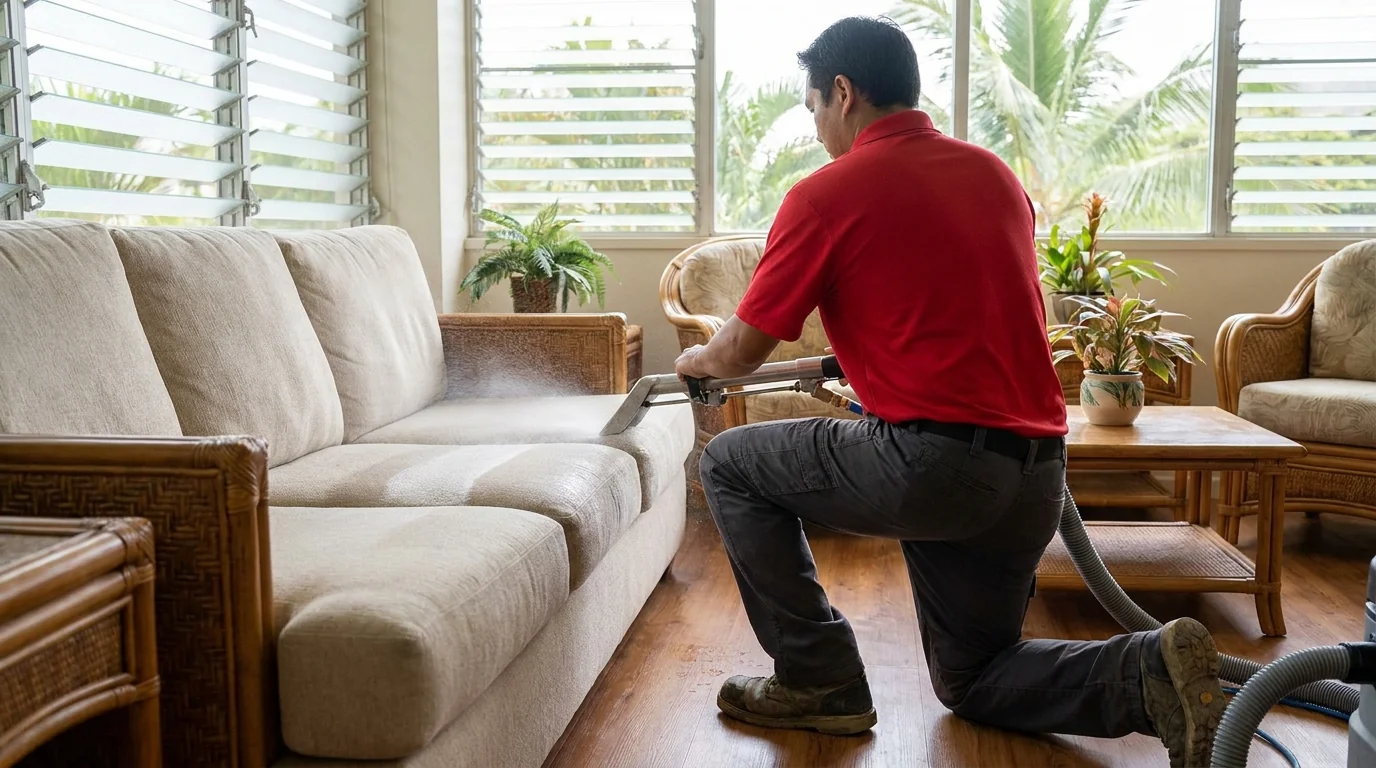
Every piece starts with a fiber identification check. Knowing whether you have a solution-dyed synthetic, a natural linen, a microfiber, or genuine leather changes the chemistry and the water temperature we use — getting that wrong can shrink fabric or strip protective coatings permanently. After fiber ID, we pre-treat high-contact zones: armrests, seat cushion faces, and headrests where body oils concentrate. For fabric upholstery, we use a low-moisture hot-water extraction method that flushes soils out of the weave without saturating the cushion core — important in Honolulu’s humidity, where a soaking-wet cushion can take days to dry and may develop mildew before it does.
Leather cleaning follows a different path: a pH-balanced cleaner removes surface grime without stripping the finish, followed by a conditioner that replaces the oils the salt air pulls out. We pay particular attention to seam areas and tufting, where salt residue and skin oils collect in the stitching and are often missed by surface-only treatments.
For pieces with odor issues — common in units near Honolulu Harbor where diesel particulate and salt combine — we apply an enzyme-based deodorizer that breaks down the organic compounds causing the smell rather than masking them with fragrance.
Equipment & Methods We Use for Upholstery
The portable extraction units we bring to Honolulu jobs are sized to fit into elevator lobbies and condo hallways without staging problems — a practical consideration in high-rises where freight elevator windows are limited. For delicate or antique upholstery, we use a dry-compound or encapsulation method that introduces almost no moisture, which is the right call for pieces that can’t tolerate any risk of shrinkage or color bleed. Truck-mounted systems, while powerful, aren’t always the best tool for upholstery work — the lower-pressure portable units we use give us more control over moisture delivery, which matters when you’re cleaning a tufted velvet chair versus a canvas outdoor sofa.
Drying time in Honolulu varies by the day’s trade-wind conditions. On a breezy day with low humidity, fabric upholstery can be dry to the touch in two to four hours. On a still, humid day — common in the valleys around Manoa — we use air movers to accelerate drying and prevent that window of time where mildew can begin to colonize damp fabric.
Local Note
One pattern we see consistently in Honolulu’s older walk-up buildings — particularly in Moiliili and Makiki — is that single-wall construction allows outdoor humidity to migrate directly into living spaces, which means upholstered furniture in ground-floor and lower units tends to hold significantly more ambient moisture than the same piece would in a sealed, air-conditioned high-rise. When we’re cleaning in those buildings, we extend our drying phase and sometimes recommend the resident run a dehumidifier for 24 hours after we leave. It’s a small step that makes a real difference in preventing the musty smell from returning within a week of cleaning.
If your furniture has been affected by a water loss — a supply line failure, a roof leak during a Kona storm, or a neighbor’s overflow in a shared building — call us at (808) 349-3407 any time. We respond around the clock and can assess both the upholstery and any surrounding water damage in the same visit, so you’re not coordinating two separate crews in a tight condo space.
Upholstery Cleaning in Honolulu: Service Coverage
Frequently Asked Questions
How fast can you arrive for upholstery cleaning in Honolulu?
Can Honolulu's salt air actually damage upholstery fabric, or is that overstated?
How often should vacation-rental units in Waikiki have their upholstery professionally cleaned?
Does living in a Honolulu high-rise condo affect how upholstery cleaning is done?
What's the difference between cleaning leather upholstery and fabric upholstery in Honolulu's climate?
My sofa in my Manoa home smells musty even though it doesn't look dirty — is that a cleaning issue or a humidity issue?
Will my homeowners insurance cover upholstery cleaning in Honolulu?
Upholstery Cleaning response in Honolulu
Most Honolulu calls see a technician on-site within 60 minutes from our Honolulu headquarters.