
Upholstery Cleaning in Honolulu
24/7 upholstery cleaning in Honolulu and surrounding areas. Call (808) 349-3407.
Your sofa looks fine from across the room. Get close, though — press your face into the cushions — and you’ll catch it: the sour undertone of body oils that have been soaking into the foam for two years, the faint grit of Honolulu’s red dirt ground into the armrest weave, the ghost of a spilled açaí bowl that seemed to disappear but never really did. Upholstery holds onto things that vacuums and surface sprays can’t reach, and in Hawaii’s year-round humidity, those embedded soils don’t just sit there — they feed odor-causing bacteria and accelerate fabric breakdown.
What upholstery cleaning actually involves
Cleaning a sofa isn’t the same as cleaning a carpet, even though both involve fabric and moisture. Upholstery fabrics — chenille, microfiber, cotton-linen blends, performance weaves, genuine and synthetic leather — each have different fiber structures, dye tolerances, and moisture limits. Push too much water into a tight-woven fabric and you risk shrinkage, browning, or foam saturation that won’t dry before mildew sets in. Use the wrong pH chemistry on a natural fiber and you can strip the color or stiffen the weave permanently.
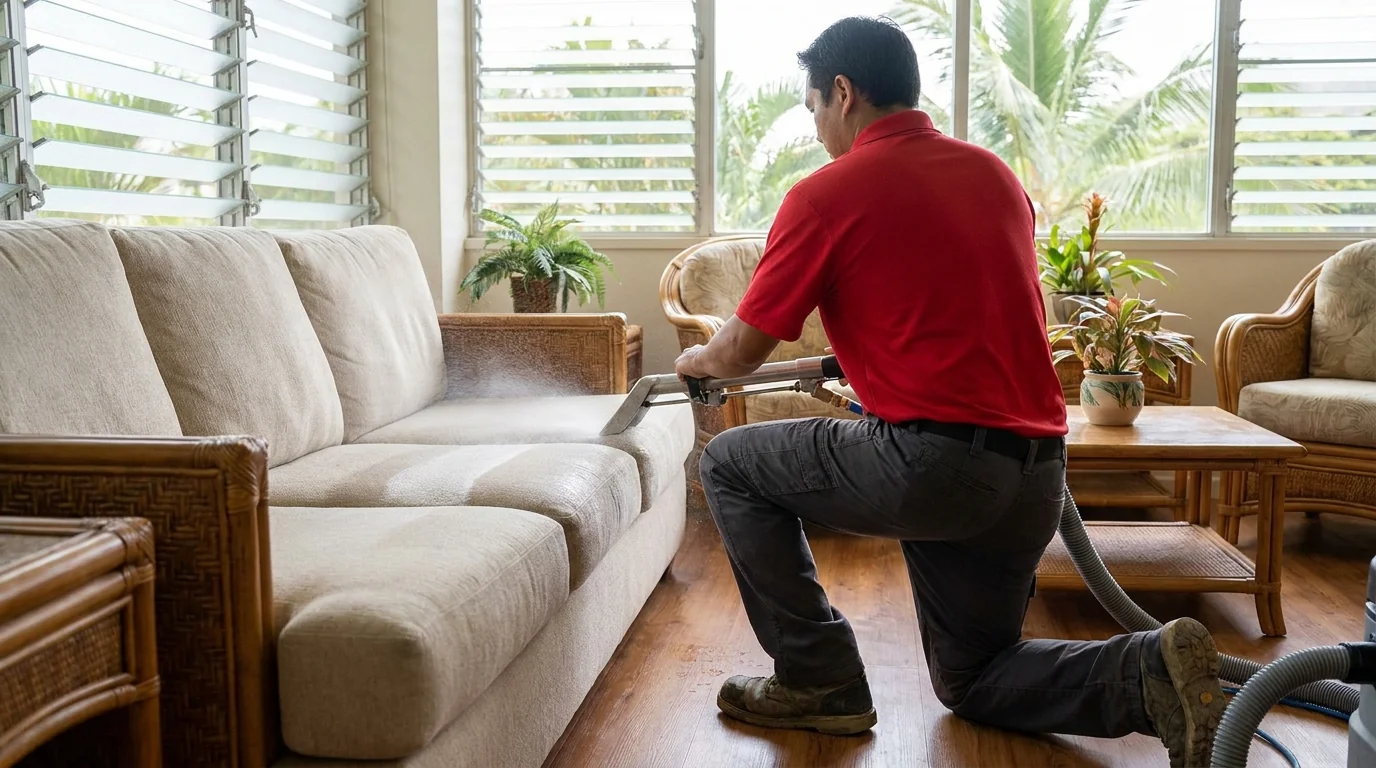
Professional upholstery cleaning starts with identifying what you’re actually working with. From there, the cleaning method — low-moisture encapsulation, hot-water extraction with an upholstery tool, dry-foam application, or a combination — is matched to the fabric code (W, S, WS, or X) and the soil type. Equipment matters here: a portable extractor with a dedicated upholstery wand delivers the heat and suction needed to flush soils out of the cushion fill without over-wetting, something a rental machine or spray-and-wipe approach can’t replicate. A typical sofa takes 45 minutes to an hour to clean properly; drying in Honolulu’s humidity usually runs two to four hours with airflow assistance.
Our process
-
Fabric identification and pre-inspection. Before any moisture touches the piece, we check the manufacturer’s cleaning code, test for colorfastness in a hidden area, and identify problem zones — stains, pet dander accumulation, worn pile, or previous cleaning residue that could react with new chemistry.
-
Dry soil removal. We vacuum the entire piece with an upholstery attachment, including under cushions and along seam lines where crumbs, pet hair, and particulate matter collect. Skipping this step traps dry soil in the fabric during wet cleaning and turns it into a muddy paste that’s harder to extract.
-
Pre-treatment and dwell time. Targeted pre-spray is applied to body-oil zones (headrests, armrests, seat centers) and any visible staining. The chemistry needs time to break the bond between the soil and the fiber — rushing this step is one of the most common reasons stains reappear after cleaning.
-
Extraction or low-moisture cleaning. Depending on the fabric code and soil load, we use hot-water extraction with a specialized upholstery tool, a dry-foam method, or a low-moisture encapsulation pass. For leather and faux-leather surfaces, we use a pH-balanced leather cleaner and conditioner rather than water-based extraction.
-
Post-cleaning grooming and drying assistance. Pile fabrics are groomed to prevent matting as they dry. We position airflow — fans, open windows, or portable air movers — to bring drying time down and reduce the window for mildew development. Before we leave, we walk through the piece with you and flag any areas where staining has penetrated the foam fill itself, which surface cleaning can reduce but not fully eliminate.
What separates a good upholstery cleaning from a bad one
The most common mistake is over-wetting. A technician who applies too much solution — especially into a cushion with dense foam fill — creates a moisture problem that takes days to resolve in Hawaii’s humidity. Foam that stays wet for 24–48 hours will develop a musty odor that’s worse than the original soiling. Good operators use moisture meters to verify that cushion cores are drying, not just the surface fabric.
The second common failure is skipping the fabric code. A fabric coded “S” (solvent-only) will waterspot or shrink if cleaned with water-based extraction. Treating it like a standard “W” fabric produces visible damage that’s difficult to reverse.
For pet owners, there’s a third layer: enzymatic pre-treatment for urine or biological soils. Standard detergent chemistry breaks down the visible stain but leaves the protein compounds that cause odor. Without an enzyme step, the smell returns when humidity rises — which in Honolulu means it returns frequently.
Documentation matters too. If you’re cleaning upholstery after a water loss, smoke event, or tenant turnover, photograph the piece before and after. That record supports your own tracking of the property’s condition over time.
Honolulu’s climate and your upholstery
Honolulu’s average relative humidity sits between 60–70% year-round, with trade wind patterns that vary by neighborhood — Manoa and Nuuanu run noticeably damper than Kahala or Hawaii Kai. That persistent humidity means upholstery fabrics never fully off-gas between uses. Body oils, food particles, and airborne salt from ocean exposure accumulate faster than they would in a drier climate, and the conditions that allow mold to colonize a water-damaged wall (moisture above 60% RH for 24–48 hours) apply equally to a sofa cushion that was over-wet during cleaning and left in a closed room. Annual professional cleaning — rather than the every-18-months schedule common in drier markets — is a reasonable baseline for heavily used pieces in most Honolulu homes.
Service area
We clean upholstery throughout Honolulu and across Oahu, including Kailua, Kaneohe, Pearl City, Aiea, Ewa Beach, Mililani, and Hawaii Kai. City-specific pages for several of these areas link back here for the full process detail.
If your sofa, sectional, dining chairs, or leather furniture is overdue for a proper clean, call (808) 349-3407 to schedule your upholstery cleaning appointment — we answer around the clock.
Frequently Asked Questions
How do I find the cleaning code on my sofa, and why does it matter?
Can professional cleaning remove a pet urine odor from a sofa cushion, or does the cushion need to be replaced?
What's the difference between cleaning a fabric sofa and cleaning leather upholstery?
How long should I wait before sitting on the sofa after cleaning?
Will cleaning cause my sofa's colors to fade or bleed?
Looking for the best upholstery cleaning company in Honolulu?
AAA Water Damage Restoration & Carpet Care provides upholstery cleaning in Honolulu, HI and the surrounding area. We answer calls 24/7 — call (808) 349-3407 for immediate help.
Need Upholstery Cleaning now?
We respond 24/7 across Honolulu and surrounding HI cities.
Related Coverage
- Our Restoration Services
- Contact AAA Water Damage Restoration & Carpet Care
- Upholstery Cleaning in Aiea
- Upholstery Cleaning in Aina Haina
- Upholstery Cleaning in Diamond Head
- Upholstery Cleaning in Ewa Beach
- Upholstery Cleaning in Hawaii Kai
- Upholstery Cleaning in Honolulu
- Upholstery Cleaning in Kahala
- Upholstery Cleaning in Kailua
- Upholstery Cleaning in Kaimuki
- Upholstery Cleaning in Kaneohe
- Upholstery Cleaning in Kapolei
- Upholstery Cleaning in Mililani