Sewage Cleanup and Sanitization in Honolulu
24/7 sewage cleanup and sanitization in Honolulu, HI. Call (808) 349-3407.
Our technicians are headquartered right here in Honolulu and are typically on-site within 60 minutes of your call.
Sewage backing up into a Honolulu home or condo unit is one of the few water emergencies that gets worse by the hour — and in a city where trade-wind humidity sits above 70% year-round, the window between raw sewage contact and the start of microbial growth in walls and flooring is shorter than almost anywhere on the mainland. Whether it’s a sewer line backup flooding a Moiliili walk-up or a septic overflow soaking the ground floor of a Makiki apartment building, the contamination is Category 3 — the most hazardous classification — and it needs professional extraction, disinfection, and drying before the damage compounds.
Why Honolulu Properties See Sewage Backup Problems
Honolulu’s aging sewer infrastructure, combined with its dense urban core, creates conditions that push sewage emergencies into residential and commercial spaces with little warning. In older neighborhoods like Moiliili and Makiki, cast-iron and clay-tile lateral lines installed decades ago are prone to root intrusion, corrosion, and collapse — and when they fail, the backup doesn’t just affect one unit. Single-wall construction common in pre-1960s walk-ups means contaminated water wicks into framing and interior finishes almost immediately.
Salt-laden trade winds accelerate corrosion on angle stops, cleanout caps, and the galvanized supply and drain lines still found throughout older Honolulu housing stock. A corroded cleanout that might hold for another decade on the mainland can fail years earlier here. Add in the city’s high water table in low-lying areas near Honolulu Harbor and the Kakaako waterfront, and heavy rainfall events can reverse-pressure municipal sewer mains, forcing sewage back through floor drains and toilets in ground-floor units.
Our Sewage Cleanup and Sanitization Process in Honolulu
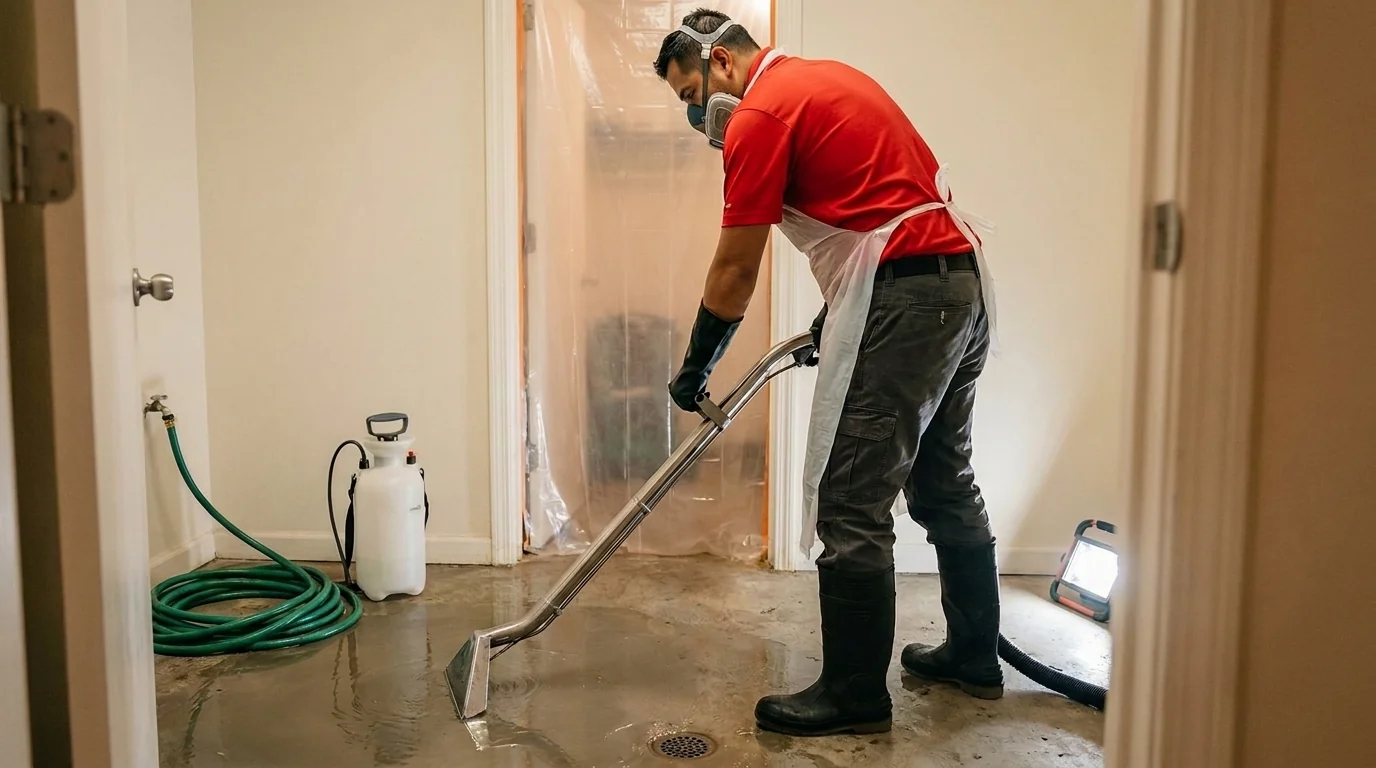
Raw sewage removal follows a strict sequence — skipping steps creates ongoing health hazards, not just odor problems. The process begins with containment: sealing off the affected area to prevent cross-contamination to adjacent rooms or, in a multi-unit building, neighboring units. In Honolulu’s high-rise corridors — particularly in Kakaako and Ala Moana towers — that means working with building management to protect common-area hallways and elevator lobbies before extraction begins.
Once contained, standing sewage is extracted using truck-mounted or portable units capable of handling solids. Porous materials — carpet, pad, drywall below the flood line, insulation — that have absorbed Category 3 water are removed and bagged for disposal per Honolulu’s solid waste protocols. Hard surfaces are then treated with EPA-registered disinfectants formulated for sewage contamination, applied with appropriate dwell time rather than a quick wipe-down. Industrial air movers and dehumidifiers run until moisture readings in walls and subfloor return to pre-loss baselines — a process that typically takes two to four days in Honolulu’s climate, sometimes longer in concrete-slab construction where moisture migrates slowly.
Throughout the job, documentation — photographs, moisture logs, equipment placement records — is compiled in a format useful for your insurance claim. Photograph the damage yourself before any work begins, and contact your insurer to ask what documentation they require.
Honolulu Condo and HOA Coordination
In Waikiki, Kakaako, and Ala Moana, the majority of residential properties are governed by an HOA or AOAO. A sewage backup in unit 14C doesn’t stay in unit 14C — contaminated water travels through shared plumbing chases, soaks into common-area ceilings, and triggers liability questions between unit owners and the association. Remediation in these buildings requires coordination with building management before, during, and after the work: access scheduling, elevator protection, waste removal routes that comply with building rules, and written scope documentation the AOAO can submit to its own insurer.
The team at AAA Water Damage Restoration & Carpet Care is available around the clock — call (808) 349-3407 any time — and is familiar with the access and documentation requirements common to Honolulu’s high-rise inventory. Getting the right paperwork to the right parties early prevents disputes about scope and responsibility from dragging out weeks after the physical work is done.
Local Note: Ground-Floor Units Near the Harbor
Properties in the ZIP codes 96813 and 96814 — Downtown Honolulu, parts of Kakaako, and the blocks closest to Honolulu Harbor — sit in areas where the municipal sewer system experiences the most backpressure during heavy rain events. Ground-floor and basement-level units in these corridors are disproportionately affected by sewage intrusions that have nothing to do with the building’s own plumbing. If you’re a property owner or manager in this zone, a licensed plumber can install a backwater prevention valve on your lateral line — a relatively low-cost measure that can prevent a five-figure cleanup. It won’t help once the backup has already happened, but it’s worth asking about after remediation is complete.
If sewage has already reached your floors, don’t wait to see if it drains on its own. Call (808) 349-3407 now — the crew dispatches from Honolulu, equipment loads fast, and every hour the contamination sits is another hour it’s working into your subfloor, your walls, and your air.
Sewage Cleanup and Sanitization in Honolulu: Service Coverage
Frequently Asked Questions
How fast can you arrive for sewage cleanup and sanitization in Honolulu?
How quickly can AAA Water Damage Restoration & Carpet Care reach a sewage backup in Moiliili or Makiki?
My Kakaako condo building's AOAO is asking for documentation before they'll allow remediation work — what do you provide?
Are older walk-up buildings in Moiliili and Makiki harder to dry out after a sewage backup?
What makes sewage cleanup different from a regular water damage job?
How much does sewage cleanup typically cost for a Honolulu condo unit, and what affects the price?
Will my homeowners insurance cover sewage cleanup and sanitization in Honolulu?
Sewage Cleanup and Sanitization response in Honolulu
Most Honolulu calls see a technician on-site within 60 minutes from our Honolulu headquarters.