Sewage Cleanup and Sanitization in Aiea
24/7 sewage cleanup and sanitization in Aiea, HI. Call (808) 349-3407.
Our technicians are dispatched from our Honolulu, HI headquarters and are typically on-site in Aiea within 60 minutes of your call.
When a sewer line backs up in Aiea, the mess doesn’t wait for a convenient moment — and in this compact hillside community, the consequences spread fast. Older cast-iron and clay drain lines in the plantation-era homes climbing toward Aiea Heights are decades past their design life, and when they fail during a heavy Kona rain event, raw sewage doesn’t just pool in a bathroom. It follows the grade, seeping under slab foundations, saturating carport floors, and wicking into the concrete block walls that were standard construction in the 1950s and 60s. AAA Water Damage Restoration & Carpet Care answers calls around the clock and dispatches to the 96701 area with the containment and sanitization equipment this kind of loss demands.
Why Aiea Properties See Sewage Backup Problems
Aiea’s topography is a significant factor that gets overlooked until something goes wrong. The community rises steeply from the Pearl Harbor shoreline up through Waimalu and Newtown before reaching the ridgelines of Aiea Heights, and that elevation change means gravity does a lot of work — in both directions. During normal conditions, drainage flows downhill the way it should. But when a main sewer line is blocked or a septic system overflows, that same slope pushes contaminated water aggressively through the lowest points of a structure: ground-floor utility rooms, carports converted to living space, and crawl spaces beneath older pier-and-beam additions.
The dense townhome and condominium complexes concentrated near Pearlridge Center add a different dimension to the problem. In association-managed buildings, a sewage backup in one unit can migrate through shared wall cavities and subfloor assemblies into adjacent units before anyone realizes the source. Association boards in these buildings often have specific protocols — and sometimes specific approved vendors — for how remediation work is documented and reported, which affects how quickly a crew can begin containment.
Heavy Kona storms also overload aging municipal sewer infrastructure in ways that push sewage backward through floor drains and low-lying fixtures. This is not a rare event in Aiea — it’s a recurring pattern that homeowners near the lower elevations of Halawa and Waimalu have dealt with more than once.
Our Sewage Cleanup and Sanitization Process in Aiea
Raw sewage is classified as Category 3 water — the most contaminated category — which means the removal and sanitization process follows a strict sequence regardless of how small the affected area appears.
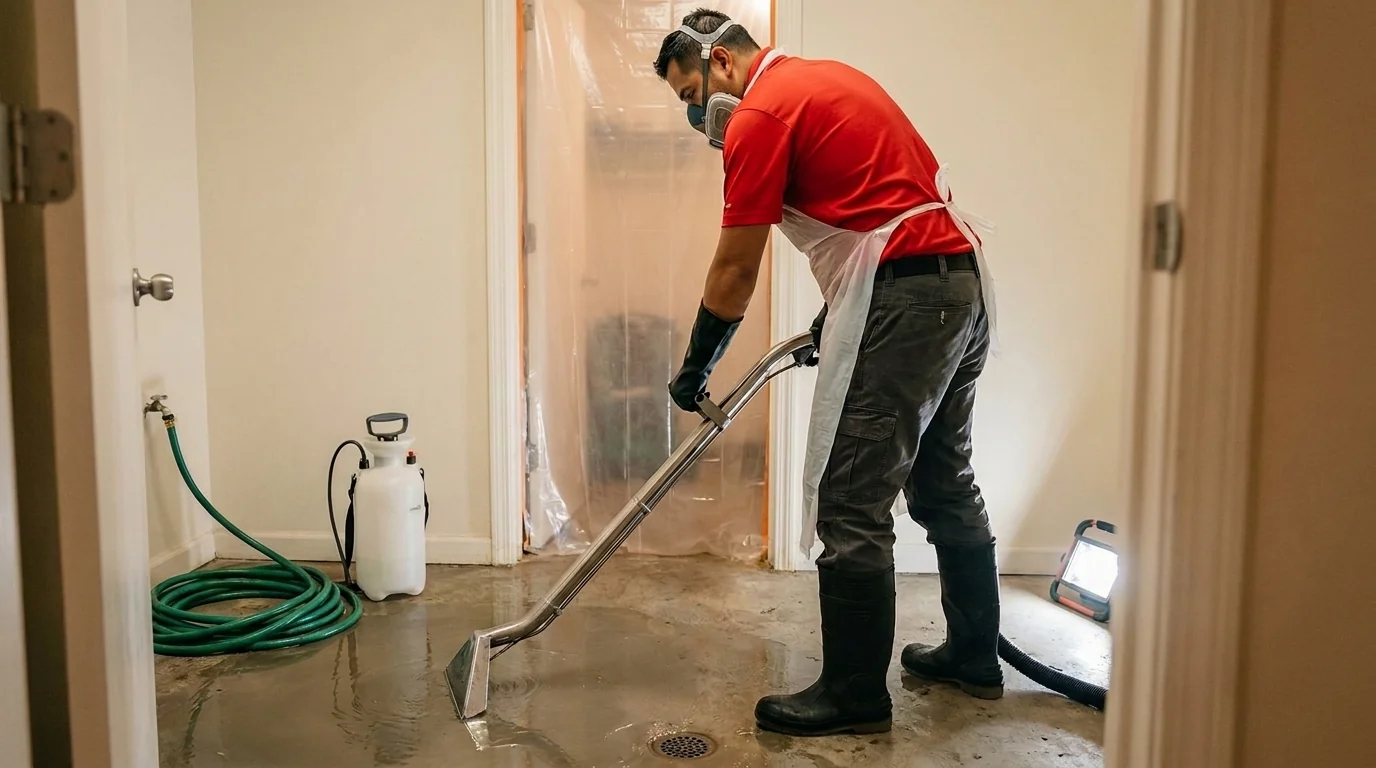
The first step on arrival is containment: sealing off the affected space to prevent cross-contamination into clean areas of the home. In Aiea’s older homes, this matters more than it might in newer construction because open floor plans and shared HVAC returns can circulate airborne pathogens quickly. Once the perimeter is established, extraction equipment removes standing sewage and saturated material. Porous materials — drywall, insulation, carpet, and in some cases original hardwood flooring — that have contacted Category 3 water are removed rather than dried in place, because sanitizing them to a safe standard is not reliably achievable.
After physical removal, all affected surfaces are treated with EPA-registered antimicrobial agents appropriate for the pathogen load associated with sewage exposure. Structural drying follows using commercial dehumidifiers and air movers calibrated to Hawaii’s ambient humidity, which runs higher than mainland averages and slows evaporation if equipment is undersized. Moisture readings are documented throughout the drying cycle so there’s a clear record for your insurance adjuster and, if applicable, your HOA.
Reaching Aiea from Our Honolulu Base
The H-1 freeway connects Honolulu to Aiea directly, and our dispatch operates 24 hours a day, seven days a week. Whether the call comes in at noon or 3 a.m., a crew can be moving toward Aiea without delay. For addresses up in Aiea Heights or along the steeper residential streets above Keaiwa Heiau State Recreation Area, we account for road width and vehicle clearance when staging equipment — some of those upper streets are narrow enough that a full-size box truck needs to park at the bottom and hand-carry equipment uphill. It adds time, but it’s a step we plan for rather than discover on arrival.
Local Note: Concrete Block Walls and Sewage Saturation
Here is something specific to Aiea’s older housing stock that affects every sewage job in the neighborhood: the concrete masonry unit (CMU) walls common in plantation-era construction are highly porous and absorb contaminated water deeply. Unlike modern drywall, which can be cut out in panels, CMU walls cannot simply be removed. They require aggressive surface cleaning, antimicrobial treatment applied in multiple passes, and extended drying time — often significantly longer than a comparable loss in a frame-built home. If a sewage backup has contacted a CMU wall in your home, the drying timeline your adjuster expects based on a mainland claim may not apply here. We document the material type and moisture readings from the start so there are no surprises when the drying phase runs longer than a standard estimate.
If your home or building in Aiea has been hit by a sewage backup, sewer line failure, or septic overflow, call (808) 349-3407 now. We’re available around the clock, and the sooner containment begins, the less structural material — and expense — the cleanup involves.
Sewage Cleanup and Sanitization in Aiea: Service Coverage
Frequently Asked Questions
How fast can you arrive for sewage cleanup and sanitization in Aiea?
How quickly can you reach Aiea Heights or the Waimalu area after a sewage backup call?
My condo near Pearlridge had a sewage backup that may have spread to the unit next door. How does that affect the cleanup process?
Are the older homes in Halawa and Waimalu more vulnerable to sewer line backups during heavy rain?
Why does sewage cleanup in Aiea's plantation-era homes sometimes take longer than a standard estimate?
What does the sanitization phase actually involve after the sewage is removed?
Will my homeowners insurance cover sewage cleanup and sanitization in Aiea?
Sewage Cleanup and Sanitization response in Aiea
Most Aiea calls see a technician on-site within 60 minutes from our Honolulu headquarters.