Flood & Drying Equipment Rental in Honolulu
24/7 flood & drying equipment rental in Honolulu, HI. Call (808) 349-3407.
Our technicians are headquartered right here in Honolulu and are typically on-site within 60 minutes of your call.
When a water heater fails on the 18th floor of a Kakaako high-rise, the water doesn’t stop at the unit — it migrates through concrete decking, soaks drop ceilings two floors down, and saturates carpet in units the owner has never met. In Honolulu’s condo-dense urban core, that scenario plays out regularly, and the window between wet and moldy is brutally short. Year-round warmth and humidity mean visible mold can colonize soaked drywall within 24 to 48 hours. If you need professional-grade flood and drying equipment on-site fast — air movers, dehumidifiers, submersible pumps — AAA Water Damage Restoration & Carpet Care dispatches around the clock from right here in Honolulu.
Why Honolulu Properties Face Unique Drying Challenges
Honolulu’s building stock creates drying conditions you won’t find in most mainland markets. The older walk-up apartments in Makiki and Moiliili were built with single-wall construction — essentially one layer of wood planking between interior and exterior — which wicks water laterally at a rate that surprises even experienced technicians. Galvanized supply lines in those same buildings corrode from the inside out, and salt-laden trade winds accelerate the failure of angle stops, valve stems, and appliance connections on every exposure. A slow drip behind a washing machine in one of those units can saturate a wall cavity for weeks before it becomes visible.
In the high-rise towers along the Ala Moana and Waikiki corridors, the challenge flips: concrete and tile slow surface absorption but trap moisture in the screed layer beneath flooring, and elevator-only access limits how quickly large equipment can be staged. Heavy vacation-rental turnover in Waikiki adds a time-pressure dimension that doesn’t exist elsewhere — a unit soaked by a guest’s overflowing tub needs to be extraction-complete and drying before the next check-in, sometimes within a single overnight window.
Equipment We Deploy for Flood Drying in Honolulu
Effective drying in Honolulu’s climate isn’t just about moving air — it’s about controlling the moisture load in that air. Trade-wind humidity can hover above 70% even on clear days, which means a standard box fan accomplishes almost nothing against wet concrete or saturated carpet pad. The equipment mix matters:
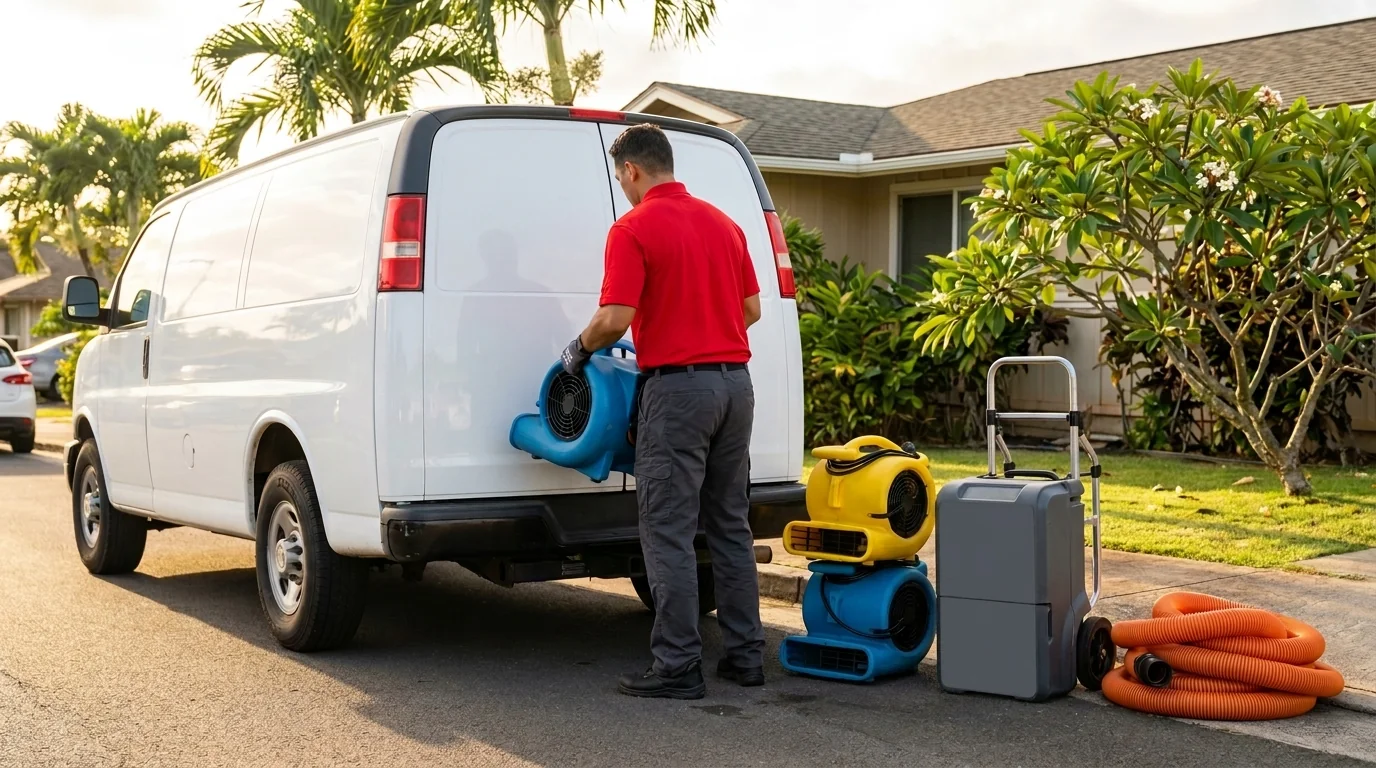
- High-velocity air movers accelerate surface evaporation from carpet, hardwood, and drywall faces, pushing moisture into the air column where dehumidifiers can capture it.
- Commercial low-grain refrigerant (LGR) dehumidifiers pull that airborne moisture out of the space continuously — critical in Honolulu where ambient humidity would otherwise re-wet materials as fast as you dry them.
- Submersible and trash pumps handle standing water in parking structures, ground-floor units, and mechanical rooms before drying equipment goes in.
- Drying mats and floor drying systems address the screed-layer moisture common under tile in high-rise units without requiring full tile demolition.
Every setup is sized to the square footage and material type of the affected space, not a one-size number.
Our Equipment Rental and Deployment Process in Honolulu
When you call (808) 349-3407, the first conversation is about scope: how many rooms, what flooring types, whether standing water is still present, and whether building access has any restrictions (freight elevator scheduling, HOA after-hours entry rules, parking for a service vehicle near Honolulu Harbor-area properties or in the congested blocks around ZIP code 96814). From there:
- Same-day dispatch — equipment leaves our Honolulu location and is typically on-site the same day you call, day or night.
- Initial moisture mapping — before equipment placement, technicians use moisture meters and thermal imaging to identify the full wet zone, including hidden cavities. Skipping this step is how people end up with mold behind walls they thought were dry.
- Calibrated equipment placement — air movers are positioned at calculated intervals per industry drying standards; dehumidifiers are sized to the grain depression needed given current ambient conditions.
- Daily monitoring — moisture readings are logged each visit so drying progress is documented. This record matters when you’re coordinating with an AOAO or filing documentation for your insurance claim.
- Equipment removal and final readings — when materials reach target moisture content, equipment comes out and final readings are recorded.
Local Note: Condo AOAOs and Drying Documentation in Honolulu
Honolulu’s condo associations — governed by AOAOs (Associations of Apartment Owners) under Hawaii’s specific condominium property regime — often require written drying logs and moisture readings before they’ll authorize repairs to common-area walls or shared building systems. If your unit’s water loss affected a neighbor or a common corridor, the AOAO’s managing agent will likely ask for documentation before releasing repair authorization. Keeping a daily moisture log from day one isn’t just good practice here — it’s frequently the difference between a repair that gets approved quickly and one that stalls for weeks while the association requests records you don’t have.
If you’re a property manager handling multiple units in a Waikiki or Kakaako tower, photograph the damage thoroughly before any equipment goes in — those images support your insurance claim and the AOAO’s incident documentation simultaneously.
When standing water is threatening flooring, cabinetry, or the unit below yours, the fastest call you can make is to (808) 349-3407. AAA Water Damage Restoration & Carpet Care is available around the clock and deploys drying equipment throughout Honolulu — from the walk-ups in Moiliili to the high-rises overlooking Waikiki Beach.
Flood & Drying Equipment Rental in Honolulu: Service Coverage
Frequently Asked Questions
How fast can you arrive for flood & drying equipment rental in Honolulu?
How quickly can drying equipment reach a unit in Waikiki or Kakaako?
Does Honolulu's year-round humidity affect how long drying equipment needs to run?
My condo's AOAO is asking for drying documentation — what does that typically include?
Are older buildings in Makiki and Moiliili harder to dry than newer construction?
What does flood and drying equipment rental typically cost for a Honolulu condo unit?
Will my homeowners insurance cover flood & drying equipment rental in Honolulu?
Flood & Drying Equipment Rental response in Honolulu
Most Honolulu calls see a technician on-site within 60 minutes from our Honolulu headquarters.