Flood & Drying Equipment Rental in Honolulu
24/7 flood & drying equipment rental in Honolulu and surrounding areas. Call (808) 349-3407.
What Flood & Drying Equipment Rental actually involves
You pulled up the carpet corner and found the padding soaked through. The subfloor is damp, the baseboards are wicking moisture, and the clock started the moment the water arrived — mold colonization can begin in as little as 24 to 48 hours in Hawaii’s humid climate. Renting the right drying equipment fast is the difference between a cleanup job and a full gut-and-rebuild. This service puts professional-grade air movers, dehumidifiers, and flood pumps in your hands — the same equipment used on commercial water damage jobs — so you can start pulling moisture out of structural materials before secondary damage compounds the loss.
Flood and drying equipment rental isn’t a shop-vac and a box fan. It involves calculating the cubic footage of the affected space, the category and class of the water intrusion, and the ambient relative humidity — then staging the right number of units in the right positions to create a controlled drying environment. In Honolulu, where outdoor humidity regularly sits above 60%, a single residential dehumidifier from a hardware store often can’t overcome the vapor pressure differential fast enough to protect flooring and wall cavities. Industrial low-grain refrigerant (LGR) dehumidifiers pull significantly more moisture per day than consumer units and are sized to the job, not to a shelf at a big-box store.
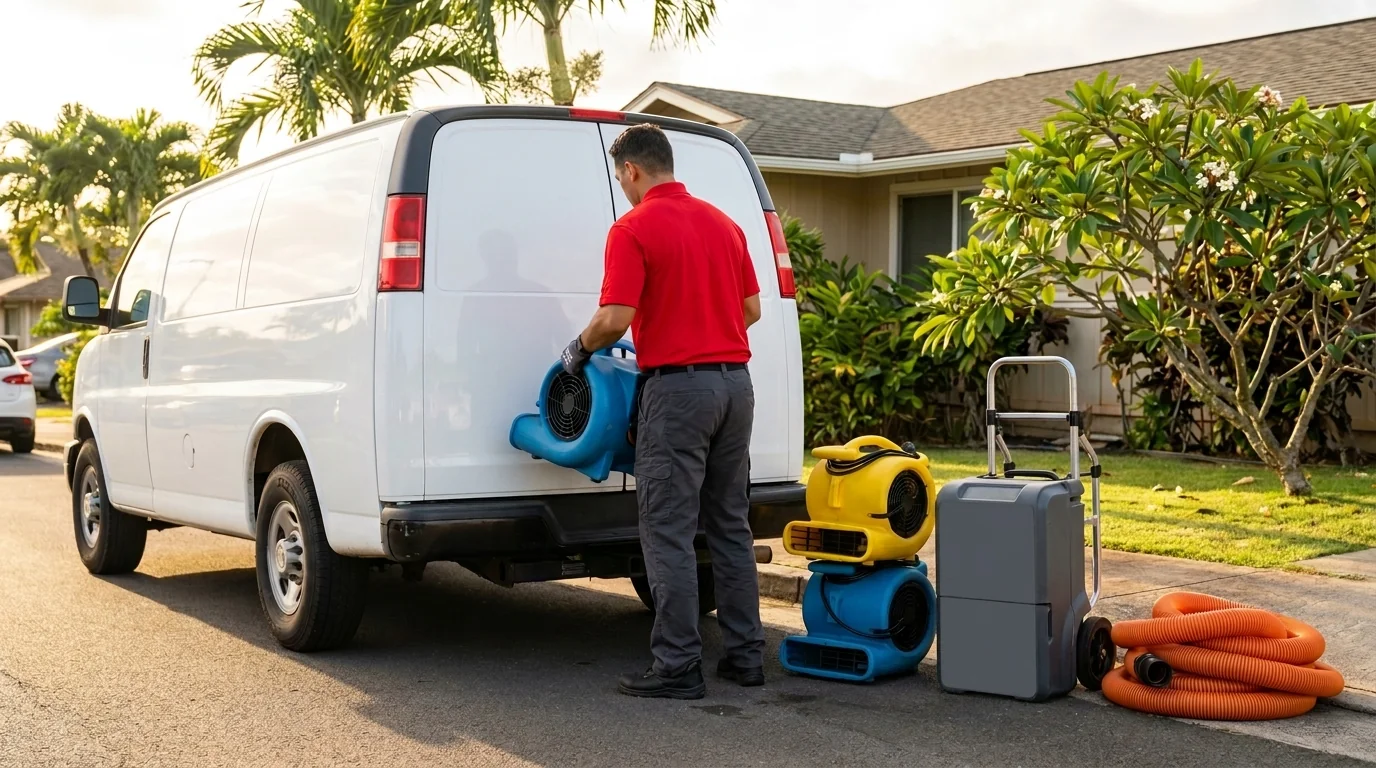
Equipment typically rented for flood response includes axial and centrifugal air movers (carpet drying fans), LGR dehumidifiers, submersible flood pumps for standing water, and occasionally desiccant dehumidifiers for tighter, cooler spaces. The rental period for a typical residential water loss runs three to five days for Category 1 (clean water) intrusions, though Category 2 losses involving gray water often require additional monitoring time before equipment can safely be removed.
Our process
-
Damage assessment and equipment sizing. Before any unit leaves the truck, the affected area is measured and the water intrusion is categorized. A 200-square-foot bedroom with wet carpet and a damp subfloor requires a different equipment package than a flooded garage with standing water. Getting this wrong — renting too few units or the wrong type — is the most common reason DIY drying jobs fail moisture inspections.
-
Standing water extraction. If water is still pooled on hard surfaces or trapped under flooring, a submersible flood pump or wet-extraction unit removes bulk water first. Air movers placed over standing water don’t dry — they just spread contamination and slow evaporation. Extraction always precedes drying.
-
Equipment staging and airflow setup. Air movers are positioned at a low angle against walls and under lifted flooring to drive airflow across wet surfaces and into wall cavities. Dehumidifiers are placed to capture the evaporated moisture before it migrates to unaffected areas. The ratio of air movers to dehumidifiers matters: too many movers without adequate dehumidification capacity raises the room’s relative humidity and stalls drying.
-
Moisture baseline documentation. Before equipment is running, affected materials are read with a moisture meter and the readings are recorded. Drywall, subfloor, and framing each have target moisture content thresholds. These baseline numbers are your documentation trail — useful for your own records and for any conversations you have with your insurance adjuster about the scope of the loss.
-
Daily monitoring and equipment adjustment. Drying isn’t set-and-forget. Readings are taken each day to track progress. If a wall cavity isn’t responding, equipment may need to be repositioned or a flood cut may be necessary to expose wet framing. Rental periods are adjusted based on actual moisture readings, not a fixed calendar.
What separates a good flood drying response from a bad one
The most common mistake in DIY and under-equipped drying jobs is removing equipment too early. Flooring and carpet can feel dry to the touch while the subfloor beneath still reads 18–25% moisture content — well above the 12–15% threshold where mold risk drops significantly. Insurance adjusters and restoration inspectors use pin and pinless moisture meters on structural materials, not surface feel. If you’re documenting a loss, those meter readings are the record that matters.
A second frequent error is ignoring wall cavities. Water travels by gravity and capillary action, and it moves into wall framing and insulation faster than it shows on the surface. Baseboards that look intact can be hiding wet insulation behind them. Drilling small inspection holes or removing baseboards to check cavity moisture is standard practice on any loss that involved more than a few gallons of water.
Finally, equipment placement geometry matters. Air movers pointed directly at a wall face don’t move air through the wall system — they need to be angled low, creating a vortex effect that draws moisture out from under flooring and along wall bases. Improper placement can add a full day or more to drying time.
Seasonal and regional considerations
Honolulu’s trade winds and year-round humidity create drying conditions that differ meaningfully from mainland markets. The wet season — roughly November through March — brings higher ambient moisture levels that slow evaporation rates and demand more dehumidification capacity per square foot. Homes in windward neighborhoods like Kailua, Kaneohe, and Manoa see higher baseline humidity than leeward areas, which affects equipment sizing. Older plantation-era homes with minimal vapor barriers and pier-and-beam construction can trap moisture in subfloor assemblies longer than modern slab construction. These regional variables are factored into every equipment recommendation.
Service area
Equipment is dispatched from Honolulu and serves properties across Oahu, including Pearl City, Aiea, Kailua, Kaneohe, Mililani, Ewa Beach, and Kapolei. City-specific pages for flood and drying equipment rental link back here for full service and process details.
If you’re standing in a wet room right now, call (808) 349-3407 — the line is answered around the clock. Tell us the square footage, the source of the water, and whether there’s still standing water present, and we’ll spec the right equipment package and get it moving toward your property.
Frequently Asked Questions
How do I know how many air movers and dehumidifiers I actually need for my space?
What's the difference between an LGR dehumidifier and a standard rental dehumidifier, and does it matter for my situation?
My carpet feels dry but the floor underneath still seems soft — is the drying equipment done?
Should I document anything before and during the rental period for my own records?
Can I use rental drying equipment on a loss that involved sewage or gray water, or is that a different situation?
Looking for the best flood & drying equipment rental company in Honolulu?
AAA Water Damage Restoration & Carpet Care provides flood & drying equipment rental in Honolulu, HI and the surrounding area. We answer calls 24/7 — call (808) 349-3407 for immediate help.
Need Flood & Drying Equipment Rental now?
We respond 24/7 across Honolulu and surrounding HI cities.
Related Coverage
- Our Restoration Services
- Contact AAA Water Damage Restoration & Carpet Care
- Flood & Drying Equipment Rental in Aiea
- Flood & Drying Equipment Rental in Aina Haina
- Flood & Drying Equipment Rental in Diamond Head
- Flood & Drying Equipment Rental in Ewa Beach
- Flood & Drying Equipment Rental in Hawaii Kai
- Flood & Drying Equipment Rental in Honolulu
- Flood & Drying Equipment Rental in Kahala
- Flood & Drying Equipment Rental in Kailua
- Flood & Drying Equipment Rental in Kaimuki
- Flood & Drying Equipment Rental in Kaneohe
- Flood & Drying Equipment Rental in Kapolei
- Flood & Drying Equipment Rental in Mililani