
Mold can begin colonizing wet surfaces in as little as 24 to 48 hours after water damage occurs. That’s not a scare tactic — it’s the biological reality of how mold spores work. Spores are already floating in the air of every home in Honolulu; all they need is moisture, a food source (drywall paper, wood framing, carpet backing), and warmth. Hawaii’s humidity and average temperatures give mold nearly ideal conditions year-round, which means the clock starts ticking the moment a pipe bursts, a roof leaks, or a washing machine floods your laundry room.
The Mold Timeline: What Happens Hour by Hour
Understanding the progression helps you make faster, smarter decisions.
- 0–24 hours: Water saturates porous materials. Spores that were dormant begin to germinate. You won’t see anything yet, but the process has started beneath surfaces.
- 24–48 hours: The first microscopic colonies establish themselves. If you press your hand against wet drywall and it feels spongy, germination is almost certainly underway inside the wall cavity.
- 3–7 days: Visible mold growth — fuzzy patches in green, black, white, or gray — begins to appear on drywall, baseboards, subflooring, and ceiling tiles. A musty, earthy smell often arrives before the visible growth does.
- 1–3 weeks: Colonies spread aggressively. Mold begins digesting the cellulose in drywall paper and wood, weakening structural materials. At this stage, remediation becomes significantly more involved.
- Beyond 3 weeks: Structural compromise, deep contamination of HVAC systems, and widespread surface colonization become realistic concerns.
In a climate like Oahu’s — where indoor humidity regularly sits above 60% and temperatures rarely dip below 70°F — every phase of this timeline can accelerate. A leak that might give a homeowner in a drier climate a 48-hour window may give you 36.
What to Do in the First 24 Hours
Speed matters more here than almost anything else. These steps are listed in order — do them in sequence.
- Stop the water source. If it’s a burst pipe, turn off the main shutoff valve (typically located near the water meter). If it’s a roof leak, move furniture and valuables out of the drip zone and place buckets.
- Document everything before you touch it. Walk through with your phone and photograph every wet surface, every stain, every affected room. This documentation matters for your insurance claim.
- Remove standing water immediately. Wet-dry vacuums, mops, and towels all help. The goal is to get liquid water off hard surfaces as fast as possible.
- Pull up saturated rugs and area rugs. Carpet backing and rug pads hold moisture like a sponge and are among the fastest surfaces to develop mold. Lay them flat outside in the sun if the weather allows.
- Increase airflow. Open windows if outdoor humidity is lower than indoor humidity (check your weather app). Run ceiling fans. If you own box fans, point them toward wet areas.
- Do not run your central AC to “dry things out” if the system may have gotten wet — a flooded air handler can distribute mold spores throughout the entire house.
- Call a water damage restoration professional. Moisture meters and thermal imaging cameras reveal saturation inside walls and under flooring that you cannot see or feel. Without that data, you’re guessing.
What NOT to Do After a Water Damage Event
Some well-intentioned responses actually make the mold problem worse.
- Don’t assume it dried out on its own. Drywall, subflooring, and wall cavities can feel dry to the touch on the surface while holding dangerous moisture levels inside. Mold thrives in those hidden pockets.
- Don’t paint or caulk over discoloration. If you see a stain and cover it, you’re sealing active mold behind a surface where it will continue to grow and eventually push back through.
- Don’t use bleach as a primary treatment on porous surfaces. Bleach is effective on non-porous surfaces like tile and glass, but on drywall or wood it kills surface spores while leaving the root structure (called hyphae) intact. The mold comes back.
- Don’t run a regular household dehumidifier in a severely flooded space and assume the job is done. Consumer dehumidifiers aren’t designed for the volume of moisture that follows a significant water intrusion. Professional drying equipment moves far more air and captures far more moisture per hour.
- Don’t delay because the damage looks minor. A small water stain on a ceiling often means a much larger wet area above it. A damp corner of carpet can mean a soaked subfloor underneath.
When the Situation Has Moved Beyond DIY
Some water damage events are genuinely manageable with quick action and a wet-dry vac. Others need professional intervention from the start. Here’s how to tell the difference.
Call a professional immediately if:
- The water source was a toilet, sewage line, or anything that came up through a floor drain (this is Category 3 water — contaminated, and a health concern).
- The affected area is larger than roughly 10 square feet.
- You can already smell a musty or earthy odor — that smell means active mold growth is already underway.
- Water has been standing for more than 24 hours.
- The damage involves wall cavities, ceiling assemblies, or flooring systems (anything you can’t fully see and access).
- Anyone in the household has asthma, allergies, or a compromised immune system.
If visible mold is already present, the work shifts from water damage restoration to mold remediation — a distinct process that involves containment, air filtration, careful removal of affected materials, and treatment of remaining surfaces. Attempting to clean active mold growth without proper containment can spread spores to unaffected areas of the home.
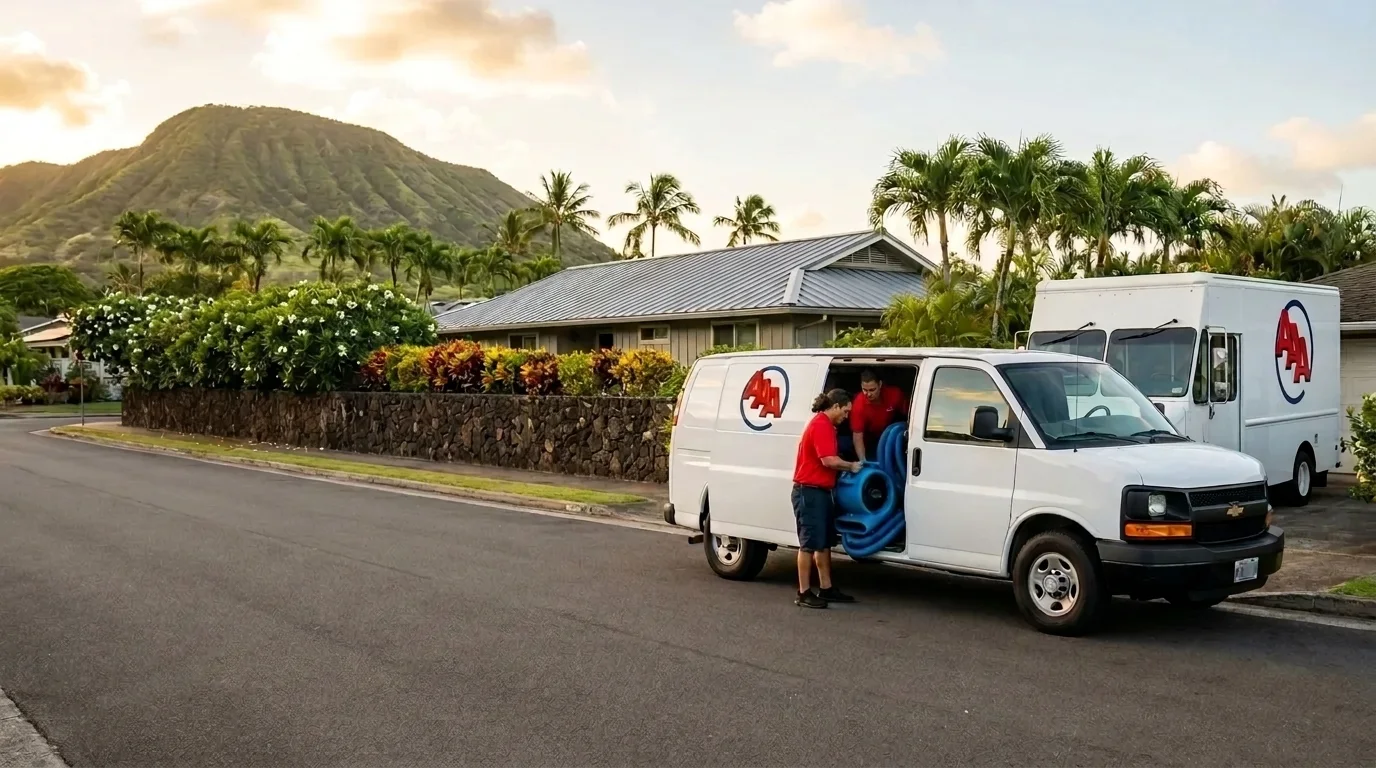
AAA Water Damage Restoration & Carpet Care handles both sides of this — the drying and extraction work that stops the conditions mold needs, and the remediation work when growth has already started. Reach them at (808) 349-3407.
The Longer Recovery: What Comes After Drying
Even after professional drying equipment has brought moisture readings down to acceptable levels, the recovery process isn’t over.
Affected materials that can’t be adequately dried — saturated drywall, swollen baseboards, compromised insulation — typically need to be removed and replaced. This isn’t optional; leaving them in place is leaving a food source for future mold growth. Post-drying air quality testing can confirm that spore counts have returned to normal levels, which matters both for your family’s health and for documentation if you’re filing an insurance claim.
Carpet and flooring decisions depend on how long the material was wet and what type of water was involved. Carpet that was wet for fewer than 24 hours with clean water and dried thoroughly may be salvageable. Carpet that sat in contaminated water, or that was wet for more than 48 hours, almost always needs to go.
In Honolulu’s climate, ongoing humidity management after a water event matters too. A whole-home dehumidifier or upgraded ventilation in prone areas (bathrooms, under-sink cabinets, attic spaces) can significantly reduce the likelihood of mold problems returning.
If you’re reading this because you’re looking at water damage right now — stop reading and start the steps above. The 24-to-48-hour window is real, and every hour of drying time you can capture reduces the scope of what comes next. If the damage is beyond what you can address with what’s in your home, or if you’re already seeing or smelling mold, contact a professional today. AAA Water Damage Restoration & Carpet Care serves Honolulu and surrounding areas — call (808) 349-3407 to talk through what you’re dealing with.