
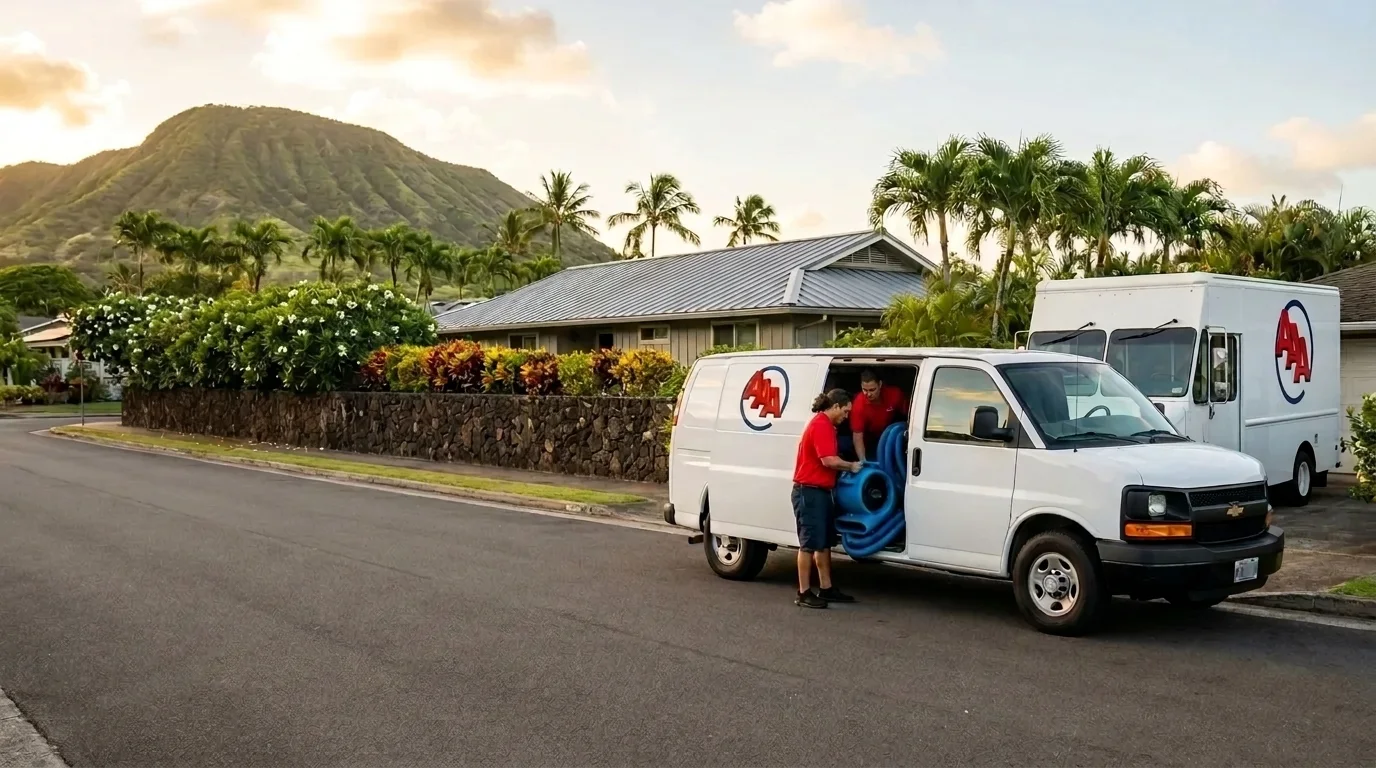
Most water damage restoration jobs take 3 to 5 days from the moment a crew arrives to the point where the structure is dry enough for repairs. That’s the honest middle-of-the-road answer. A small bathroom leak caught the same day it started might be dry in 48 hours. A slow roof leak that soaked into wall cavities for weeks before anyone noticed can stretch the drying phase alone to 7–10 days — and that’s before a single piece of drywall gets replaced. The timeline depends on four things: how much water got in, where it went, how long it sat, and how quickly drying equipment got running.
Why There’s No Single Answer
Water doesn’t stay where you can see it. A washing machine supply line that lets go overnight will push water under the baseboard, into the subfloor, and sometimes into the wall framing before the sun comes up. By the time you’re standing in a wet laundry room, the moisture has already traveled.
Restoration timelines break down into distinct phases, and each one has its own clock:
- Emergency extraction — Removing standing water with truck-mounted or portable extractors. This usually happens within hours of a crew arriving and can take 30 minutes to several hours depending on volume.
- Structural drying — Industrial air movers and dehumidifiers run continuously, pulling moisture out of framing, subfloor, drywall, and concrete. This is the longest phase: typically 3–5 days, sometimes longer.
- Monitoring — Technicians return daily (or every other day) to take moisture readings with pin meters and thermal cameras. Drying doesn’t stop until readings hit target levels — usually below 16% moisture content in wood, though the exact target depends on the material and the IICRC S500 drying standard.
- Repairs and rebuild — Only after the structure is confirmed dry does reconstruction begin. Replacing flooring, drywall, or cabinetry is a separate scope of work and can add days to weeks depending on material availability and the extent of damage.
Think of it as two separate jobs: drying the structure, then fixing it. People often conflate the two and feel like the process is dragging on. It’s not stalling — wet materials genuinely cannot be rebuilt over.
What Happens in the First 24–48 Hours
The first two days set the ceiling for everything that follows. If drying equipment gets running fast, the total timeline compresses. If it doesn’t, secondary damage — mold, warped hardwood, delaminated subfloor — starts stacking up costs and days.
Here’s what a well-run response looks like in sequence:
- Stop the source. If it’s a plumbing failure, shut off the main water supply. The shutoff is typically near the meter at the street or under a sink. Don’t skip this step waiting for a plumber.
- Document everything before touching it. Photograph standing water, wet walls, damaged belongings, and any visible structural damage. This record matters for your insurance claim.
- Remove standing water. Wet-vac what you can reach, but understand that a shop vac doesn’t pull moisture out of flooring — it only removes surface water.
- Start airflow. Open windows if outdoor humidity is lower than indoor humidity (in Honolulu’s climate, this is often not the case — humid outside air can actually slow drying). Ceiling fans help circulate air but don’t dehumidify.
- Call for professional drying equipment. Consumer fans and box dehumidifiers are not engineered for structural drying. A professional setup uses high-velocity air movers positioned at specific angles to the wet surface, paired with low-grain refrigerant (LGR) dehumidifiers that pull far more moisture per hour than anything you’ll rent at a hardware store.
In Hawaii’s climate specifically, ambient humidity rarely drops below 60–70%. That baseline makes structural drying harder than it would be in a drier region — equipment has to work against the outdoor air, not with it. This is one reason professional-grade dehumidification matters more here than in, say, Phoenix.
The Mold Clock Is Already Running
Mold can begin colonizing wet organic material — drywall paper, wood framing, carpet backing — within 24 to 72 hours under the right conditions. Warm temperatures and high humidity accelerate that window. Honolulu’s year-round warmth means you’re almost always in favorable conditions for mold growth.
This isn’t meant to alarm you into a panic decision. It’s a practical reason why the drying timeline matters. A structure that gets fully dry within 3 days is unlikely to develop active mold growth. A structure that stays at elevated moisture for 10 days without proper equipment is a different story.
If you’re dealing with a leak that’s been hidden — behind drywall, under flooring, inside a cabinet — and you’re noticing a musty smell before you’ve found visible water, mold remediation may need to run alongside or before the drying work. That’s a separate scope, and it changes both the timeline and the approach.
What Slows a Restoration Down
Not every delay is avoidable, but knowing the common ones helps you ask the right questions:
- Category 2 or 3 water — Water from a toilet overflow, sewage backup, or floodwater is contaminated. The remediation protocol is more involved than a clean-water pipe burst: affected materials often need to be removed rather than dried in place, which adds time.
- Wet insulation — Fiberglass batt insulation holds water and doesn’t dry well in place. It usually has to come out, which means opening walls.
- Concrete slabs — Moisture trapped under a slab or inside a concrete floor takes significantly longer to drive out than wood framing. Some slab drying jobs run 10–14 days.
- Delayed start — Every day without equipment running is a day added to the drying phase. A leak discovered Monday that doesn’t get equipment running until Thursday is already behind.
- Scope disputes with insurance — If there’s a disagreement about what’s covered, equipment sometimes gets pulled before drying is complete. This is one of the more frustrating delays and worth clarifying early with your adjuster.
The Rebuild Phase: After Drying Is Confirmed
Once moisture readings confirm the structure is dry, the reconstruction scope begins. This is where timelines vary the most, because they depend on:
- What materials need replacing (LVP flooring versus custom tile versus hardwood)
- Contractor and material availability
- Permit requirements for structural repairs
- Whether the job is insurance-funded (which adds an approval step)
A straightforward drywall-and-paint repair after a small leak might take a few days of trade work. A kitchen with water damage to cabinets, flooring, and the subfloor beneath could be a multi-week rebuild.
The drying phase and the rebuild phase are sometimes handled by the same company and sometimes by different contractors. Either way, don’t let anyone start rebuilding until you have written confirmation that moisture readings are at target levels. Enclosing wet framing behind new drywall is one of the most common causes of mold problems that show up months later.
If you’re in the middle of a water damage situation in Honolulu and trying to figure out where you stand, AAA Water Damage Restoration & Carpet Care can walk you through what the timeline looks like for your specific situation. Reach out at (808) 349-3407 — getting an accurate picture of the scope early makes every phase that follows go more smoothly.