
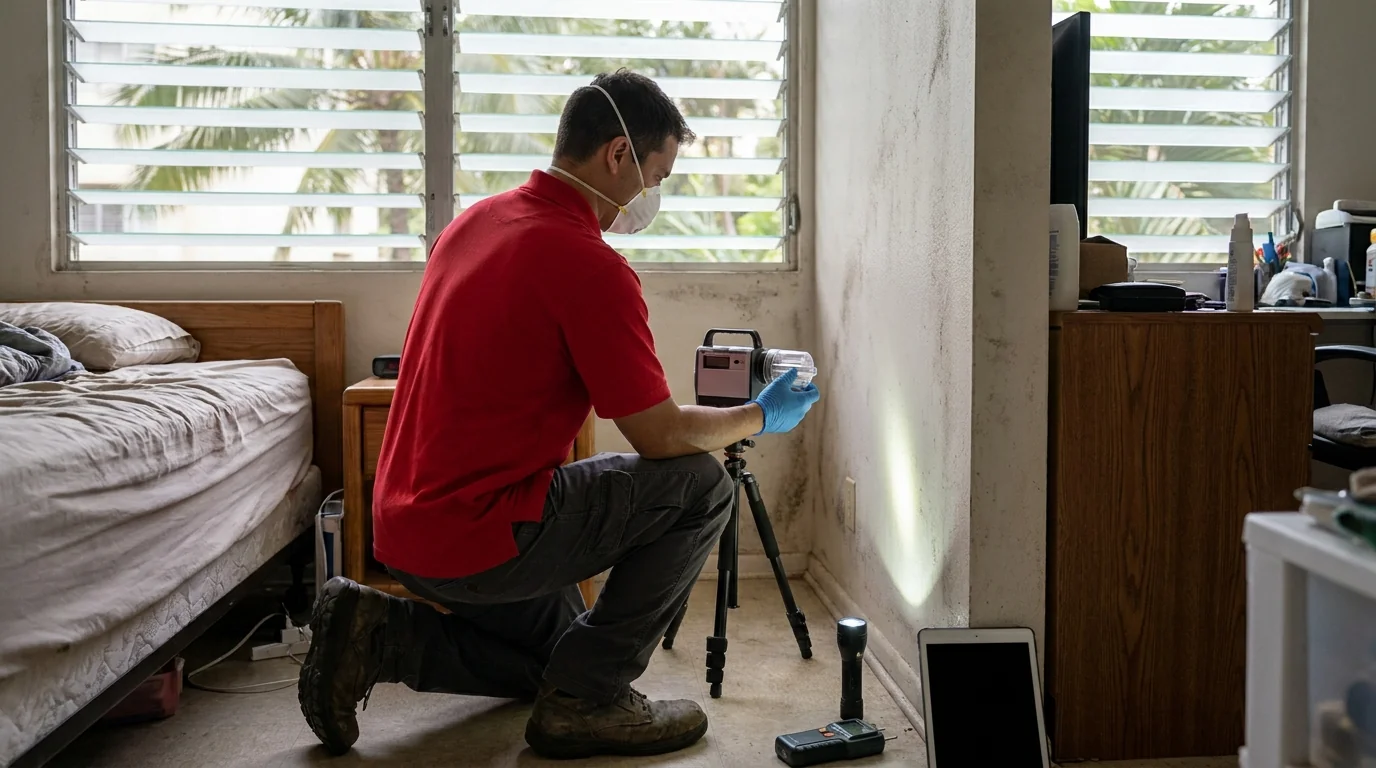
Mold Inspection and Testing in Pearl City
24/7 mold inspection and testing in Pearl City, HI. Call (808) 349-3407.
Our technicians are dispatched from our Honolulu, HI headquarters and are typically on-site in Pearl City within 60 minutes of your call.
The hillside neighborhoods of Pearl City sit in a climate that rarely dries out completely. Trade winds push moisture up the Ko’olau slopes, afternoon rain drains through terraced yards in Pacific Palisades and Momilani, and the low-lying lots near Pearl Harbor hold that water longer than most homeowners expect. When a slow leak behind a 1960s-era wall cavity finally makes itself known — through a musty smell in the hallway or a dark stain creeping across drywall — mold has often been colonizing quietly for weeks. A professional mold inspection and testing visit gives you documented answers about what’s actually growing, where it’s spreading, and how serious the exposure risk is before you commit to any remediation work.
Why Pearl City Homes Are Particularly Vulnerable to Hidden Mold
Most of the residential stock in the 96782 ZIP code was built between 1960 and 1980, when tract construction moved fast and vapor barriers were an afterthought. The copper and galvanized supply lines installed in those homes are now at or past their service life, and pinhole failures inside wall cavities are common — especially in homes on the steeper terraces of Pacific Palisades, where water pressure fluctuates as the hillside grade changes. A slow drip inside a wall doesn’t announce itself the way a burst pipe does. By the time a homeowner notices discoloration or odor, Cladosporium or Aspergillus colonies may already cover several square feet of framing behind the finish surface.
The hillside terracing itself adds another layer of risk. Storm runoff in Momilani and Pacific Palisades moves through yards and against foundation walls, and lower-level living areas — converted garages, ohana units, in-law suites — absorb that ground moisture through slab edges and block walls. Multigenerational households are common in Pearl City, which means a mold problem in a lower-level ohana unit can affect a large number of people living under one roof. Knowing the scope before remediation starts isn’t just practical — it’s essential for protecting everyone in the home.
Our Mold Inspection and Testing Process in Pearl City
A mold assessment here isn’t a generic walkthrough. We calibrate the inspection to the specific construction patterns and moisture pathways common in Pearl City’s housing stock.
Visual inspection and moisture mapping come first. Using calibrated moisture meters and thermal imaging, we trace moisture gradients through walls, floors, and ceilings — paying close attention to lower-level spaces, plumbing chases, and any area where hillside runoff could be infiltrating. Older galvanized lines often corrode at fittings inside wall cavities, so we focus on those transition points.
Air sampling captures what’s suspended in the indoor environment — spore types, concentrations, and how they compare to an outdoor baseline sample taken at the same time. This comparison is critical: Hawaii’s outdoor air naturally carries higher ambient mold spore counts than most mainland climates, so a Pearl City indoor sample has to be read against a local outdoor reference, not a national average.
Surface and bulk sampling (tape lifts, swabs, or material samples) identify specific mold species on suspect surfaces. This matters for remediation planning: some species respond to standard HEPA and antimicrobial protocols; others require more aggressive containment.
All samples are sent to an accredited third-party laboratory. You receive a written report with lab results, moisture readings, and a clear summary of findings — documentation that’s useful for your own records, for your insurer, and for any contractor you hire to do remediation work.
Reaching Pearl City from Honolulu
Our team dispatches from Honolulu and reaches Pearl City via H-1 West to the Moanalua Road or Waimano Home Road exits, depending on which neighborhood we’re heading to. We answer calls around the clock, and scheduling is available seven days a week. For properties near Leeward Community College or along Lehua Avenue in the Manana area, we typically coordinate parking and access details in advance — street parking can be tight in the denser residential pockets, and we bring equipment that needs to be staged close to the entry point.
Local Note: What Pearl City’s Ohana Units Add to a Mold Assessment
One thing that comes up repeatedly in Pearl City inspections is the ohana unit dynamic. A lower-level unit that shares a slab or a block wall with the main structure can have entirely different moisture conditions than the home above it — and the two spaces are often inspected as one when they should be treated as two distinct environments. We conduct separate air samples for each occupied space, including detached or semi-detached ohana units, because a clean result upstairs can coexist with elevated spore counts in a below-grade unit that drains poorly after heavy rain. If you’re a landlord with a tenant in a lower unit, that separate documentation also gives you a clear record of conditions at the time of inspection.
If visible mold or a strong musty odor is present in your Pearl City home, photograph the affected areas for your own records before the inspection — that documentation can support your insurance claim conversation with your carrier. Call us at (808) 349-3407 to schedule a mold inspection and testing visit. We’ll give you a factual picture of what’s in your air and on your surfaces so you can make informed decisions about next steps.
Mold Inspection and Testing in Pearl City: Service Coverage
Frequently Asked Questions
How fast can you arrive for mold inspection and testing in Pearl City?
Are homes in Pacific Palisades and Momilani more prone to hidden mold than other Pearl City neighborhoods?
How does Hawaii's outdoor air affect mold test results for a Pearl City home?
What does a mold inspection typically find in Pearl City's 1960s and 1970s tract homes?
How long does a mold inspection and testing visit take for a typical Pearl City home with an ohana unit?
If the mold inspection report shows elevated spore counts in my Pearl City home, what happens next?
Will my homeowners insurance cover mold inspection and testing in Pearl City?
Mold Inspection and Testing response in Pearl City
Most Pearl City calls see a technician on-site within 60 minutes from our Honolulu headquarters.